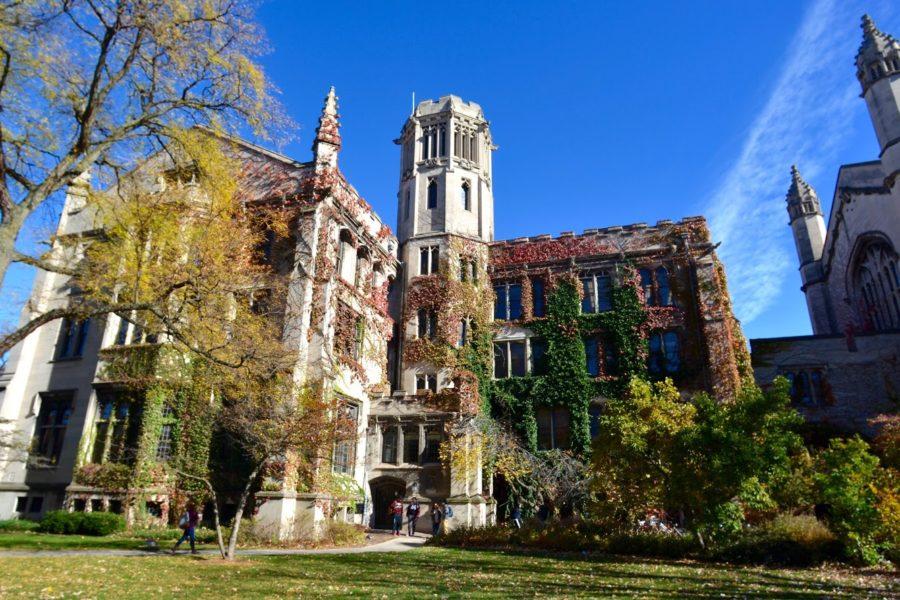
Nearly two months after its scheduled release, there is still no word on an opening date for Proof, the film adaptation of alumnus David Auburn’s Pulitzer Prize-winning play, about a University of Chicago professor and the relationship between his daughter and one of his students.
Once predicted to be a frontrunner in this year’s Academy Awards, the film’s delay has caused frustration among moviegoers and Hollywood insiders alike, generating concerns over unforeseen problems. Last December, audiences had hoped to see the likes of Gwyneth Paltrow, Anthony Hopkins, and Jake Gyllenhaal grace the Chicago quads on the silver screen. In autumn 2003 the production, directed by Academy Award-nominee John Madden (Shakespeare in Love), moved to the University of Chicago campus to film a number of scenes, drawing a great deal of attention from the community.
During the filming, hundreds of star-struck students volunteered as interns, production assistants, and extras, anxious to see their contributions on the big screen in December. In addition, the University administrators worked closely with the Proof team to accommodate their needs while on an active college campus.
“Shifting the release dates of films by months or even years is certainly not unusual in the film business,” said Steve McFarland, the former University communications project manager for the film. McFarland, who is now associate director of development communications at Harvard University, added, “Whenever Proof is finally released, I’m certain it will be a great piece of work, and be something the University of Chicago will be proud to have participated in.”
Hart-Sharp Productions, the company that produced and financed Proof, estimated a release in the fall of 2005, but promised no guarantees. “Our side of the project is completed, so it’s totally up to Miramax now,” said a company representative, who refused to give his name. “The film is out of our hands.”
After backing the film financially, Hart-Sharp sold the final project to Miramax for distribution in theaters and film festivals worldwide. With no update from the distribution company since December, the company representative reiterated, “It’s all being delayed because of complications with Miramax.”
The film’s setback reflects a turning point for Miramax Films and its status in the movie industry. The company recently laid-off 65 of 485 employees, or 13 percent of its workforce, and has not commented on any future business plans, according to an Indiewire.com report. During last month’s Sundance Film Festival, conversation buzzed about the possible breakup of the company later this year.
Miramax Films was formed in 1979 by brothers Harvey and Bob Weinstein, who named the company after their parents, Miriam and Max. The company originally produced lower-budget “art house” films, but has since grown into an industry powerhouse, posting $695 million in movie revenues last year and estimated to be worth $2 billion, according to Business Week Online.
In 1993, Walt Disney Studio Entertainment bought Miramax for $75 million, marking the start of a rocky relationship between the Weinstein brothers and Disney CEO Michael Eisner. In September 2005, the Weinstein brothers’ contract with Disney will expire, signaling an uncertain future for both companies.
In a recent Securities and Exchange Commission filing, Disney representatives issued a statement that the company was unable to determine whether current projects would be abandoned or suffer financial setbacks. There is no indication whether or not Proof is one of the projects mentioned in the statement.
In a telephone interview, Miramax representatives had no updates on Proof. “In movies, it happens all the time,” said one Miramax representative, adding that no estimate for a release date can be considered until after September. “It’s hard to tell at this point,” said another representative from Harvey Weinstein’s office.
Hart-Sharp Productions acknowledged the close link between Proof and the University of Chicago community, and addressed growing concerns over the film’s questionable future. “It will definitely come out,” said the Hart-Sharp representative, who noted that Miramax is only one of the many distributors in the industry. “It’s a final film, for sure, and we’re going to get it out somehow.”
Amidst the uncertainty, Hart-Sharp remains optimistic about their film, and their representative encouraged the University community to be patient. “It’ll be out later this year and hopefully it’ll win some awards,” he said.