Skip to content

Advertisement

Viewpoints » Letter to the Editor

Letter: Activists disrespect visiting lecturer

In demonstration against American-Israeli speaker, Students for Justice in Palestine rejected UChicago’s tradition of open dialogue.

On the evening of February 25, the World Behind the Headlines program at I-House held an event entitled “Legitimate Target: A Criteria-Based Approach to Targeted Killing.” Amos Guiora, an American-Israeli law professor at the University of Utah and counterterrorism specialist, was invited to talk about targeted killings, the criteria for determining what is a legitimate target, and the need for restrictions on current drone warfare.

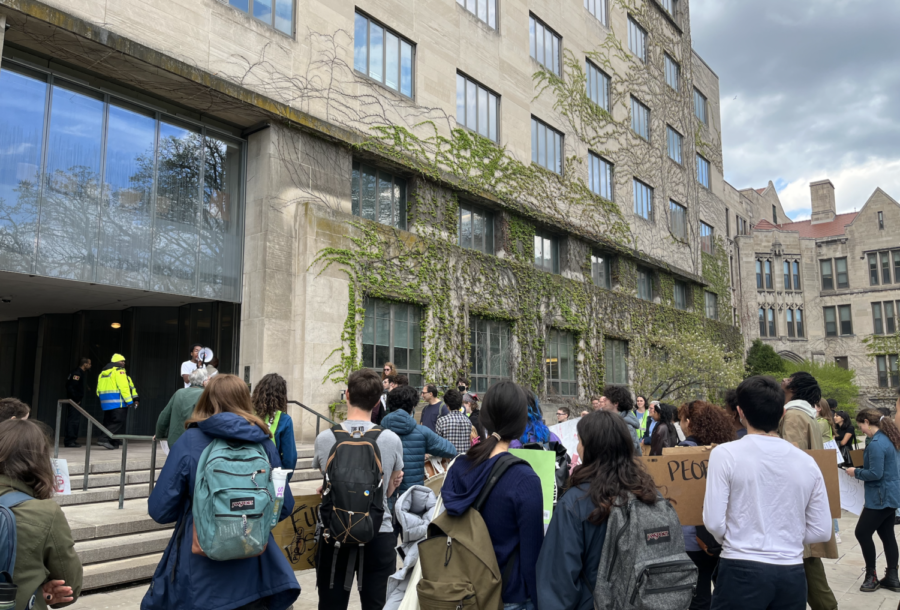
Before the event began, Students for Justice in Palestine (SJP) representatives were protesting in front of I-House, blocking the path for people to enter the building. This was not only an inconvenience for people who wanted to attend the event, but for the residents of I-House as well.

The talk began relatively peacefully, without any major disturbances, and many SJP members sat in the front row of the hall. As soon as the law professor mentioned that he served for 19 years in the Israel Defense Forces, the students turned their chairs around and put their backs toward the distinguished speaker. They accused him of being a war criminal and yelled for the end of “the occupation.” The professor did not engage and was booed as a coward. Eventually, the protesters caused enough of a disturbance that I-House staff asked them to leave.

It is certainly reasonable for people to disagree with a speaker’s opinion. However, it is rude to interrupt an event with political statements that are unrelated to the topic at large. What I find most fascinating is that SJP did not criticize Professor Guiora’s views on targeted killings in their chair demonstration. Rather, they criticized the fact that he was an Israeli and had served in the IDF. They were not protesting his opinion, but rather his right to speak. The University of Chicago is a rich intellectual community that shares the values of free thought, expression, and civil discourse. SJP’s actions on Monday broke from this tradition. I hope they will recognize their inappropriate actions and change their behavior accordingly.

Blake Fleisher, Class of 2015


11 comments on “Letter: Activists disrespect visiting lecturer

  1. reply
    Matt Andersson, MBA '96

    As an aerospace expert, I attended this presentation. The young letter writer is not producing the most accurate picture of what actually happened and frankly sounds rather scripted.

    This is a subject of enormous contention as it is typically centered on warfare methods in the Middle East. Given the speaker’s pedigree that night (Israeli dual citizen and former Israeli Defense Forces member) it naturally led to the provocation of alternative positions over the legitimacy of Middle East war prosecution, of the which the drone is an especially contentious part (along with its regular collateral damage, a euphemism for murder and war crime, which is what the protestors were really signaling. Moreover, Israel is the single largest producer and exporter of drones, selling to over two dozen countries).

    Those alternative positions, I thought, were maturely and peacefully demonstrated at the event. Yet the University police, guns at their sides, were standing in the entranceway and hall, and obviously pressured the removal of protestors (none of whom blocked or interfered with entrance to event); in one instance a police member placed his hand on his pistol as the protestors were followed out of the building, while another university assignee tried to block or filter entrance to the hall. This reminded me a bit of the Ehud Olmert event in 2009 which was a somewhat similar display of university institutional control and a rather deep cultural bias.

    While provocative speakers need to be heard, natural audience reaction is not overly difficult or burdensome to manage, and it interactively challenges the speaker’s honesty and intentions and to come “off script.” That dynamic was interrupted or preempted by university institutional correctness and an obvious cultural affinity for the speaker.

    As for the protestors outside on the street, several of them were communicating a very dangerous and little known fact: drones are being re-deployed to the US for “homeland security” use, and with an ambiguous legal construct tucked under government’s arm (what the speaker was championing somewhat cleverly), its use is open to unaccountable interpretation and consequences, including their use for surveillance on university campuses, which is in aquisition planning across the country.

    Regards.

    • reply
      Reply to Matt Anderson

      I wasn’t at this event. However I was at the Ehud Olmert event in 2009. You think the problem there was “university institutional control and a rather deep cultural bias?” Well, that says a lot about your judgment.

      The protesters, for lack of a better term, at the Ehud Olmert event planned to prevent him from being heard. First, they spread themselves throughout the room. Then one would stand up during the lecture and scream at Olmert (and that included calling him names such as “bastard,” “pig,” and “faggot”) until being dragged out of the room. As soon as one was dragged from the room, another would do the same thing. They effectively prevented him from speaking for a good twenty minutes. The purpose of all this was not to challenge the speaker’s honesty and intentions and make him go off script, it was to prevent an alternative viewpoint from being heard. It’s the exact same tactic that was used against Michael Oren at UC Irvine.

      If you want to challenge a speaker, stay and ask your questions. It was made very clear that there would be time for questions after the lecture. What happened to Ehud Olmert, what happened to Michael Oren, and what happened, so I now assume, to Amos Guiora, was not a natural audience reaction, but rather a concerted effort to prevent free speech.

  2. reply

    Wonder what would happen to these activists in the Palestinian territories?

    ^^^^^^^^^^^^

    Feb 13, 2013
    In another story the Western media apparently refuses to cover, any Palestinian who dares to criticize Hamas or the Palestinian Authority risks being arrested or summoned for interrogation.
    Palestinian journalists are now hoping to bring this to the attention of President Barack Obama when he meets with President Mahmoud Abbas next month.
    The journalists say they want United States and the rest of the world to know that the crackdown on freedom of expression in both the West Bank and Gaza Strip is designed to hide the fact that Palestinians are governed by two repressive regimes that have no respect for human rights and democracy.

    • reply
      Matt Andersson, MBA '96

      The Q&A at Olmert was through moderated written card submission; that isn’t free speech or discourse; it’s edited, sanitized and filtered commentary.

      As for protesting, the fine art of disobediance is perhaps the most important lesson one can learn on a university campus. As Frederick Douglass once stated, “Men want crops without plowing up the ground; they want rain without thunder and lightening.” Olmert knew what what coming; an mere extra 30-60 minutes of audience engagement was his for the taking, as it is for any “speaker.” He chose institutional control, as most contentious speakers often do who defend (rather than advance) a position.

      Moreover, questions are one thing; registering natural and rightful interests is another. The US constitutional convention was a food fight and real democracy doesn’t emerge (or survive) in civility; it’s messy–and beautiful. The Middle East (and much of Asia) is largely a clandestine security state culture, on both sides, hence much of the public’s frustration and contempt for its “leadership” along with their cultivation and receipt of foreign favoritisms and resulting social imbalances, or worse.

      As for Amos Guiora, he was there as a special interest advocate with a somewhat if not rather disengenuous script–and he hardly faced much of an overbearing disruption or challenge. What he did face was healthy and helpful–and there should have been much more, especially about US re-importation of Middle East security programs and the political and financial incentives. Like Olmert, engagement was his for the taking; but he wasn’t havin’ any.

      Otherwise, free speech isn’t freedom–that is asserted, not received or allowed; and in one’s rush to defend institutional correctness, comformity and comportment, the finer arts of deeper listening, thinking and factual discovery (and clarification) through emotional activation, can be compromised or lost.

      Cheers.

  3. reply

    Prejudice: From the cradle to the grave.

    ^^^^^^^^^^^^^^

    Official PA television—the PA’s PBS—airs programs that feature children as young as six reciting anti-Semitic and violent poems. Just months ago, for example, a little girl recited a poem that claimed, (and I quote) “[Christians and Jews] are inferior, cowardly, and despised.” Three days earlier, on a different program, another young girl insisted that (and I quote), “Our wars are for the Al Aqsa Mosque, and our enemy, Zion, is a Satan with a tail.”
    This is apparently what passes for “educational television” under the Palestinian Authority.
    From cradles to kindergarten classrooms; from the grounds of summer camps to the stands of football stadiums, messages of extremism are everywhere in Palestinian society.
    In the international community, there is no shortage of individuals to lecture Israel about what it must do for peace. Yet these same “human rights advocates” stutter, mumble and lose their voices when it comes to criticizing Palestinian incitement.
    Ignoring words and thoughts of hate does no favors to the Palestinian people. It does no favors to families who seek to build better lives for themselves and their children. And, perhaps most importantly, it does no favors to Palestinian leaders who advance the language of peace instead of the dogmas of hate.
    Laying the groundwork for a stable peace in our region will not happen overnight. But those who would like to foster better relations between Israelis and Palestinians must start by speaking out against incitement in Palestinian society. The next generation—both Israeli and Palestinian—deserve no less.

  4. reply

    Amos Guiora is a professional and respects the right of anyone to speak their mind and protest.

    I work in the Communications Office at the University of Utah. I am sure Professor Guiora handled the incident with decorum and respect.

    Had he been allowed to deliver all of his remarks, the audience would know that he asks his students the tougb questions about when its right to shoot in self defense, and when it’s a violation of international law. Professor Guiora does this tbrough anti-terrorism simulations where students portray the roles of decision makers.

    The fact that he was with the Isreali Defence Forces is but one part of his experience, making him a sought after speaker. He is a diplomat and a mentor to students on ethiclal actions during mlitary service, and they repect him.

    Every country has the right to self defense, but not abuse and Professor Guiora knows the difference. He would never defend himself here, but please allow me.

    • reply
      Matt Andersson, MBA '96

      Remi: The good professor doesn’t need to be defended, nor defend himself (although it is revealing that he turns to institutional protection). This isn’t about him, per se.

      As for disrespect or abuse, we can’t be having any of that now, can we.

      What this particular thread is about concerns only one primary issue: Do UC students model their campus speaker events and their own behavior after Firing Line or Mr. Rodgers?

      Amos was actually able to rattle off his entire pre-written speech, while stepping back from his podium at the slightest provocation, rather than engage the audience.

      But he was not there to engage the audience; he was there to sell a script, while Diane Feinstein was selling Brennan, Israeli and OEM industrial interests: universal extra-constitutional military authority.

      Amos reminds me of Walt Rostow who I studied with at the LBJ School at the University of Texas at Austin (AB, ’84; you may recall him as an alum then yourself, although that is probably unlikely). As his peers called him: “a wolf in sheep’s clothing” (deception is the Sine qua non of IL/Mossad operations).

      Like Vietnam, the GWOT (global war on terror) is an ideological (and financial) program that is normalized through public social threat routines, media messaging and reinforcement; institutionalized through Aesopian language and power structures, then finally perpetuated through threats of social ostracism from asserted behavioral and cognitive deviancy, thus the contention over White House internal terror and target memos.

      The imbedding of special interest radicalism in placid social and institutional clothing (i.e. university professors among others) is also enforced by threat of force; no longer are water hoses or rubber bullets necessary on campus; surveillance and the constant threat of overhead punishment reinforces obedience. Over 5,000 drone aircaft are on order for US domestic deployment.

      As to his views on targeted killing, Guiora said: “targeted killing absolutely is the implementation, the manifestation of aggressive, preemptive self-defense based on Article 51 of the United Nations Charter.”

      Unfortunately, Amos does not seem obligated to reference UN law on war crime, which he conveniently ignores (were there any UC law students there at the presentation?), let alone the US constitution.

      For some casual reading on Amos’s programs, try the following for lite fare: “Terrorism Primer”(2008). Perhaps after dinner and cocktails, his “Interrogating the Detainees: Extending a Hand or a Boot” might be tasty. For a better understanding of 911, try his “Using and Abusing Financial Markets: Money Laundering as the Achilles Heel of Terrorism.” On 9.10.01, it was announced that $2Trillion was missing from the Pentagon accounts. The Pentagon CFO at the time, his colleague and Israeli dual-citizen and Rabbi, is still at large.

      Cheers and “hook ‘em horns” indeed.

      “I assume the Americans can learn something from our experience,” adds Ephraim Kam, a former IDF colonel now with the Jaffee Center for Strategic Studies in Tel Aviv. “How do you deal with a population that doesn’t want you?

  5. reply
    A college alum and current professor

    As a former leader of students for Israel at the U of C Hillel it saddens me to see that the same things happen year after year and time after time, without dialogue there is only disruption not progress

    • reply
      Matt Andersson, MBA '96

      College Alum:

      Why don’t you start by identifying yourself?

      And what same things? Be specific.

      As for “only disruption” what facts do you cite; and if any, why are you discriminating against disruption? What is progress?

      Disruption is the first step toward progress.

      Otherwise, accomodating a lecture on nano-tech invasive phenol-enzymes? Fine. Sit in peace, listen and then respond.

      But accomodating a speech by an accused war criminal that has overseen the killing of thousands of innocents (on both sides)?

      Perhaps a different dynamic.

      As for the students at Hillel, they’ll get over it.

      Cheers.

  6. reply

    Matt,

    Get off the Marron. You are an embarrassment. Please do not comment any more, as it can only hurt the Palestinian people.

    Cheers.

    • reply
      Matt Andersson, MBA '96

      Some might believe that comment would not normally survive the Maroon’s (I think that’s what you meant) Terms of Use agreement, and we can’t be having any of that now, can we. Of course, these are not normal times and the drone attack and related legal agenda are not normal issues in normal clothing. Regards, and thank you.

      “One might hope that someone would have an ideal in favour of freedom of speech, and think it desirable that all possible ways of regarding intellectual issues should be aired, but in fact so abstract a consideration is not a motive, even apparently in the minds of those who express some disagreement with the overwhelming ideological trend.” Celia Green

Leave a Reply

Your email address will not be published. Required fields are marked *

By submitting a comment, you agree to the terms of service of The Chicago Maroon.