A small crowd gathered on Thursday evening to hear Mark Strand, the Andrew MacLeish Professor on the Committee on Social Thought, read poetry as part of the Divinity School’s 2004 John Nuveen Lecture.
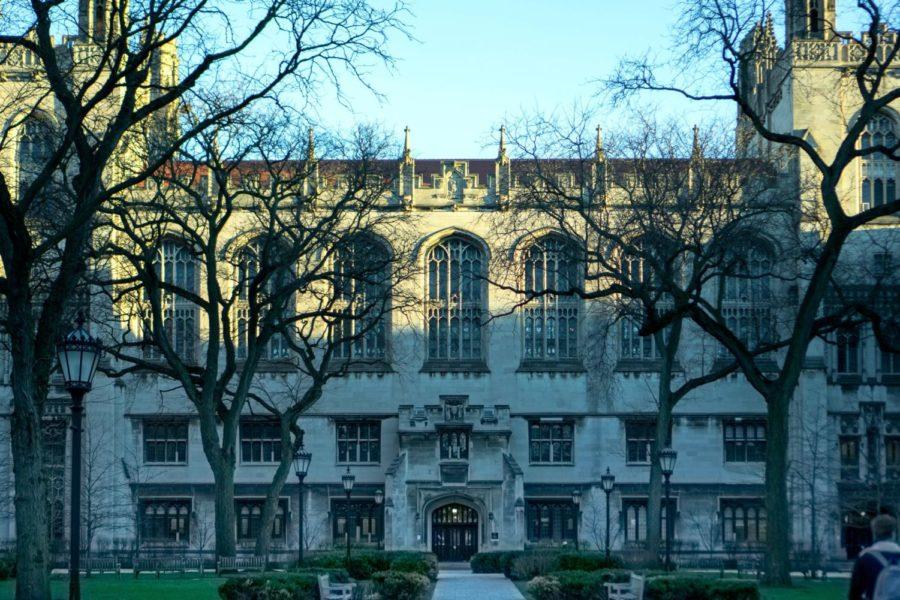
Rick Rosengarten, dean of the Divinity School, introduced Strand in Swift Hall and spoke of John Nuveen’s life as a Chicago businessman and philanthropist. Rosengarten said that it was Nuveen’s wish to encourage the relationship between the Divinity School and the campus at large, which the tradition of the Nuveen lecture has respected by inviting a member of the University community whose research bears on religious issues.
Strand recited poems from three of his books, as well as several new ones. He began his readings with a comment on his attire: “I dressed up today. I don’t usually wear a tie, but I felt I had to concede something to the formality of the lecture,” he said. “To be a poet you have to be scruffy.”
Strand said that this was the first occasion on which he had spoken in the Divinity School. “The kind of belief I’m interested in is the kind of belief that lasts about the length of a poem.” Strand said. “A poem asks you to believe while you are reading it. I believe in power of poetry to enchant, elevate and entrance, to enlarge one’s sensibility, and somehow to increase one’s responsiveness to the world. I believe in the same things you believe, I hope.”
Strand’s selection of poems had a common theme of the passing of time and the transitory nature of life. “No one sees it happening, but the architecture of our time is becoming the architecture of the next time No one can stop the flow, but no one can start it either,” Strand said.
An element of fatalism appeared in another of Strand’s poems, “Perfection is out of the question for people like us.” In a refrain poem of seven parts, Strand wrote, “If you think good things are on the way, and you think the world will improve, don’t hold your breath. Just go to the graveyard, and ask around.”
Among the new poems Strand read was “Man and Camel,” published in the October 11 issue of the New Yorker. Strand admitted that the poem—about the “ideal image for all uncommon couples”—made him chuckle. He suggested that it might be the title of his next book.
Other poems Strand read included “2002,” with its theme of imminent death, “Mother and Son,” a son’s experiences upon the death of his mother, and “2032,” in which death is personified as a man in a limousine waiting for his driver. Some poems diverged from the common themes of mortality, such as “Cake,” in which a man becomes lost in a dense wood while intending to pick up a cake; and “Elevator,” a short poem in which the narrator encounters a man in the basement, to whom he says enigmatically, “I’m going down, I said, and I won’t be going up.”
In the question and answer session that followed the lecture, Strand was asked about his choice to portray death as masculine. Strand replied that his male personification of death originally came from his musings about Father Time, adding that he did not mind being perceived as a sexist. “If you make death a woman in our culture, you leave yourself open to . . . um. . . questions,” Strand said. Upon further reflection, Strand said, “I think I will write a poem in which death is a woman, or a transsexual.”
Another audience member inquired about how Strand viewed the transitory nature of the physical world. Strand described a commitment to paying attention. “I try to pay attention to those things that mean something to me,” he said.
Strand was also asked about the influence poetry has on politics. “Poetry hasn’t done much to influence political behavior, certainly not recently,” Strand said.
In a discussion of the merit of contemporary poetry, Strand noted that there are now 20 or 25 poets who are among the best of all time. Asked if he considered himself among those poets, Strand said, “I don’t know. That’s for others to say, really. Someone might say I’m 97th, someone else might say ‘he’s number two.’ But I’m up there, I’m 70 years old.”