


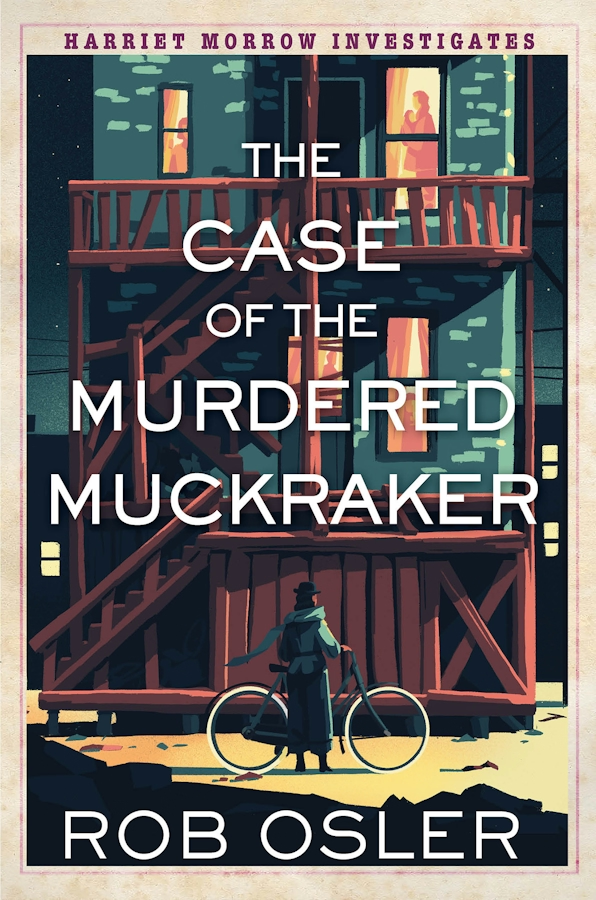
The Case of the Murdered Muckraker is the second novel in Rob Osler’s Harriet Morrow Investigates series, following the success of the four-week USA Today bestseller The Case of the Missing Maid. In this sequel, Harriet Morrow continues her journey as the first female operative at the Prescott Detective Agency in 19th-century Chicago. In addition to her investigative work, Harriet faces the challenges of being a lesbian in the late 1800s, raising her teenage brother on her own, and navigating the complexities of life during the Progressive Era in Chicago.
In The Case of the Murdered Muckraker, Harriet is determined to further prove herself as a capable female detective. However, this becomes difficult when her newest case involves the suspicious murder of a muckraker—a journalist who exposed corruption and social injustices in the Progressive Era—who possessed details of the city’s underlying corruption, with an innocent mother being imprisoned as a suspect. To solve this case, Harriet must camouflage her fiery and nonconforming personality by adopting several different disguises, from a tenement woman to a man named Harry. Through these disguises, she uncovers wrongful convictions and connects a series of violent deaths, all while facing constant danger.
In his interview with the Maroon, Osler detailed numerous factors that led to the choice of Chicago as the novel’s setting, such as the variety of neighborhoods for the protagonist to explore and social issues for her to navigate, including sexism, crime, and class inequality. He also highlighted the late-19th-century setting, noting that “2,000 miles of paved, flat roads were available to Harriet throughout her travels and investigations,” which she explored with her steadfast companion, an Overman Victoria bicycle.
Having lived in Chicago for several years as an advertising copywriter at Leo Burnett, a Chicago-founded marketing company, Osler described how his time in the city significantly affected how he wrote the Harriet Morrow Investigates series. While Osler and Harriet experienced Chicago in vastly different eras, Osler described both modern and older Chicago as “a very muscular city… it’s big, it’s bustling.” He explained that living in the location allowed him to obtain a “general vibe of the city.”
Specifically, living in Chicago enabled Osler to become familiar with the city’s architecture. Although Chicago has changed in many ways since the start of Harriet’s detective journey 127 years ago, Osler noted that several buildings from that era still exist today. While living in Chicago, he was “able to see those buildings, get a better feel for the architecture and the architecture center downtown on Wacker Drive… [and] take a couple tours.”
The Case of the Murdered Muckraker primarily focuses on the city’s corruption, a theme Osler developed through research. 1898, the year the book is set, falls in the heart of the Progressive Era, which saw of urbanization, industrialization, harsh working conditions, and a growing middle class. Osler explained that two characters from the book, Dan “Irish” Walsh and Michael “Saloon Mickey” Powers, are based on real aldermen—elected council members—in Chicago’s history: Michael “Hinky Dink” Kenna and John “Bathhouse” Coughlin, respectively, both of whom served Chicago’s First Ward, a district then dominated by brothels, saloons, and gambling dens. These details, based on true aspects of the period, become vital elements of the novel’s plot.
Of the many social issues presented throughout the series, Osler particularly emphasized Harriet’s constant defiance of gender norms. “Harriet—right on!” Osler said, encouraging both the protagonist and readers to confront social norms and patriarchal pressures. He noted that although some readers might disagree with the feminist ideals he presents through Harriet’s perspective, he did not seek to explicitly state his own political beliefs in the story, but instead naturally embed representation and diversity within it.
Osler also crafts Harriet as more than just a detective. Though detective characters are often presented as lonesome outsiders, much of the novel focuses on Harriet’s various forms of relationships, including with Aubrey, her brother; Pearl Bartlett, the employer of the maid from the series’ first book, who befriends Harriet; Matthew McCabe, a fellow queer detective; and Barbara Wozniak, Harriet’s love interest.
Another crucial element of the plot is the absence of Harriet’s parents, who passed away when Harriet was a young adult. Osler introduced this loss because he “wanted her to be more independent and have more pressure on her. And also not have [her parents] tell her what she could and couldn’t do.” As a result, she can “just remember them fondly and believe that they would be supportive.” He particularly stressed the connection with her younger brother across both novels. Their relationship contains “tension, but they love each other.… [Osler] wanted that dynamic to be tough love.”
Although Harriet’s queerness is important to her identity, Osler noted that it was not meant to be the focus of the story, going so far as to say that the mystery would not have been affected at all if he had made Harriet straight. He said he added this dimension to her character because “queer people exist. I want to read stories about them, and I want straight people to read stories about them, where they just are, and that they happen to gay, lesbian, trans, etc. But their world doesn’t revolve around that.”
To further explain this point, Osler recalled an interaction he had with an “older, white, straight woman who, [he] believed, was probably more on the conservative side” after a panel discussion at a conference. This woman had read two prior books of his from the Hayden and Friends Mystery series, which stars a gay man named Hayden. The woman approached Osler, praising his books and noting that it “didn’t bother her that Hayden had a queer lifestyle.” Osler pointed out that the term “gay lifestyle” is inherently problematic, reducing an important characteristic into something far less fundamental. But, in this situation, “[he] just decided [he] was going to let that slide.… [He] had brought her to a better place than she was because of these two books.” This further encapsulates Osler’s attitude toward his work, which he hopes will positively impact all readers.
Osler doesn’t claim to be “changing the world,” but noted that, “in [his] own little way, [he] achieved something with that one woman,” possibly influencing her to be more accepting and supportive. He clarified that, although he had no way of knowing whether she had had any prejudice against queer people prior to reading his book, he hadn’t wanted to spoil the moment by lecturing her. He just “let it ride.”
Osler went on to compare Harriet’s queerness to his own. When asked why the plot does not purely revolve around Harriet’s LGBTQ+ identity, he simply said, “Because… I play tennis. I do a lot of other stuff. I don’t just sit here thinking, ‘Wow, it’s so great to be a gay man.’” Osler said that he replaces the nectar in his hummingbird feeders, buys cat food, and simply lives his life. Similarly, Harriet, like any other person, has tasks and responsibilities: grocery shopping, doing her laundry, and raising her brother. She also has a difficult profession, especially for a woman in the 19th century. Osler emphasized that numerous other factors play a role in her life, not just her sexuality.
According to Osler, the Harriet Morrow Investigates series is set to have six books, with the third installment already in progress. Additionally, Osler’s third short story following Perry Winkle, a nonbinary amateur sleuth, will be released in the Ellery Queen Mystery Magazine later this year. Osler is also planning a new series, with the first book, The Butler, coming out in summer 2027. Osler described this as a contemporary series that follows Clive Humphrey, whose “zeal for order and discipline for both his clients and staff has lethal consequences.”
All in all, Osler’s primary wish for readers to gain from his novels is enjoyment; he hopes to create a fun, fast read. Second, he aims to further not just representation of queer people but also relatability, which he tries to do by making Harriet a multifaceted protagonist. He wants audiences to read a queer hero who is not defined solely by their queerness—one who is “as relevant and as zesty and as fun and bold [and] as courageous as Harriet is.” The point was best encapsulated by Osler himself, who remarked that he wanted to write something “unapologetic about the hero, Harriet, being a lesbian. It doesn’t matter that she likes women. It doesn’t matter, because Harriet is awesome. And that’s just not a problem.”
Osler masterfully achieves these goals, as The Case of the Murdered Muckraker is not only a queer story but also an exhilarating and engaging mystery that reflects social issues of the past and present.


