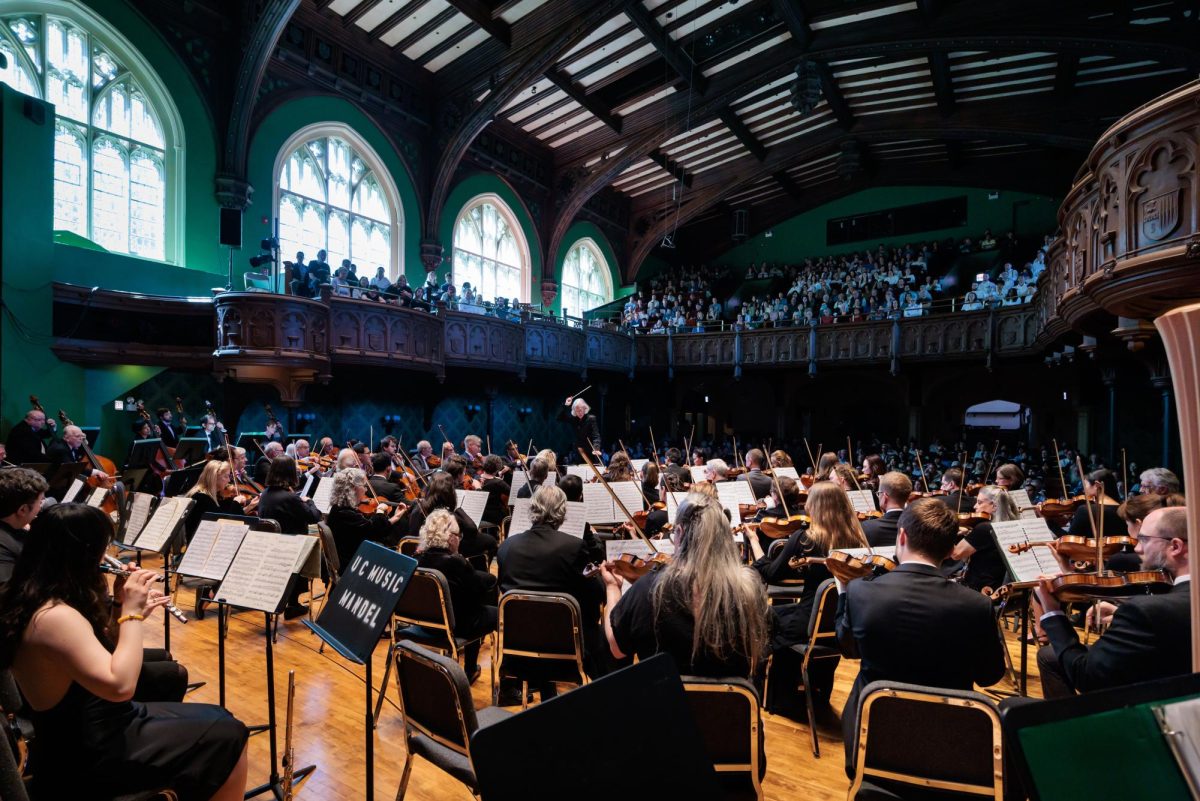
On May 9 and 10 at Mandel Hall, the University Symphony Orchestra (USO) joined forces with the University Chorus and Motet Choir for their final concert of the year.
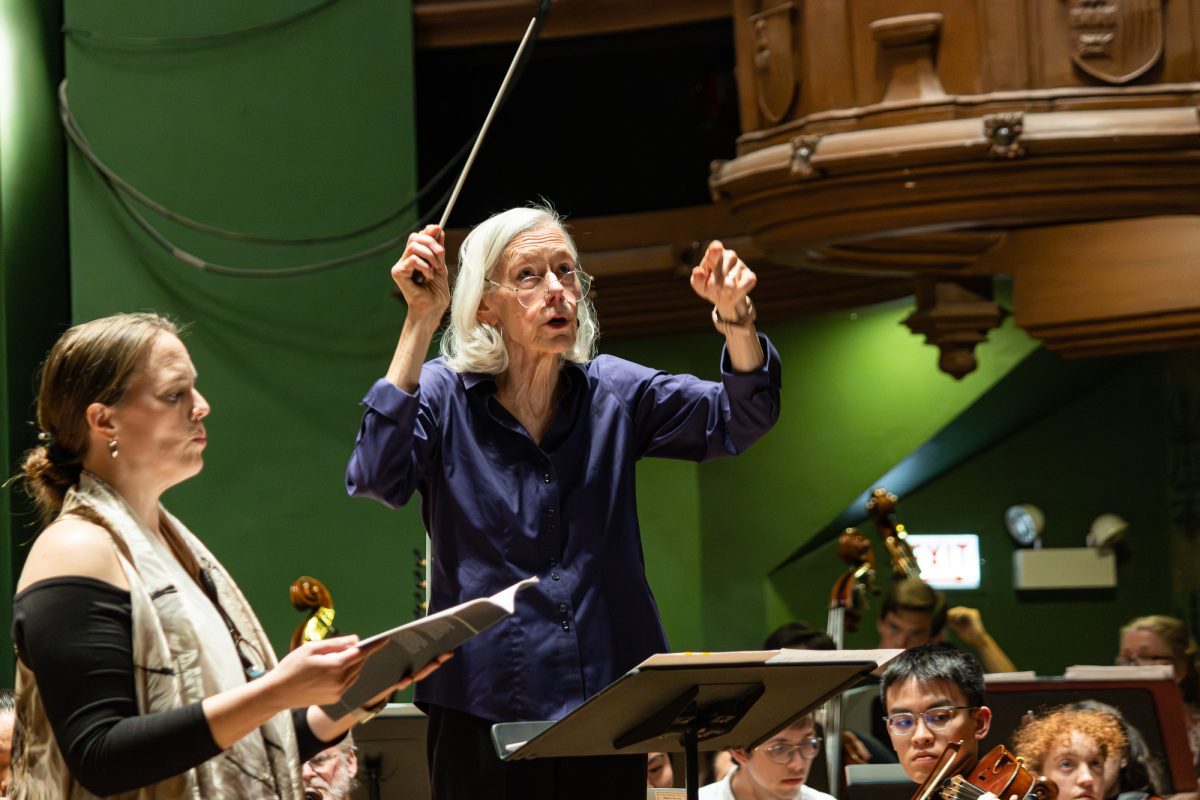
USO Music Director and Conductor Barbara Schubert entered the stage with a brilliant, shimmering black dress as she took command of the large ensemble. She was no stranger to this occasion. This concert marked the culmination of “Opus 50,” a monthslong celebration of her 50th year as Music Director of the USO. Over the course of five decades, Schubert has shaped generations of musicians at the university, pushing both students and alumni to take on works that would challenge even seasoned professionals. With a performed repertoire of over 2,500 works, she has led the orchestra with energy, artistry, and imagination.
The program opened with a performance of Johannes Brahms’s Academic Festival Overture by a USO alumni orchestra, featuring nearly 100 returning alumni. Brahms composed the Overture during the summer of 1880 as a tribute to the University of Breslau after they notified him that he would be awarded an honorary doctorate in music. Rather than delivering a speech for the event, Brahms took a more playful approach by weaving together a handful of popular German student songs into a lively, celebratory overture. Schubert followed in Brahms’s footsteps. “We’re at an academic place, it’s a festival that we’re celebrating,” Schubert said in an interview with the *Maroon*. “I feel like I should be presenting a performance as well, rather than talking about my years with the University Symphony.”
Schubert and the Alumni Orchestra brought an atmosphere to the Overture that felt both polished and exhilarating. Starting out quiet and soft, the tempo eventually picked up and the energy grew purposeful. In the final minute of the Overture, the piece came to life. This was not a group of alumni merely going through the motions, but musicians who had returned to Mandel Hall with a purpose.
The main event was Gustav Mahler’s Symphony No. 2 in C Minor, “The Resurrection.” Mahler worked on the piece for nearly a decade, completing it in 1894, and it remains one of the most ambitious works in the orchestral repertoire. Spanning five movements and scored for a large orchestra, chorus, and solo singers, the symphony runs for over an hour and grapples with themes of death, faith, and what lies beyond. The first movement begins with an unsettling tremolo, generating the first sense of unease in the piece. As more instruments join, the drama unfolds and the audience gets a taste of what is to come.
The second and third movements, a gentle respite and a sardonic scherzo, offer brief moments of relief before culminating in something best described as a shriek towards the end of the third movement. The USO’s performance offered no breaks for the audience as the sounds swung without warning between moments of quiet stillness to outbursts of orchestral eruptions, keeping listeners on the edge of their seats. Much of the credit goes to Schubert, whose commanding direction coaxed the trumpets, oboes, horns, and percussion to stand out at precisely the right moments. Each distinct eruption felt deliberate and controlled, creating the right impact at the right time.
It wasn’t until the fourth movement that the audience finally got a taste of the human voice for the first time. Camille Robles, the mezzo-soprano, began to sing in the fourth movement, “Urlicht,” a brief but deeply moving setting of a poem from *Des Knaben Wunderhorn*, a collection of German folk poetry compiled by Achim von Arnim and Clemens Brentano. The text is simple and childlike and Robles delivered it with a warmth and intimacy that cut through the hall. “Urlicht” was stillness before the storm, and Robles carried that weight beautifully, with a quiet, tender performance that left the audience in hushed anticipation for the drama to come.
The fifth and final movement is the symphony’s climax. Mahler opens with the orchestra, which is then followed by the voices of both soloists. Schubert and the USO created both the backdrop and the energy necessary to support the piercing voices of the soloists, shifting between moments of collapse and desperate urgency. Gradually, something began to change, the chaos thinned, and the first glimpses of a resolution began to appear.
In a single fluid motion, Schubert turned to face the audience, her baton never once stopping.
Without warning, voices began to pour down from above. What initially seemed like a group of well-dressed audience members was actually a part of the performance. When the chorus finally entered the piece, many in the audience were visibly startled as they craned their necks upwards. The University Chorus and Motet Choir had been quietly seated in the balcony above, an arrangement not typical of a chorus-orchestra performance.
It was a breathtaking effect, the sound seeming to descend and ricochet from somewhere beyond the hall itself, which felt entirely fitting for a symphony about death and resurrection. As the chorus swelled to full voice alongside the orchestra, the music built towards one of the most overwhelming climaxes in the orchestral repertoire at the end of the symphony, filling every corner of Mandel Hall.
When Barbara Schubert closed the piece with the wave of her hand, the hall erupted into a standing ovation. It was the perfect send-off for the end of the year, and a fitting performance to honor Schubert’s tenure with the USO.