


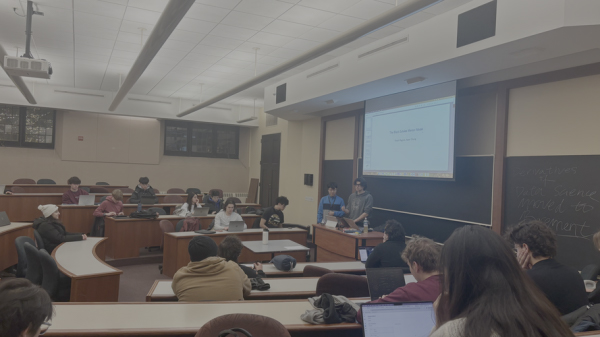
Administrators projected cautious optimism about UChicago’s financial outlook at their fifth invite-only budget town hall on December 11.
Provost Katherine Baicker and Enterprise Chief Financial Officer Ivan Samstein expressed confidence that the University’s $160 million operating deficit could be eliminated by 2028 as planned. But “we also understand there’s a lot more uncertainty in the external environment than there was when we made this plan,” Baicker said.
After lowering its deficit by 44 percent—nearly twice the decrease initially predicted by administrators—in 2025, the University expects a slower pace for deficit reductions over the next two years, Baicker and Samstein said.
The presentation also revealed compensation and other expense figures in fiscal year (FY) 2025 that were not included in UChicago’s publicly available financial statements.
Compensation increased by nearly 8 percent overall in FY2025, according to the presentation. Salaries and benefits in the Biological Sciences Division rose by 9 percent, while salaries and benefits for all other divisions increased by roughly 7 percent.
Supplies, services, and other expenses—a miscellaneous spending category that Baicker said includes travel, meals, and other non-personnel expenditures—decreased by about 7 percent, from $657 million to $610 million, in FY2025 after adjusting for accounting changes not reflected in financial statements.
External headwinds could affect future deficit reduction
The shifting federal policy landscape, including further reductions in federal grants, changing policies towards international students, and hikes in federal taxes on university endowments, still poses financial risks to deficit reduction, Baicker and Samstein said.
UChicago has not yet seen significant financial effects from any of those threats, but the University is planning in anticipation of future impacts, according to Baicker.
“The unprecedented external risks and uncertainty make it all the more important to implement additional measures to moderate spending and accelerate revenue growth,” a University spokesperson wrote to the Maroon. “That’s why we’re working closely with academic units to monitor any changes throughout the academic year, including by monitoring international student trends as the application season ramps up.”
Since the federal government’s termination of more than 70 grants in FY2025, UChicago has successfully secured more significant grant income in the first few months of FY2026, as federal agencies “were getting money out the door” before the federal fiscal year ended, Baicker said.
“We did very well in those months, but then we don’t know what the budget is going to look like going forward [in FY2027] for NIH [the National Institutes of Health], for NSF [the National Science Foundation], for DOE [the Department of Energy], [or] for the other agencies that have traditionally supported a lot of the work done at the University,” Baicker said.
Similarly, UChicago saw little change in international student numbers in FY2025 and has only seen a “localized impact” so far in 2026. International student enrollment in the College rose by less than 2 percent across all units between fall 2024 and fall 2025, according to University census reports.
“We’re watching very carefully who’s applying for next year,” Baicker said. The University sees early indications that federal actions will show larger impacts on international student enrollment in FY2027 and beyond.
Although Thursday’s presentation focused on the external pressures affecting UChicago’s university enterprise alone, Samstein added that substantial cuts to Medicaid in the coming years could also have significant impacts for UChicago Medicine. The hospital sees more inpatient Medicaid patients than any other hospital in Illinois.
Looking forward, University administrators “want to keep driving down the deficit so [they] have more free cash flow to invest in the capital infrastructure of the University” and reduce growth in the total amount of the University’s debt, Samstein said.
The University’s debt increase this year was comparable to FY2024’s $150 million debt increase. UChicago has faced criticism for taking on a heavy debt load in the past, but Samstein defended the University’s decision to make leveraged investments in infrastructure, saying in the presentation that the approach would help build the long-term wealth of the University.
Baicker also noted that, with “interest expense staying relatively flat and a growing enterprise, that means [interest on debt] is comprising a smaller share of total spending for the University.”
Administrators repeatedly pointed to master’s programs as an area of possible revenue growth. Master’s program enrollment has increased for the past two years, according to figures from the town hall presentation, but is only up slightly from the past four years.
Master’s students are “a great population to bring to the University, and one that [the administration is] keeping a close eye on,” Baicker said. She added that there were faculty committees examining how to make master’s and Ph.D. programs more sustainable at the University.
Graduate tuition revenue in FY2025 grew by close to $24 million, a 9 percent increase, according to University financial statements.
Baicker also defended UChicago’s pending $375 million sale of its Center for Research in Security Prices (CRSP)—which critics have speculated was motivated by the University’s financial troubles—calling it a “wonderful transaction” that “just increases value.”
CRSP “got so big and so useful to so many people that it would have more value if it was developed in a bigger way, commercially, by a partner,” she said. “Spinning that off and taking the proceeds… and putting [them] back into endowment for ongoing use by Booth and the University unlocks a lot of value.”
Trade-offs necessary in resource allocation, Baicker says
Baicker said the University does not expect the FY2026 budget to change much from its FY2025 budget, with shares of expenses projected to stay mostly constant. But “we need to be thinking about where we are allocating resources” within major spending categories, she said.
Additionally, Baicker said the University would need to make trade-offs to keep compensation expenses steady.
“We had many years of very limited [salary] increases for people, and that is not sustainable,” she said in response to an audience question about the timeline of the University’s staff reduction strategy. In order to keep pay competitive, she continued, “we probably need to do fewer things to make sure that everything we do is well resourced.”
“Our immediate tasks are to continue applying spending discipline, augmenting sources of revenue, and investing in the remarkable faculty and students at the University of Chicago,” the University spokesperson wrote in response to the Maroon’s follow-up question about what areas might face cuts. “We’re also working with the deans and faculty to develop additional strategies that are tailored to the goals of individual schools and divisions, keeping them at the forefront of their fields.”
Staff reductions were “modest” in FY2025, Samstein said, attributing small expense increases to restrained hiring rather than layoffs. He added that reductions were larger in FY2024, when the University offered a voluntary retirement incentive that approximately 200 people accepted.
Baicker said the voluntary retirement packages and “not fully replacing positions where there’s been attrition leav[e] more compensation to give increases to the people who are here.”
Additionally, she pointed to reassessments across academic units to determine “which centers and institutes are robust… versus which ones have outlived their most useful years, or were great ideas and gambles that didn’t quite pay off, and being a little tough about pruning where that’s warranted.”
But she emphasized that, despite pauses and reductions in Ph.D. admissions announced earlier this year in response to federal policy changes, spending on Ph.D.s has still increased, citing growing per-student costs.
She also said that spending on the Division of the Arts & Humanities “has increased year over year,” notwithstanding cost-cutting reorganization plans for the division.
“I don’t want that discussion about how we organize ourselves and [how] programs should grow versus shrink to add confusion to how much we’re actually spending on Ph.D. students, which continues to grow as is commensurate with our mission,” Baicker said.
University defends investments amid criticism of financial strategy
In response to an audience question about whether administrators felt the University had made mistakes that contributed to the deficit, Baicker called the University’s borrowing decisions over the past two decades to finance new initiatives “purposeful” and an “investment in our mission and eminence.”
“If you had the choice of being in the University of 30 years ago versus the University of today, this is a remarkable university that has accomplished a huge amount during that period,” Baicker said. “When we look at our stature, I think it speaks well of the investment and suggests that we have a lot of momentum to build on as we close the deficit.”
Still, concerns persist about UChicago’s heavy investments in expanding the College and making it more appealing to applicants, alongside a focus on hard-science programs, and how the University’s approach may have contributed to its financial issues.
President Paul Alivisatos, appearing at the end of the presentation, conceded that the University “could have paid more attention to aspects of how we created more revenues with those investments.”
“I don’t think you really ought to fault the academic choices that were made,” he said. “You could say maybe we could have done more to create the underlying web that supports all of that.”
But he pointed to the University’s recent moves, including “4+1” programs and other master’s programs, as ways of “bring[ing] those revenue sources into alignment with what the academic areas are.”
“We have a plan that’s doing the pieces that we need to do as an institution that will make us strong [and] innovative, academically… with a more sustainable budget,” Alivisatos said.








Matthew G. Andersson, '96, Booth MBA / Dec 21, 2025 at 4:11 pm
The external environment is always uncertain. What is never uncertain is the internal environment. It speaks clearly to managers with great precision: especially unit labor cost and labor utilization rates. Those are under direct management control; the external environment is not. The town hall made it clear that the administration’s intention is to wait out the political cycle; “manage” accounting information in the interim, and bank on future federal favor for a status quo ante. What is fascinating about the University of Chicago is that its administration can’t raise any capital, let alone match its peers (Harvard, Yale, Texas), who are at 5X UChicago’s endowment size, and growing. UChicago is undercapitalized, but especially, under-managed. Otherwise graduate students can see where cutbacks to their programs went: faculty and administrative raises. Administrative self-dealing is systematic. In the private sector, such management would be replaced as a matter of fiduciary duty. “Cautious optimism” always means “incautious resolve.”