


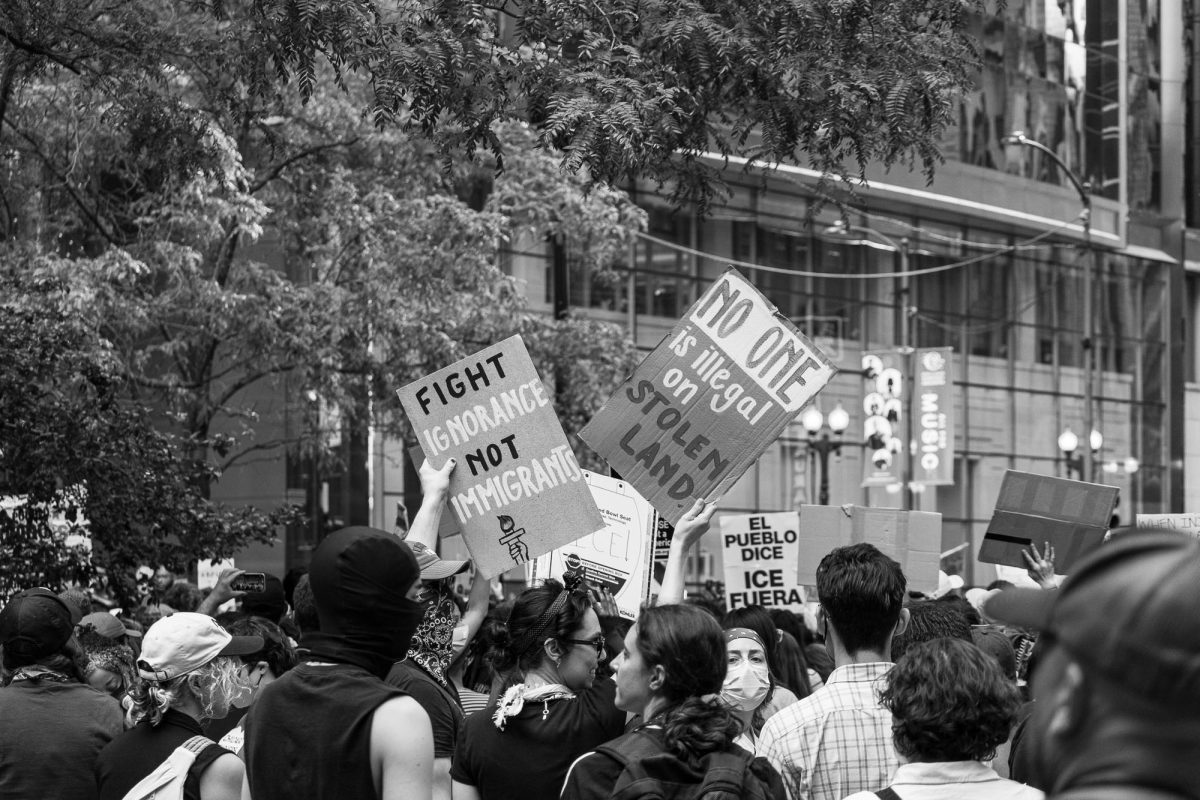
In the more than two months since President Donald Trump launched Operation Midway Blitz—the Department of Homeland Security operation intended to target “criminal illegal aliens” in Chicago—Hyde Park and other communities throughout the city have been living in fear of a campaign that claims to improve public safety.
Yet, despite the proximity and intensity of this enforcement, the University’s public stance has remained vague, characterized by a single phrase: it will cooperate with immigration enforcement “as required by law.”
Federal agents have gassed, tackled, and even shot at civilians. They have repeatedly detained protestors, many of whom are lawful residents and citizens, and held them in the infamous Broadview immigration facility. Seemingly no space is off-limits; agents have made arrests everywhere from courthouses to churches to even daycare centers, often without warrants.
Just south of Hyde Park, 300 federal agents conducted a highly publicized nighttime raid of an apartment complex. Although the government claimed that members of the Venezuelan criminal organization Tren de Aragua resided in the building, the 37 individuals detained included citizens, children, and legal residents. No criminal charges have been filed in the nearly two months since the raid.
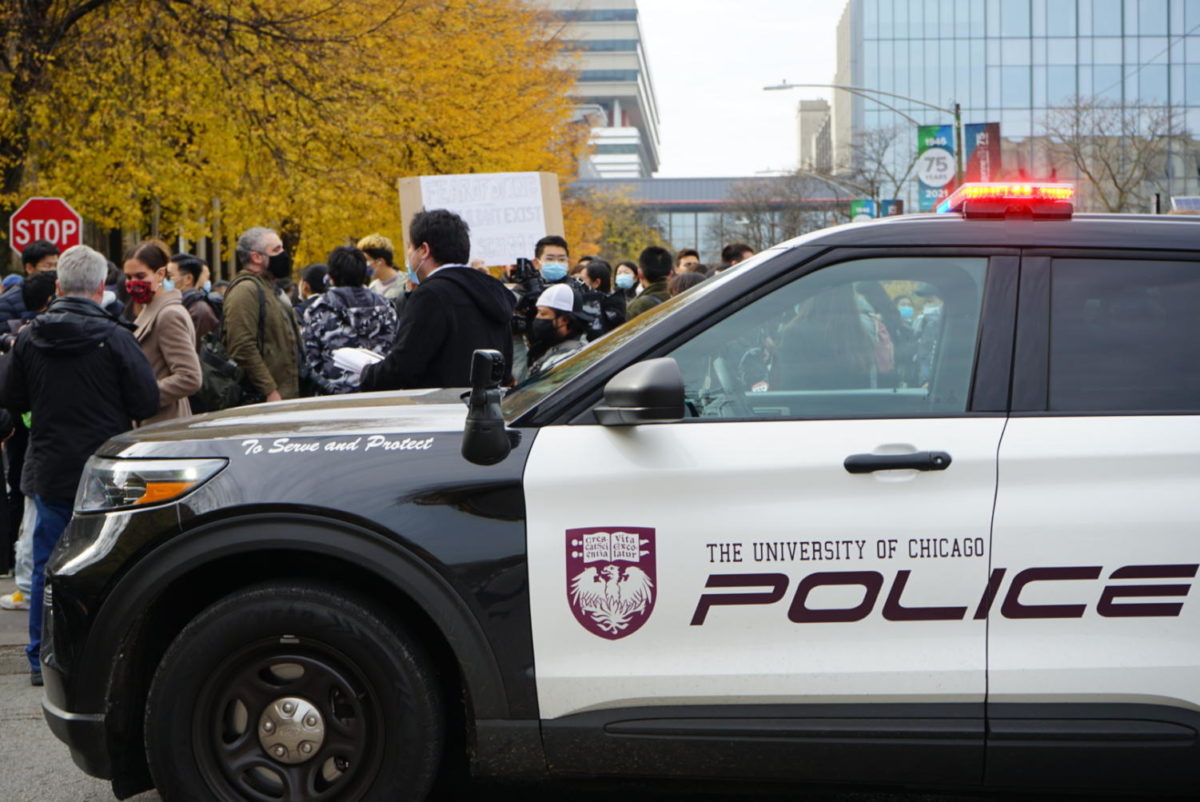
On October 15, Immigration and Customs Enforcement (ICE) briefly detained a UChicago international student at East 55th Street and South University Avenue. The student was carrying immigration documentation and was soon released. The Maroon has reported four immigration enforcement detentions in Hyde Park as well as several sightings of federal agents since Operation Midway Blitz began.
As an institution that has long emphasized its position as an “anchor” for the South Side community, UChicago has a responsibility to protect its community that extends beyond bare-minimum legal compliance. The University must take an active role in protecting students and the Hyde Park community.
What Can the University Do?
In its guidance to students, the University has continuously emphasized that it will cooperate with federal enforcement as required by law and has directed students to online resources like its “Federal Law Enforcement FAQ” website and its therapist-on-call hotline. Additionally, the Law School’s Immigration Rights Clinic provides legal representation to immigrant communities in Chicago and has released several guides on how to safely respond to immigration enforcement.
But most of the University’s guidance on dealing with ICE still revolves around calling the University of Chicago Police Department (UCPD) and carrying all necessary identification documents—advice that does little to communicate specific actions the University might take to support its students. While important, these forms of support are not a substitute for a clear institutional stance.
Other universities have taken more concrete steps to increase transparency and protection for their students following initial measures targeting international students during the first Trump administration.
In 2016, several universities, including Portland State University and Reed College, declared sanctuary status on their campuses. In 2025, the detainment of Mahmoud Khalil on Columbia University’s campus prompted the Young Democratic Socialists of America (YDSA) to launch a national campaign, leading dozens of YDSA chapters across America to campaign for similar declarations at their universities.
Sanctuary status is defined differently between institutions, though it most commonly includes:
- restricting ICE officers from entering campus without a warrant;
- barring campus police from enforcing immigration law;
- refusing to share or gather information regarding immigration or citizenship status with federal bodies;
- providing confidential legal support to students with immigration law questions;
- allowing students to complete their degrees remotely; and
- reducing or limiting campus police presence during protests and events that tend to include undocumented students.
Currently, the University’s policy includes several of these protections. Outside law enforcement are barred from entering “non-public” spaces on campus without a warrant. Under the Illinois Trust Act, UCPD, as well as local law enforcement, is prohibited from enforcing immigration law.
Still, there are gaps. Though the University does offer students assistance in finding attorneys, it does not provide immigration lawyers, specialized immigration advising, or dedicated, confidential legal representation for vulnerable students.
Additionally, UChicago has not publicly committed to limiting the collection and distribution of information on students’ immigration status; it has not articulated any policy on remote degree completion for students who may fear attending classes due to ICE presence; and it has not publicly stated any commitment to limiting UCPD presence at events that tend to include undocumented students.
By contrast, many universities have improved communication and legal protections for their students this past year. Other Ivy Plus institutions have publicly clarified their policies, emphasizing privacy and due process. In an interview with the Yale Daily News, a Yale spokesperson said that the university would decline to provide immigration information to ICE unless obligated by a judicially authorized subpoena. Similarly, Harvard has expanded its legal resources for undocumented students through the Harvard Representation Initiative.
UChicago should adopt some of these additional measures, even if it is hesitant to officially label itself a “sanctuary campus.”
It is also particularly important for the University to clarify how UCPD will interact with federal law and immigration enforcement. As it stands, an FAQ page—last updated on November 5—merely states that UChicago “cooperates with outside agencies as required by law, while protecting the rights and privacy of students, faculty, and staff.” The ambiguity of this statement does little to assuage the fears of students.
UChicago must take steps to ensure that UCPD, as a private police force, is used to protect its community rather than betray it. To ensure that students feel safe, it should state clearly that UCPD will not conduct or aid in immigration enforcement.
What Can We Do?
Many community members are already mobilizing. Students have participated in demonstrations like the “No Kings” march or the Hyde Park parents’ protest against ICE. Labor unions on campus have issued public statements criticizing the University’s response to federal immigration enforcement presence.
Last month, the Illinois Coalition for Immigrant and Refugee Rights (ICIRR)—which regularly collaborates with both undergraduate and law students—successfully lobbied for the passing of HB 1312 in the Illinois General Assembly. The legislation improves protections for individuals visiting county courts and restricts ICE’s ability to surveil individuals seeking care in hospitals, among other protections. Students interested in taking on a more hands-on role can volunteer with or donate to groups like ICIRR.
Community members can also supplement formal organizing with practical support networks. The Kenwood-Hyde Park-Woodlawn Rapid Response team, which is affiliated with ICIRR, sends alerts and communications about nearby ICE sightings; volunteer groups like Watchguard Chicago have implemented on-the-ground protections; and ICIRR’s Family Support Network hotline collects reports of ICE activity to be distributed to immigrant communities across Illinois. Students and community members can—while prioritizing their own safety—contribute to crowdsourced ICE tracking tools like iceinmyarea or the Maroon’s ICE tracker with photos and videos of federal enforcement.
While community efforts are important, and students should engage with them safely and legally, they alone cannot substitute for institutional action.
The ongoing organizing of student, faculty, and community groups has been vital in building solidarity thus far, but protests are even more effective when they are backed by clear, unified demands. The community must continue to press for more explicit limitations on UCPD involvement with ICE, protection of student immigration status data, and expanded legal support for vulnerable community members.
Conclusion
UChicago faces a choice about the type of institution it wants to be. Federal immigration enforcement is here, affecting daily life in Hyde Park and Chicago, and the University cannot remain silent when its neighbors are being detained on the same streets its students walk every day.
If UChicago—both as an institution and as a collection of individuals—truly wants to be an “anchor” for the South Side, the complacency of simply cooperating “as required by law” with immigration enforcement is not enough.
We call on the University to clearly articulate the steps it will take—and the steps it is already taking—to protect this community’s most vulnerable members. The University should clearly define what UCPD interactions with ICE should look like, expand and publicize the legal protections it makes available for students, and ensure that no one on campus is left to fend for themselves. At the same time, students should continue to contribute to community efforts if they can do so safely.
Chicago has become an increasingly unsafe and tense place in the past few months. The University must now decide where it stands.
Editor’s note: Celeste Alcalay, Tiffany Li, Naina Purushothaman, and Nathaniel Rodwell-Simon, and Kalyna Vickers have recused themselves from this editorial due to reporting conflicts.
O’Heath / Dec 18, 2025 at 9:32 pm
The ‘viewpoint’ is offensively apparent but nowhere defended.