During the second week of winter quarter, well before the sun can blink open its eyes, Henry Crown Field House fills with animal noises. Hisses, barks, and howls echo periodically through wooden walls, spilling into the icy street and alarming passersby who have not yet learned what winter sounds like at this school.
No, it’s not a secret meeting of lizard people or a band of pet store fugitives. It’s something far more unexpected and far rarer: UChicago students exercising. (More specifically, doing yoga.)
Arriving at that point in the quarter when the world seems permanently swathed in gray, Kuvia is a hallmark of winter in the College, an institutional attempt to make the season something more than just survivable. For one week, students file into Crown at 6:30 a.m. to exercise together. It’s baffling, I know.
Their only reward is a free T-shirt and the knowledge that they have done something both unnecessary and unpleasant of their own free will.
The tradition has its roots in two concepts. The first, from which its name descends, is kuviasungnerk, Inuit for “the state of feeling happy,” which can be an elusive condition in the depths of a Chicago winter—made more elusive still by the Campus North Residential Commons’ wind tunnel. In 1983, then Dean of the College Donald Levine sought to alleviate the stress of the season with a series of activities, including knitting contests, lectures on Arctic food, and readings of winter poems.
The second pillar is kangeiko, Japanese for “winter training.” Levine, an aikido practitioner, also encouraged students to complete a week of early morning exercises, rewarding perfect attendance with a commemorative T-shirt. Now, each session also ends with a free bagel, a far cry from the event’s culinary origins in “kelp and raw fish,” which students claimed helped “promote both the kuviasungnerk spirit and the sense of humor.”
To many, these ideas seemed to be at odds with each other, one emphasizing relaxation and the other discipline. Levine would disagree. “Both notions seem to me to do a splendid job of solving the key problem of the Winter Quarter…. The key problem is how to define winter in such a way that it is no longer seen as a ‘problem,’” he told the Maroon in 1984.
Today’s Kuvia is a strange amalgamation of the two concepts: alongside the more “physical” sessions hosted by sport and dance teams are workshops run by the chess and origami RSOs, all organized by the Council on University Programming as a series of hour-long, exercise-adjacent mornings. The days build up to Friday’s dip into the oft-frozen Lake Michigan—the Polar Plunge.
Settling into the Kuvia Routine
The first morning begins with an alarm at 5:45 a.m.: Apple’s “Kettle” trickles into my ear. I pry open my eyes and reluctantly extract myself from my comforter, a task that feels excessively difficult given that this was my choice.
The walk to Crown feels a bit like the witching hour. There are no cars, no people, no squirrels. Inside, students sit on the rough rubber floor, silent under fluorescent lights as they await their friends.
Sun salutations begin, drowsily, at 6:42 a.m. During cobra pose, my neighbor hisses at me sharply, her tongue jutting out in an unconvincing imitation of a snake. I hiss back.
As the week progresses, the mornings blend together. A ballet workshop reminds me why my childhood dreams of becoming a ballerina were abandoned. A session with the women’s rugby team confirms that I should never be entrusted with any task requiring significant hand–eye coordination. (To anyone who had the misfortune of receiving one of my passes, I apologize.)
By the third morning, I have accepted the way of Kuvia as my new reality: rising before dawn and anticipating ever so slightly more physical activity than usual.
Race to the Tower
People will tell you Kuvia is not competitive. These people have never attempted to secure one of the 50 spots on the Guild of Carillonists’ sunrise tour of Rockefeller Chapel.
The 20 seconds after the workshop is announced are like a pre-pandemic Black Friday sale. Once the 50 of us are selected, we begin the journey to Rockefeller.
We pack into the front pews of the chapel like sardines, elbow to elbow, awaiting instructions before we can make our way, single-file, toward the narrow, winding staircase—a 271-step climb. The exertion is unexpected. Everyone is sweating; everyone is exhausted; and some of us have been convinced that bell-playing may be our true calling, if only for the view from the top.
The sun is hidden behind the clouds, of course, but splotches of warm yellows and oranges burst through the grey here and there. Without a doubt, this is the most exercise I complete all week.
The Plunge
Kuvia ends at the lake.
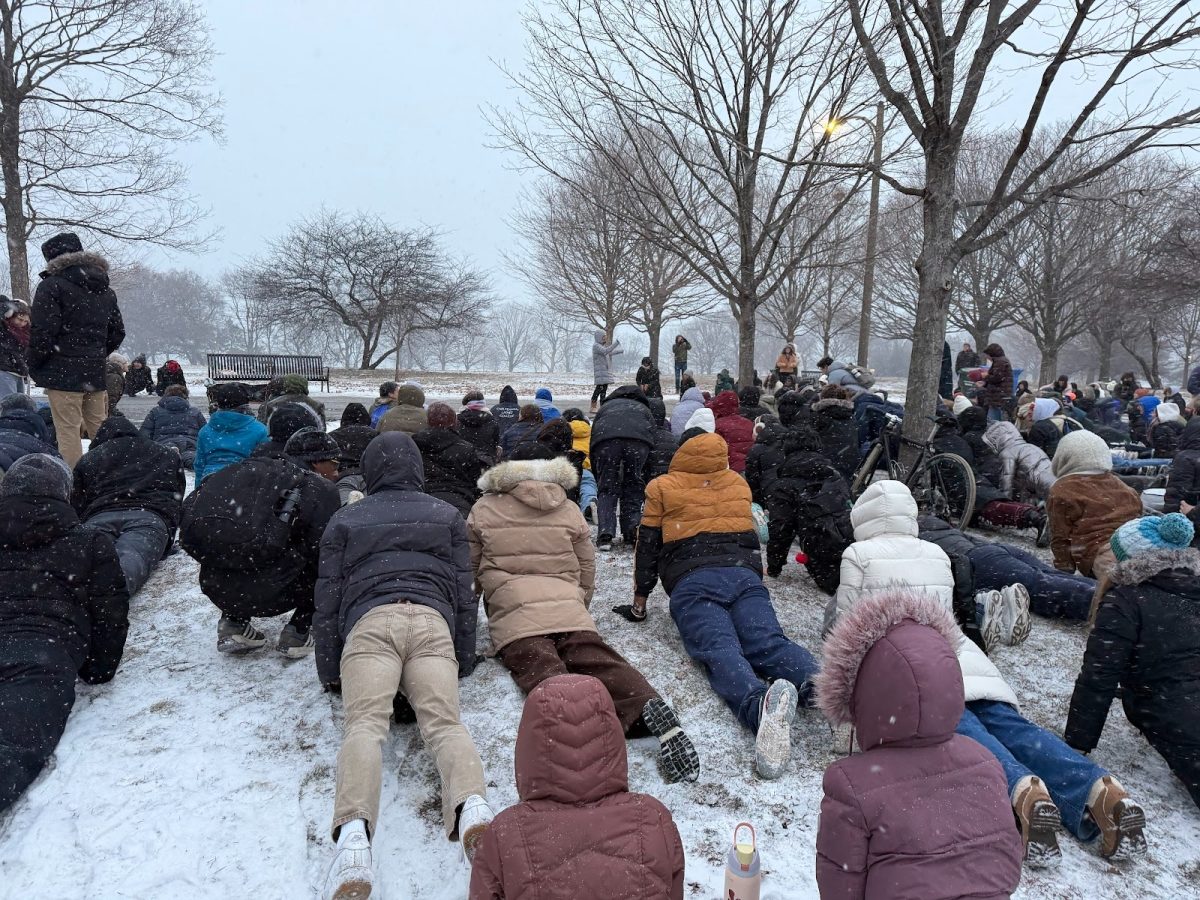
On Friday morning, we walk the mile to the Point bundled tightly in sweaters and scarves, slipping occasionally on ice. Eventually, we line up on the rocks like migrating emperor penguins, staring at the water as snowflakes pelt our faces.
Dean of the College Melina Hale leads us through the sun salutations that day. The hundred or so of us who have made it this far, including a student dressed in a polar bear costume, carry out our final downward dogs.
Then it is time for the plunge.
In 1984, after what organizers described as a “wimpy winter” the previous year, Kuvia staff were reportedly “hoping for bad weather.” Given the half-frozen lake and shards of ice that slice at legs and feet as they go white, then blue, from loss of circulation, it’s easy to see why.
Snow continues to fall. The rocks are covered in ice, sending Kuvia participants slipping into the freezing water below. Everything is cold and wet.
I barely make it to my ankles before retreating, my hands and feet burning. Feeling doesn’t return to them until my Uber reaches campus, and even then, the pins and needles linger in my fingers and toes. (As I write this, some time later, I am still cold.)
Kuvia doesn’t make winter quarter easier, by any means, but it does make it communal, and there’s a peculiar comfort to be found in the act of choosing discomfort together.