“Do you believe the artist, or do you want to break the rule?” asks Tongji Philip Qian, a Harper-Schmidt Fellow and Collegiate Assistant Professor in the department of visual arts. He’s asking you, a potential visitor to his exhibition Alloyed Commitments at Logan Center, about how you will interact with Perfect Days, the pile of T-shirts blocking a small side chamber near the exhibit’s entrance.
Visitors who “break the rule” usually do so to get a look at Anfang, an engraving featured in the exhibition guide but inaccessible unless one can find a way across the Perfect Days blockade. Other rule-breaking visitors do so by taking a Perfect Day shirt for themselves, committing a Class A misdemeanor to add a sweet conceptualist tee to their wardrobe. However, choosing to believe Qian and his implicit instructions opens the exhibition as an extensive inquiry into form, authorship, and the idea of art as the idea behind art.
Curated by Andrew Witkin, the exhibition is the combined work of Qian, his mother, dog, partner Fan Ada Wang, and Today Clothing, a contemporary menswear hub in Ann Arbor and the source of Perfect Days. Plainly drawing from conceptual artist On Kawara’s famous Today series, which consists of almost three thousand panels painted between 1966 and 2014, the store has printed the date on a T-shirt every day since 2013. The shirts are always for sale on the day of their printing, but sometimes they don’t sell.
“What do you do with the shirts that are unsold?” Qian asked owner Eric Hardin on his second visit to the store. “They said to come back the next morning” and lent the shirt labeled 27AUG2017, along with hundreds of others, to Qian.
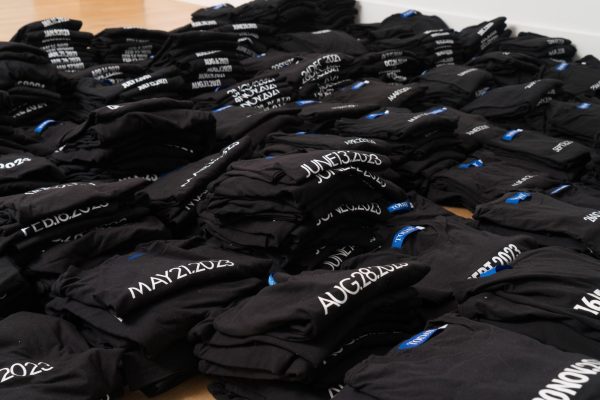
Perfect Days—named after the Lou Reed hit, specifically the version featuring operatic tenor Luciano Pavarotti—does not occupy the main space. It sits on the ground, in piles, in a room to the side. During the 2000 Shanghai Biennale, Kawara chose to not show Today in a typical gallery but exclusively showed it in a kindergarten classroom, where kids used the canvases to learn how to count. This was Qian’s first encounter with Kawara, and the 25 years since have made Qian also question the typical answers to where art ought to be.
On the wall directly facing the entrance is No-risk Hour, one of seven in the exhibition with the same name. An artwork that hearkens back to the early work of Sol Lewitt through the medium of graphite-on-wall, it consists of twenty-five neat lines of cursive, penciled timekeeping: “It is one o’clock. It is one past one. It was one past one. It is two past one,” and on, and on, all the way until it reaches “it was one to two.” It never reaches two—Qian created the work entirely during the annual duplicated hour granted by daylight savings time. When the clock changed back, Qian reset the writing after a line break: “It is one.”
Alloyed Commitments is just “a nicer way of saying mixed feelings,” Qian explained over a Zoom interview. It communicates his feelings about when art should be made: “I’m not committed to going to the studio and to making art every day.” Like No-risk Hour, Hotel Drawings and Lunch Break Drawings are both temporally restricted: the first can only be made when travelling, and the second in 10 minute time slots during 26 lunch breaks Qian had at a past job in 2022.
Ceaseless, continuous commitment to art evades Qian. “When all artists are so committed and energetic, I think that maybe we’re missing a larger picture,” Qian shrugged. Perhaps it is better to work only when the stars align, not just when there are stars in the sky. The creation of art is something that must not become an everyday enthusiasm; it must always be a little bit novel, lest it become mundane.
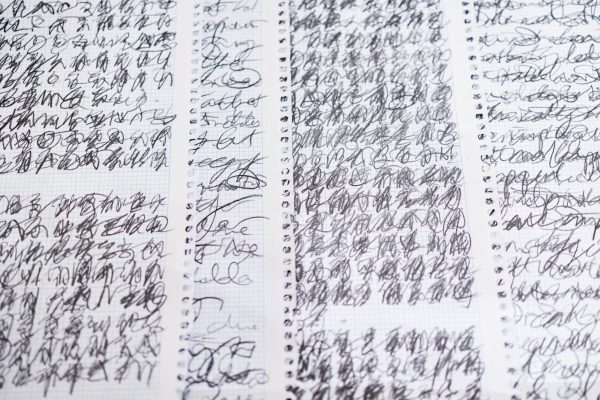
That doesn’t mean Qian is consulting the horoscope every time he picks up a pencil. “It’s not really about artistic expression. It makes my lunch break more enjoyable, and that’s why I did it,” said Qian of his Lunch Break Drawings. 13 of the drawings are pages of grid paper filled with illegible Chinese-looking scribbles. The other 13 pages are filled with illegible English-looking scribbles. “If it’s English today, the next day, I’ll do Chinese.” Even when no individual word is readable, not reading into the imagined binary is difficult. Certain choices in positioning, like the placement of the drawings in a row at waist level, make it seem like they are begging to be read and understood, emulating documents sitting at the bottoms of vitrines in the Chicago History Museum.
Qian writes illegible Chinese because he can write legible Chinese; he was born in Shanghai and played for a team that represented China in the 2010 Ultimate Frisbee World Championship. He formerly taught art during a fellowship with the educational nonprofit Teach for China in Yunnan, where he showed students Sol Lewitt’s instructions for wall drawings. Lewitt, a founder of the conceptualist movement of the 1960s (“the idea becomes a machine that makes the art”), rarely executed his wall drawings himself. Instead, he conceived of sets of instructions on how to make the art and passed the execution to his assistants.
“They responded to it very well, with no pre-existing knowledge on art and very little capability [for] doing math. So I was really convinced that conceptualism has an audience—it’s legible, it’s approachable, it’s accessible from a global perspective,” Qian said. “That’s actually how I became an artist.” Lewitt’s forty-year-old ideas were transcribed into reality through Chinese schoolchildren. “It’s not about the artist making the work, but it’s about extending democracy to draftspeople,” Qian said.
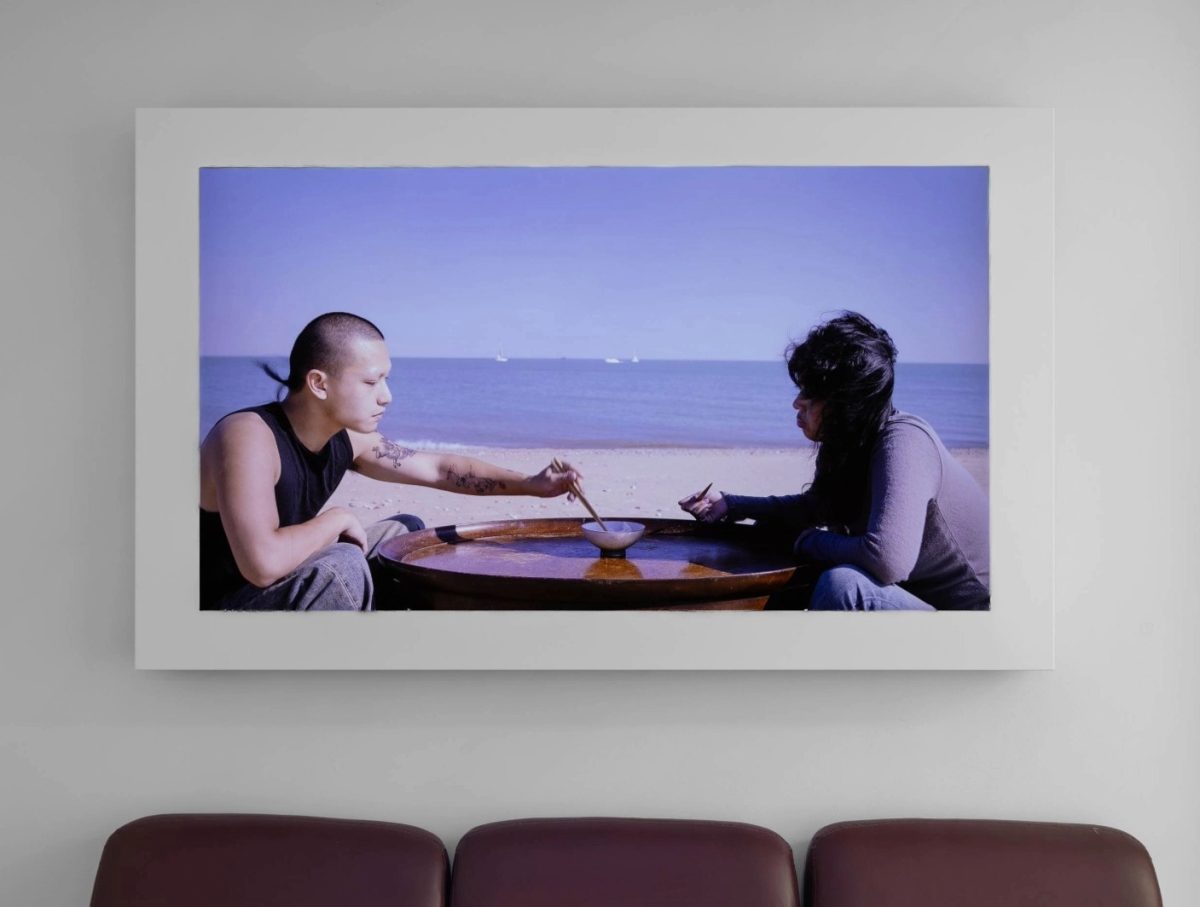
Perhaps the exemplar of Qian’s own unorthodox relation to authorship is Finding the Spiral Jetty, a documentary film shot on two cameras strapped to his dog and projected, split-screen, onto the bottom right corner of the innermost wall in the exhibition. The cinematographer captures Qian and Wang as they walk together on sculptor Robert Smithson’s magnum opus Spiral Jetty, a spiraling piece of land art located on the Great Salt Lake in Utah. Built in 1970, its creation was accompanied by a color film documenting the construction.
“I thought about doing some work with it, but I just realized so many artists have done so many things to activate the Spiral Jetty,” Qian said. “Who am I to change it? So eventually I thought, you know, maybe I can ask my dog to do a film.”
The filming of Finding the Spiral Jetty was done on two cameras: one from GoPro, and one from Da Jiang Innovations. Their playbacks are separated by the six seconds it took for Qian to turn the second camera on after turning on the first. “So again—the kind of fabricated binary between the Chinese and the American,” Qian said, this time found not in the executed art (Lunch Break Drawings) but in the tools used to make it. A binary that is entirely invisible to the visitor—unless you care to check the materials used on the exhibition guide.
Tongji Philip Qian: Alloyed Commitments will run through December 7.