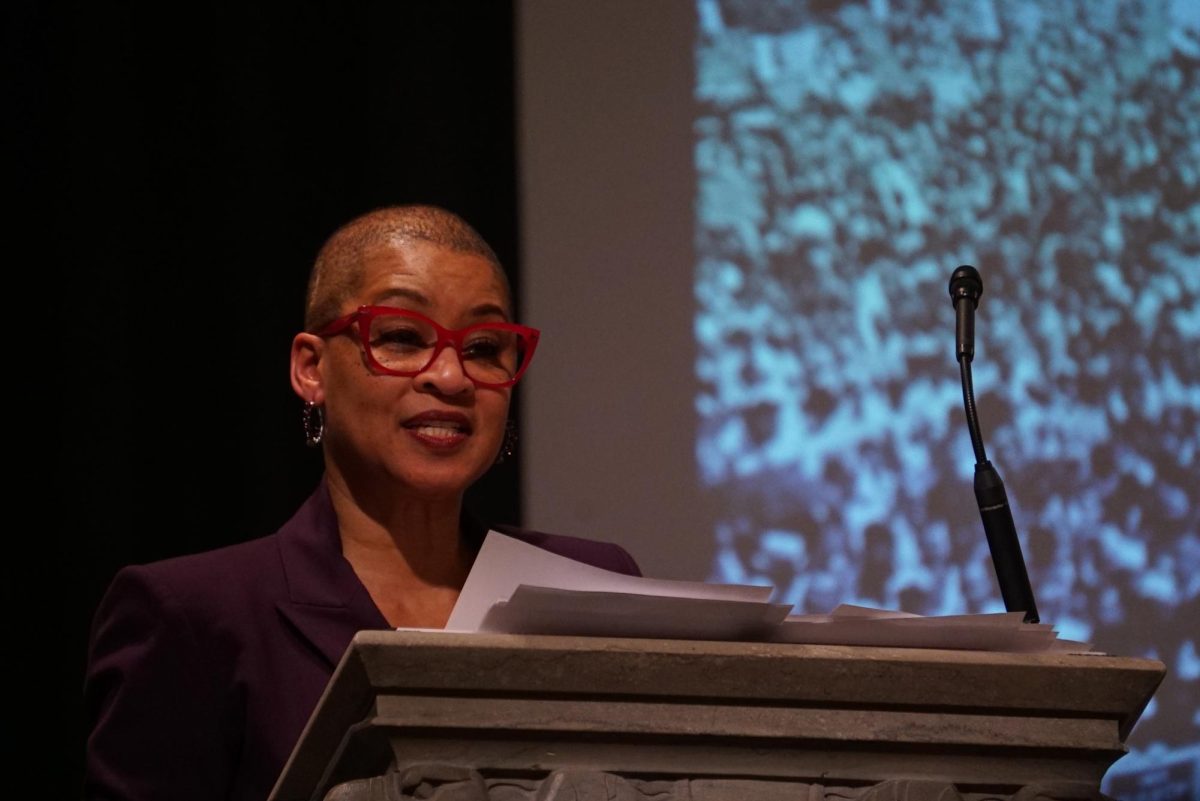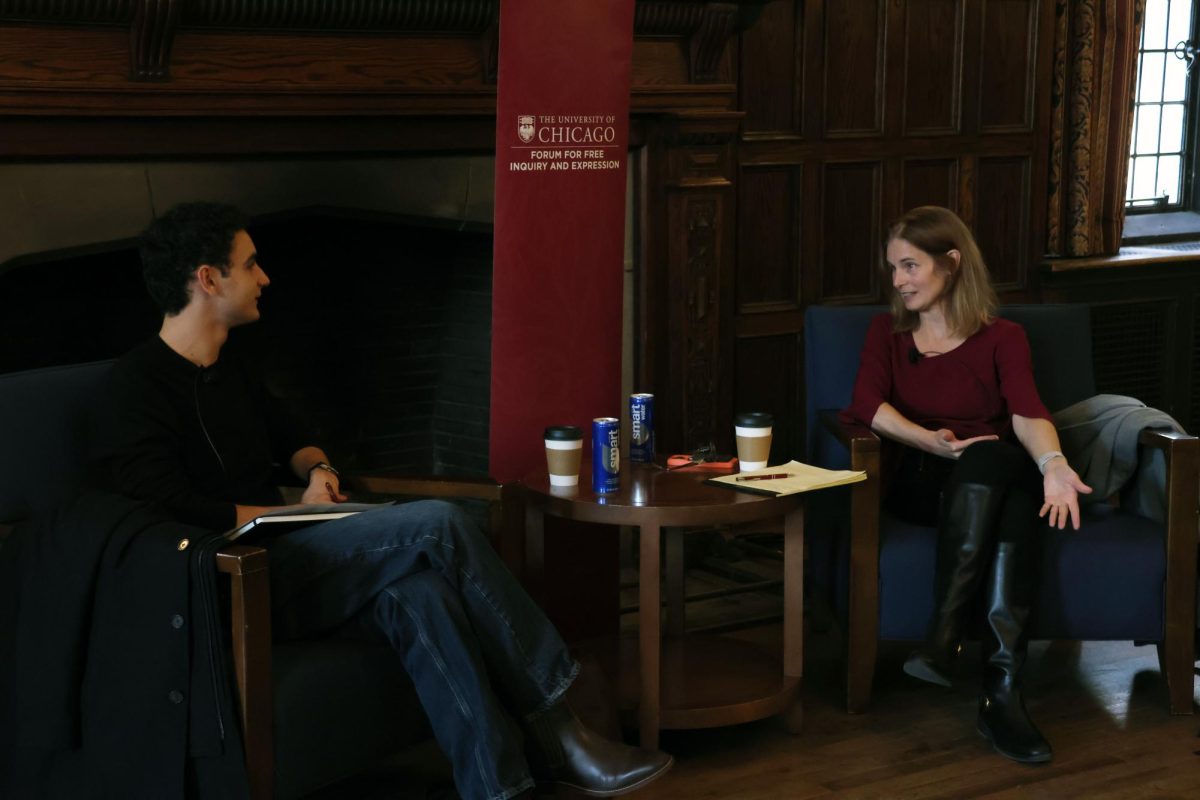
The College Committee of the Chicago Forum for Free Inquiry and Expression’s Student Board hosted a conversation with Dean of the College Melina Hale, moderated by Marcos Werning, the Forum’s college chair.
The November 14 discussion—which was open to all undergraduates—focused on the College’s present and future priorities in adhering to principles of free expression, academic rigor, and institutional neutrality; artificial intelligence; and housing policies.
Hale also suggested that current residential hall guest policies may change by the end of autumn quarter.
Werning began the moderated session by asking about the Core, which Hale described as foundational to the University’s identity. Even as some say the student population is moving further toward a culture of pre-professionalism, Hale laughed off ideas like letting business economics majors take major requirement classes before Core classes to better fit the demands of finance recruiting. She worries most about business economics students missing out on ideas beyond their major, she said, and believes they must grapple with the ideas of the Core before specializing.
She said that the UChicago undergraduate is necessarily invested in the “life of the mind,” arguing that though students may apply this foundation differently across majors, everyone should be grounded in a shared foundation of knowledge from Core classes.
Hale said the restructuring of Housing & Residential Life in spring 2025 will allow the College to bring a more conscious implementation of academic freedom into housing environments, including through a reworking of the training for resident heads to help them better understand the University’s values.
Most resident heads are current professors or enrolled in the University’s graduate or professional schools but did not necessarily graduate from the College.
Another of Hale’s goals is to make residential commons more accessible to all students by changing the guest policy. The University’s campus was originally designed to facilitate socializing in residence halls, Hale said. She added that she expects HRL to take steps to make entering residence halls by the end of this quarter.
Housing policies were tightened in 2024 when the current online advance-registration system was implemented, replacing a prior tap-in system. Students living on campus are restricted to two guests each at any time.
Hale said she believes the College’s consistently upheld value of institutional neutrality has helped UChicago amid recent tumult in higher education. In response, Werning posed the critique that not taking a stance is taking a stance. But Hale said that there is no alternative that would make the University more neutral, and that as a place rather than an individual, it isn’t the University’s role to take a position.
Another change Hale said was meant to strengthen academic freedom is the addition of a course evaluation question that asks about students’ comfort with sharing their views in the classroom. First implemented in the spring quarter of 2025, the results showed 89 percent “yes” votes on average across the College, and 96 percent “yes” votes in the Division of Arts & Humanities and the Divinity School, according to Hale.
Regarding artificial intelligence, Hale foresees no change to the current policy of leaving AI guidelines to faculty discretion on a class-by-class basis. The College will continue to build best practices in accordance with the guidelines of the Chicago Center for Teaching and Learning, she said.
She added that incorporating AI when it is the best way to get a result is important, and a return to in-class written and oral examinations has helped to maintain academic integrity in other classes.
Editor’s note, November 19, 3:14 p.m.: The Chicago Forum for Free Inquiry and Expression clarified after the initial publication of this article that its event had been off the record. The article was updated to paraphrase and preserve the meaning of previously included direct quotes.