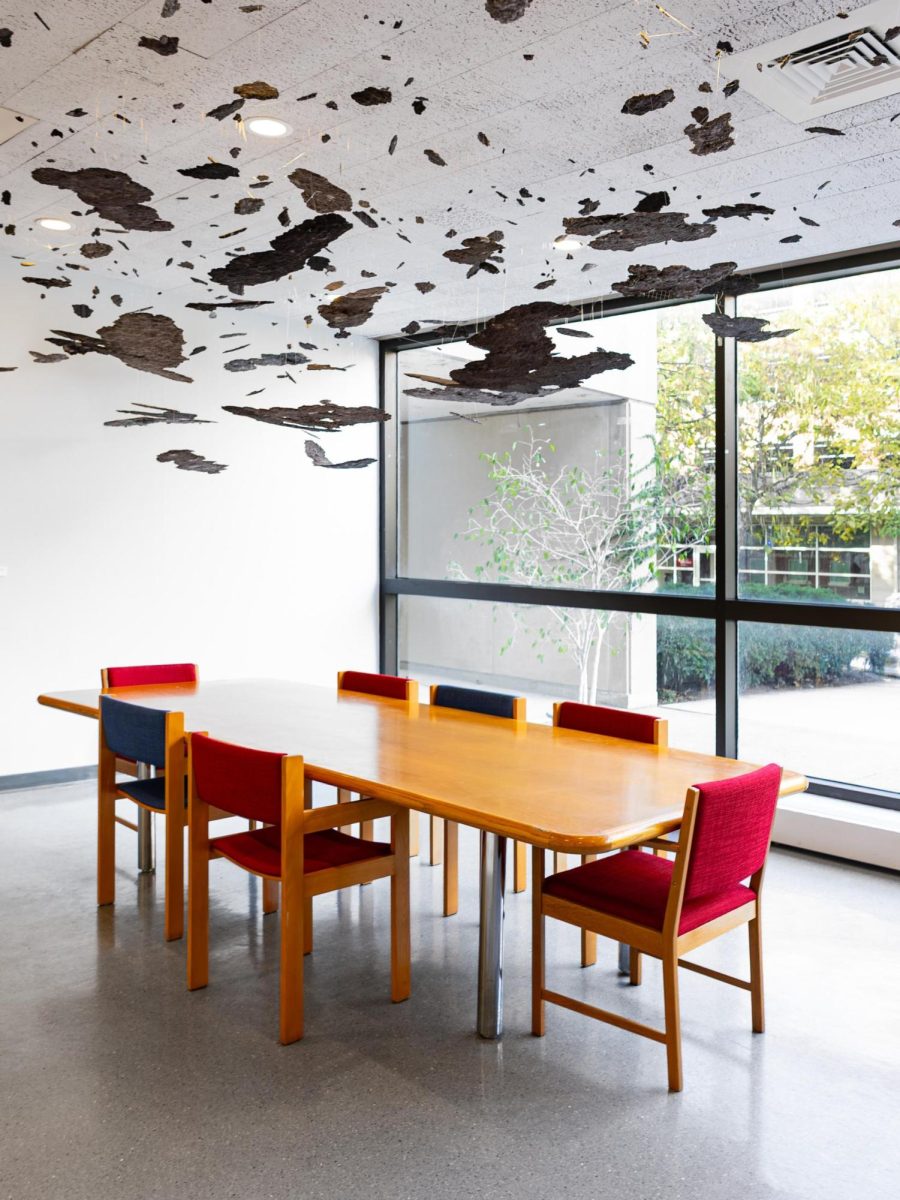
Fragments of dark papier-mâché hang from the ceiling of the Cochrane-Woods Art Center’s first-floor lounge, evoking the aftermath of an explosion. Clustered above the central table of the lounge, the individual pieces converge into a single mass that descends gently from the ceiling, echoing the concave form of a crater. This is the heart of Air Crash Report, a site-specific installation by artist Faye Yingfei Liang.
Air Crash Report stirs up the memory of China Eastern Airlines Flight 5735 (MU5735). In March 2022, the domestic flight inexplicably plummeted into the ground in Wuzhou, Guangxi. In its wake, the crash left not only a gaping crater and the pain of lives lost, but also deep frustration over its unidentified cause. Investigations by the Civil Aviation Administration of China and representatives from the American National Transportation Safety Board found no obvious abnormalities in the flight. On the following two anniversaries of the crash, updates were issued but no definitive causes were identified.
Liang initially encountered the crash during her career as a photojournalist in China, where she was assigned coverage of the wreckage site but was never permitted to actually see the crater. Years without answers eventually yielded the creation of “Crater Surveyor,” Liang’s character who has dedicated their life to reconstructing details from the negligible evidence and media coverage. Air Crash Report follows Crater Surveyor’s determined plight. It also continues Liang’s multimedia exploration of human stories amid oppressive social systems, a project she has pursued since beginning her visual arts M.F.A. at the University of Chicago in 2024.
Crater Surveyor’s story continues to unfold as visitors move through the corridors of CWAC. Neon yellow and pink notices cling to the wall at the foot of a staircase, their surfaces torn and abraded as if hastily posted and violently removed. Words emerge through the scuffed layers, offering insights into the crash’s media frenzy: whispers of a pilot’s suicide and rumors of American political interference.
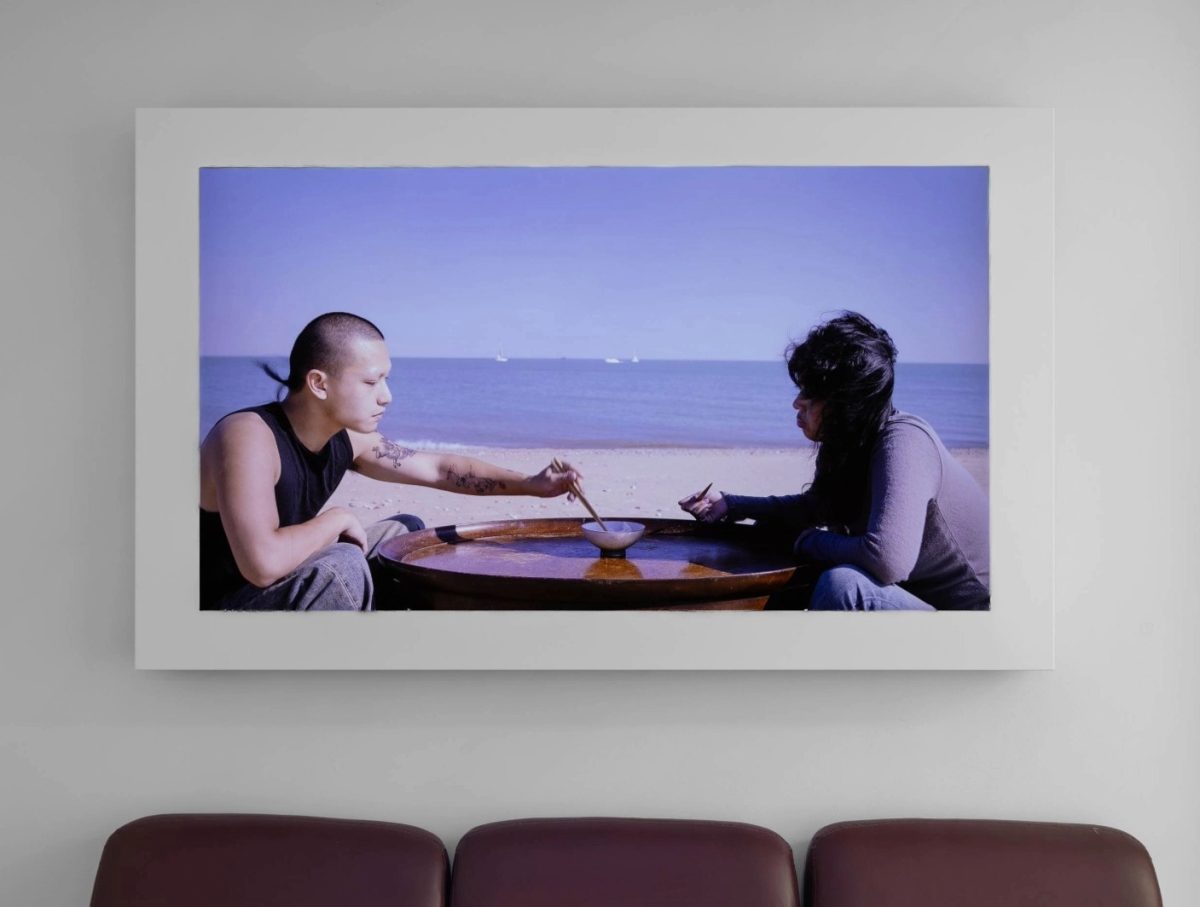
On the second floor, a red chair captivates viewers’ attention. It has been pushed under a desk, atop which rises a bizarrely tall stack of printed documents: a tangible manifestation of sifting through copious conspiracies with no avail. Nearby, a video quietly plays behind a curtain, inviting viewers to put on headphones and hear Liang’s tale. The artist describes following a villager toward the crater but getting stranded in the woods while a visual sequence underscores the tragedy of mass death, showing scenes from 9/11 to the final moments of MU5735.
Through the construction of a fictional character in pursuit of facts, Liang blurs the boundaries between reality and imagination, imbuing the exhibit with a constant sense of instability. Air Crash Report invites viewers to confront the uncertainty of truth in the face of mass tragedy and the failure of institutional structures relied upon for answers. Liang meditates on how trauma persists when explanation fails, questioning the limits of societal frameworks.
Air Crash Report was on view from September 29 to October 31.