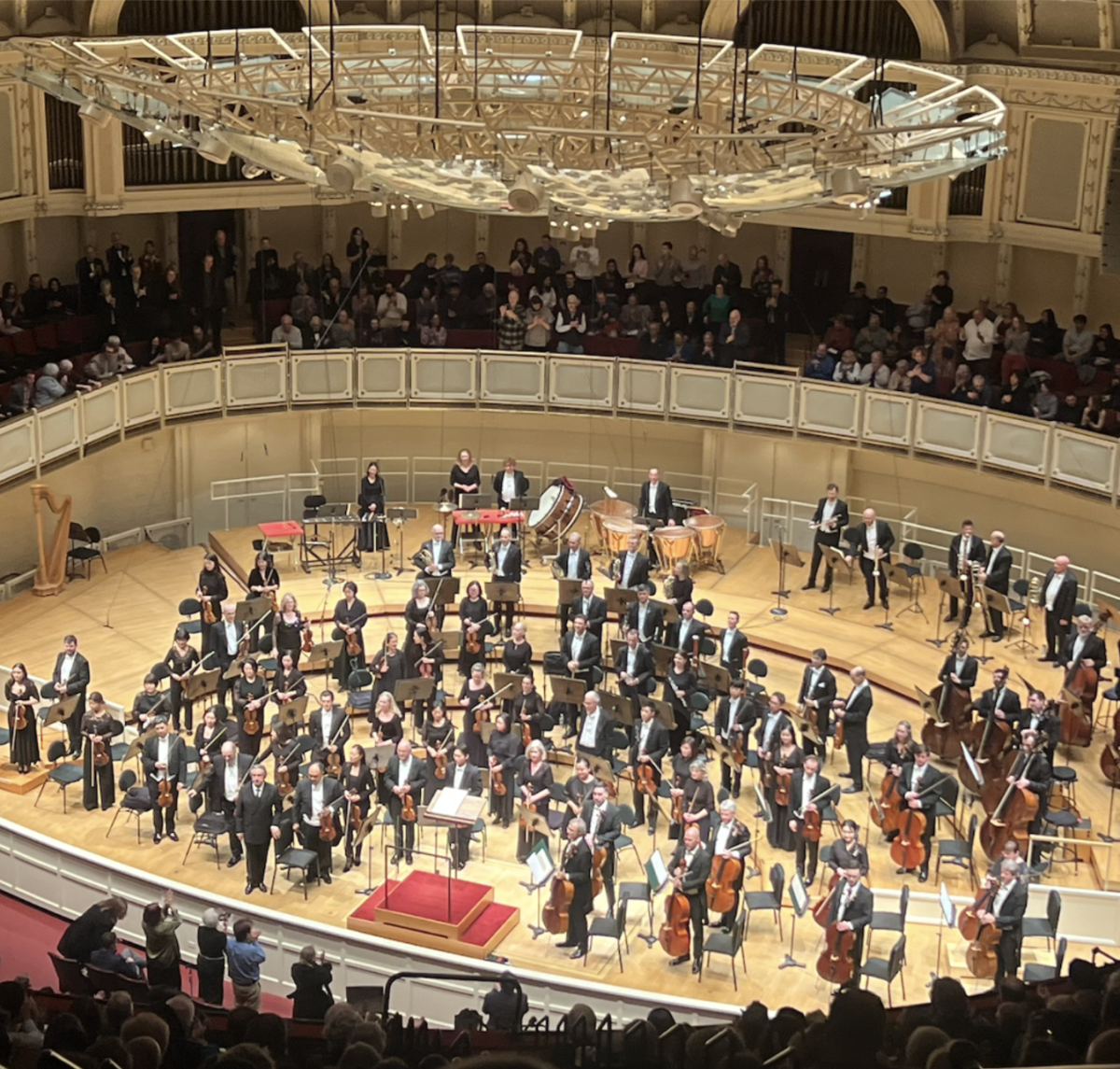
Having served as music director of the Chicago Symphony Orchestra (CSO) from 2010–23, Riccardo Muti has played an integral role in shaping the acclaimed ensemble’s unique sound. As he returns to his former home, Muti’s tight-knit artistic bond with the orchestra remains evident in every note.
The world-renowned maestro, in town for two weeks, led a demanding program that balanced charm with grandeur, including selections by Johann Strauss II, Paul Hindemith, and Antonín Dvořák, on October 30.
The program opened with the overture to Johann Strauss’s operetta The Gypsy Baron, which, like many Strauss works, is deceptively lighthearted. This work marked Strauss’s first attempt to move away from the playful nature of operetta toward the more serious world of opera. What may sound like a simple sequence of jubilant, catchy melodies is in fact richly layered and complex.
Muti has consistently championed this piece over the past year, performing it first at the Vienna New Year’s Concert last winter, which featured music by the Strauss family, and again as an encore with the Vienna Philharmonic at New York City’s Carnegie Hall. Having heard both performances (one in person, one online), I went into Orchestra Hall on Saturday expecting more of the same. But I could not have been more wrong.
Even at 84 years old, Muti never fails to bring freshness and energy to each of his concerts. In this performance, Muti brought out new colors and experimented with new tempos, showcasing the complex and multifaceted nature of Strauss’s score. Halfway through the piece, where the tempo reads “allegretto moderato,” Muti took the passage slower than he had in his earlier renditions, building a drawn-out accelerando throughout the entire phrase, whereas the same section had been far brisker and livelier with the Vienna Philharmonic.
Unchanged, however, was the brilliant waltz section, whose beautiful melody you may recognize from Strauss’s “Schatz-Walzer” (Treasure Waltz). Muti, a seven-time conductor of the Vienna New Year’s Concert and master of the Viennese waltz repertoire, led the passage with flair and charm, which he maintained all the way to the piece’s powerful conclusion, capped off by a sustained long note and powerful timpani roll.
Next came Paul Hindemith’s symphony Mathis der Maler (Mathis the Painter), based on the life of the 15th-century painter Matthias Grünewald, who was famously torn between his commitments to art and political activism. Hindemith, in many ways, shared the same dilemma, composing this work during Nazi Germany at a time when the role of art in society seemed more restricted than ever. The piece’s political undertones cannot be ignored: though not Jewish himself, Hindemith’s wife, Gertrude, was half-Jewish, which strained his relationship with the government and ultimately forced him to flee to Switzerland in 1938 and later to America in 1940. In Mathis der Maler, Hindemith grapples with the tension between music and politics and ponders the significance of his art at a time of violence and oppression.
A longtime supporter of Hindemith’s music, Muti brought out the darkness of the score with incredible precision. The CSO was at its best in the second movement: in Brucknerian fashion, the piece moves very slowly, developing toward an exultant climax before ending softly and peacefully. The patience of Muti’s direction, as well as the impressive balance of the orchestra, evoked all the drama of the music without being overly commanding and excessive.
At no point did he attempt to Muti-fy the score. Rather, like any great conductor, Muti let the composer speak through him. The result was a gut-wrenching performance that reminded the audience of the enduring link between art and politics.
After intermission, Muti and the CSO returned for the evening’s centerpiece: Dvořák’s Symphony No. 9 in E minor, known commonly as “From the New World.” Always a crowd-pleaser, the piece is a staple of the symphonic repertoire, especially in America, where Dvořák famously composed it.
The symphony is so often played that it can sometimes feel routine. Yet Muti’s interpretation was once again bold and original, a fresh take to a familiar score. The opening movement was fiery and dramatic, with Muti placing an added emphasis on the brass and percussion sections (and with as fine brass section as the CSO’s, can you blame him?). His notable decision to take the repeat of the exposition, which is often omitted, added additional breadth and tension to the movement. From the soft entrance of the main motif in the horn section to the final tutti, Muti’s brisk tempi and dramatic drive kept us on the edge of our seats.
The slow movement, in sharp contrast to the first, was gentle and elegant. Although Muti’s gestures were minimal, he seemed in perfect harmony with the orchestra—a testament to his rapport with the musicians, as well as to what must have been some very meticulous rehearsals. Every note seemed deliberate, as if handcrafted by the maestro, yet nothing seemed forced, but rather smooth and polished. The hushed pianissimo of the final bars was like a whisper, echoing softly across the silent hall.
The third movement continued the energetic tone of the first. Fast-paced and filled with short, quick notes, the rhythmic drive of the movement often gets blurred in many performances. But not in this one. The CSO’s playing was crisp and precise: even as the central motif jumped between sections, it felt less like a string of short bursts of sound and more like one continuous musical line.
In the fourth movement, we saw an even more energized Muti, jumping up and down on the podium as the CSO brass section delivered an explosive performance of Dvořák’s famous melody. As in the Hindemith selection, the musicians did not let themselves get lost in the adrenaline of the music, but rather maintained a remarkable consistency from start to finish. The symphony resolved with a powerful tutti that faded gently into a sustained chord in the wind section, the tranquil echoes of which lingered in the air as Muti kept his arms up to hold off the applause. Only after the moment fully sunk in and the echo faded did Muti lower his arms to an immediate standing ovation.
In this concert, Muti showed us what defines a great conductor. Producing beautiful sounds is one thing; the real mark of any great artist is the ability to weave a piece into one unified, cohesive narrative. Tonight, Muti and the CSO did both.