UChicago’s Department of Safety and Security (DSS) updated its Federal Law Enforcement FAQ page on November 5, offering new guidelines for student and faculty interaction with federal law enforcement agents including Immigration and Customs Enforcement (ICE) and National Guard officers.
The FAQ page was first published on September 9, the day the Trump administration began mass deportation raids in Chicago dubbed “Operation Midway Blitz.” Prior to this update, UChicago’s Office of International Affairs (OIA) had also issued general guidance to international students in an email on October 16 after an international student was briefly detained by federal immigration enforcement on October 15; similar guidance was published on OIA’s website on October 16.
Though the guidelines have stayed largely the same, the new FAQ page offers greater clarity and details on the University’s official stance.
The newest update came about three weeks after the first documented detainment in Hyde Park. In total, the Maroon has confirmed five ICE detainments of individuals in the Hyde Park, Kenwood, and Woodlawn neighborhoods; the most recent took place on October 27.
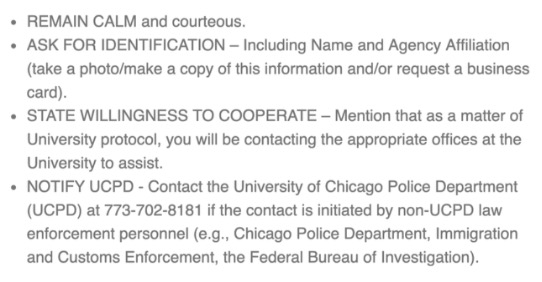
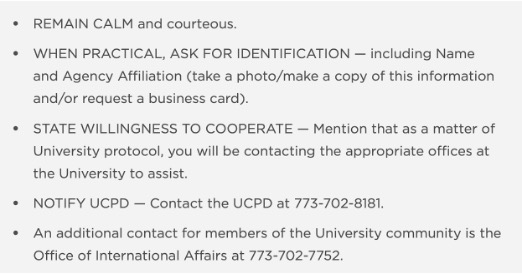
The University’s key guidance on interaction with federal law enforcement officers, including members of ICE or the National Guard, has stayed the same in the November 5 statement. It advises students to remain calm, collect the agent’s identification when practical, state their willingness to cooperate, mention that the University protocol is to contact the appropriate offices, and then contact the University of Chicago Police Department (UCPD), listing the OIA as an additional point of contact.
The original statement did not include the number for the OIA, and specified to only contact the UCPD if the contact is initiated by non-UCPD law enforcement personnel. The update also specifies to only ask for identification “[w]hen practical.”
The FAQ page also contains details on UCPD’s protocol for responding to attempts from outside law enforcement to access “non-public areas of campus.” This protocol is largely limited to checking warrants, preventing escalation, and cooperating “with outside agencies as required by law while protecting the rights and privacy of students, faculty, and staff.”
Non-public areas of campus include residence halls, parking lots, the UChicago Charter and Laboratory Schools, and “locked” campus buildings. The FAQ page does not detail which buildings are locked.
In a statement to the Maroon, a University spokesperson clarified that “‘[n]on-public spaces’ or ‘locked buildings’ generally mean areas that are locked and not accessible to the public. Examples include residence halls, private offices, and certain research labs.”
If agents enter such spaces, the University has directed students to call UCPD.
Outside of these property infringements, UCPD “does not have the legal authority to intervene in another law enforcement agency’s investigations” within its patrol radius, the FAQ page states. In those cases, UCPD officers have been directed to connect students to other University resources, such as the Dean-on-Call Program, which provides referrals, information, and support to students during an emergency.
UCPD is unable to respond to calls off campus and outside of its extended patrol boundaries, which stretch from 64th to 37th Street and between South Cottage Grove Avenue and South DuSable Lake Shore Drive. Off-campus students are advised to contact the dean-on-call through the UChicago Safe mobile app for emergency support. Outside of these resources, the DSS suggests students make use of Student Wellness services and mental health professionals at the University.
Additionally, the November 5 update clarifies that the DSS will not issue campus-wide alerts when a student is detained by federal authorities. Instead, cAlerts will remain reserved for what the University defines as an “active life-safety emergency,” which includes severe weather, major power outages, unexpected closures, and active threats such as armed shooters. Encounters with ICE or other federal agents do not meet that threshold, according to the FAQ page, so students seeking information are advised to consult “various crowdsourced or community news sources.”