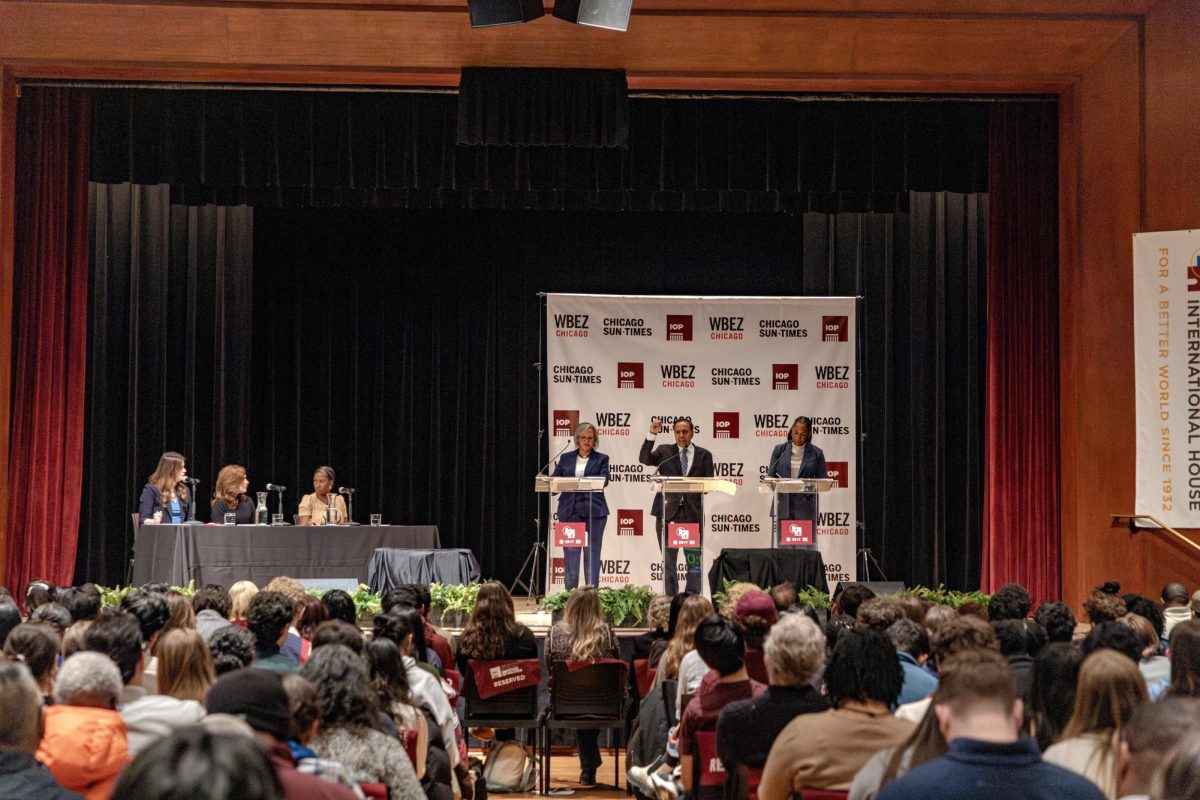
Illinois Lieutenant Governor Juliana Stratton and U.S. Representatives Raja Krishnamoorthi and Robin Kelly took the stage at UChicago’s International House last Monday for an hour-long debate in the race to fill the U.S. Senate seat left vacant by Democratic Senator Dick Durbin, who decided not to seek reelection.
Stratton and Krishnamoorthi clashed over campaign funding practices and strategies for enacting meaningful policy within the Republican-controlled Senate.
The debate, moderated by WBEZ’s Sasha-Ann Simons, the Chicago Sun-Times’s Tina Sfondeles, and Institute of Politics Senior Director Jennifer Steinhauer, addressed the recent protests in Minnesota over Immigration and Customs Enforcement (ICE) activity, the effects of artificial intelligence (AI) on the job market, potential term limits for senators, and federal taxes.
Stratton began the debate by criticizing Krishnamoorthi’s record on ICE, which she characterized as compliant and untrustworthy.
“As [ICE] started to attack the city of Chicago last summer, [Krishnamoorthi] went onto the House floor in Washington, D.C. and voted to thank ICE,” Stratton said. “He’s accepted funding from ICE contractors; that is not the example of somebody who’s going to stand up to Donald Trump and fight for all of our communities.”
Stratton was referring to Krishnamoorthi’s vote in favor of House Resolution 488, which included a section that “expresses gratitude to law enforcement officers, including U.S. Immigration and Customs Enforcement personnel, for protecting the homeland.” Stratton also pointed to a $29,300 contribution by Palantir Chief Technology Officer Shyam Sankar to Krishnamoorthi’s campaign.
“99 percent of that resolution was about condemning antisemitism following an attack on 14 Jews in Boulder, Colorado,” Krishnamoorthi said in response. “As for the donation that I received from a Palantir exec, when it came to my attention, we donated it to Illinois migrant rights groups.”
Stratton also criticized Krishnamoorthi’s effectiveness as a representative.
“To be in Congress for a decade and only get four bills passed and signed into law, whether it’s by a Republican president or a Democrat president, four bills,” Stratton said. “And do you know what those four bills are? To rename post offices.”
“We’re in the lead, and sometimes, people feel the need when they get desperate to go on the attack,” Krishnamoorthi told reporters during a post-debate “spin room.” He currently leads Stratton in primary polls by 21 points.
While much of Stratton and Krishnamoorthi’s time on the debate stage was characterized by attacks and rebuttals, Kelly spoke mainly about her own policy objectives and stayed largely away from the more contentious moments.
“I’m not a show horse, I am a workhorse,” Kelly said. “I’ve passed a number of bills, and my staff laughed at me because I have done so much I can’t even remember to tell you all the things that I’ve done.”
When asked about the state of artificial intelligence and its potential impact on the job market for college students, all three candidates expressed cautiously optimistic perspectives on AI’s potential to improve efficiency and create new opportunities for the middle class.
“I think training, training, training, and putting money behind it, helping our colleges train people, [as well as] our junior colleges and also our high schools, to get our young people into the field faster,” Kelly said, arguing that teaching young people to use AI could provide them with new, high-paying job opportunities.
“AI is only good if it leads to another AI, and that is ‘Amazing Illinois,’” Krishnamoorthi said, adding that AI has the potential to “enhance the effectiveness and productivity of the people of Illinois.”
Krishnamoorthi also acknowledged the importance of maintaining labor standards when introducing AI into manufacturing. “Fourteen unions have now endorsed me because I try to make sure that they are at the table whenever we think about, ‘How do you bring new technology to bear on old processes?’” he said.
The issue of corporate funding for campaigns was also at the forefront of the debate. Stratton has refused to take money from corporate political action committees (PACs), unlike Krishnamoorthi and Kelly. Still, Stratton’s opponents criticized her campaign-funding practices, pointing out that an advertisement she ran was briefly taken off the air for violating campaign finance rules.
“My opponents have taken millions of dollars in corporate PAC money,” Stratton said. “It’s hard to push forward policy that will really benefit the people and not corporations when you’ve accepted millions of dollars from corporations.”
“I take corporate PAC money, but check how I vote. I vote like the people who put me in office want me to vote,” Kelly said in response. “You see who I take corporate PAC money from, unlike the commercial that the lieutenant governor [Stratton] has that is paid for by dark money, and we don’t know who’s behind those commercials.”
According to the Chicago Sun-Times, Stratton has “received $5,000 in corporate PAC money and $46,000 from corporations in her super PAC, the Level Up PAC, a hybrid PAC she created in January in anticipation of a Senate run.”
A hybrid PAC can both contribute limited donations directly to candidates and raise unlimited funds for expenditures related to, but not in direct coordination with, a politician’s campaign.
On January 16, the Illinois Future PAC released an advertisement in support of Stratton’s candidacy. The advertisement, funded by the independent super PAC, was briefly taken off the air because it failed to clearly disclose that it was not officially affiliated with Stratton’s campaign.
In the debate, candidates also emphasized policy objectives aimed at alleviating economic struggles for the working class.
Krishnamoorthi proposed a $25,000 tax credit for first time homebuyers. “I feel that young people especially are having a hard time being able to afford the 20 percent or more down payments necessary for buying a home, and I think buying a home is part of the American dream,” Krishnamoorthi said.
Kelly similarly focused on middle-class economic struggles, suggesting “realistic wage increases.” “I know sometimes when you raise wages, that affects particularly small businesses,” Kelly said. “So, I would like to see realistic wages raised, but also tax credits for small businesses that will raise those wages so that they’re not losing money, and see how we could have a win-win situation.”
Voting for both the Democratic and Republican Senate primary elections will take place on March 17 with polling places open between 6 a.m. and 7 p.m. UChicago students who register to vote with their college addresses are eligible to vote in the primary.