Jesse Ssengonzi was only nine years old when he moved from North Carolina to Uganda. He and his siblings first fell in love with swimming through the local summer league in their hometown of Cary, which led them to pursue year-round swimming. However, living thousands of miles from their home club, it seemed that they might be without their sport for the foreseeable future. But Ssengonzi’s father had other ideas. Every day, he drove them 40 minutes to a hotel pool to coach them himself, a dedicated routine that kept them going.
This consistent structure and discipline stayed with Ssengonzi long after he returned to the United States. His family eventually moved back to North Carolina, allowing him to rejoin the competitive swim scene with a renewed sense of purpose. By the time he was in high school, he had developed into an elite recruit, picking up offers from powerhouse Division I schools like Duke, the University of North Carolina, and North Carolina State.
Choosing a Division III program over such storied athletic powerhouses is almost unheard of for a recruit of Ssengonzi’s caliber, but his priorities were elsewhere. His decision to commit to UChicago was influenced by a mix of parental research and personal identity. “My mom looked up [the] top schools in the U.S., and UChicago was number six that year,” Ssengonzi recalled. “I never heard of UChicago before, but I was drawn by the idea of being close to a big city, coming from North Carolina.”
The move to Hyde Park also aligned better with his emphasis on academics. He would go on to graduate from the College in 2024 with degrees in computer science and economics. As Ssengonzi explained, “I’ve always been a little bit of a floater in that my whole personality is not athletics. I always saw swimming as something that I would eventually stop doing and that academics mattered more.” Ssengonzi was also well aware that Division I schools have the expectation of training year-round while Division III schools don’t. “For me, a big thing was the potential and ability to study abroad or get internships and fully commit my time to the internships.”
Even as his times began to improve, Ssengonzi still didn’t think that his swimming career would extend beyond his senior year at UChicago. “In my head, I always felt like that was what my path was going to be. Swimming doesn’t matter after I finish college,” he explained. “I didn’t even know I was going to represent Uganda at the Olympics.”
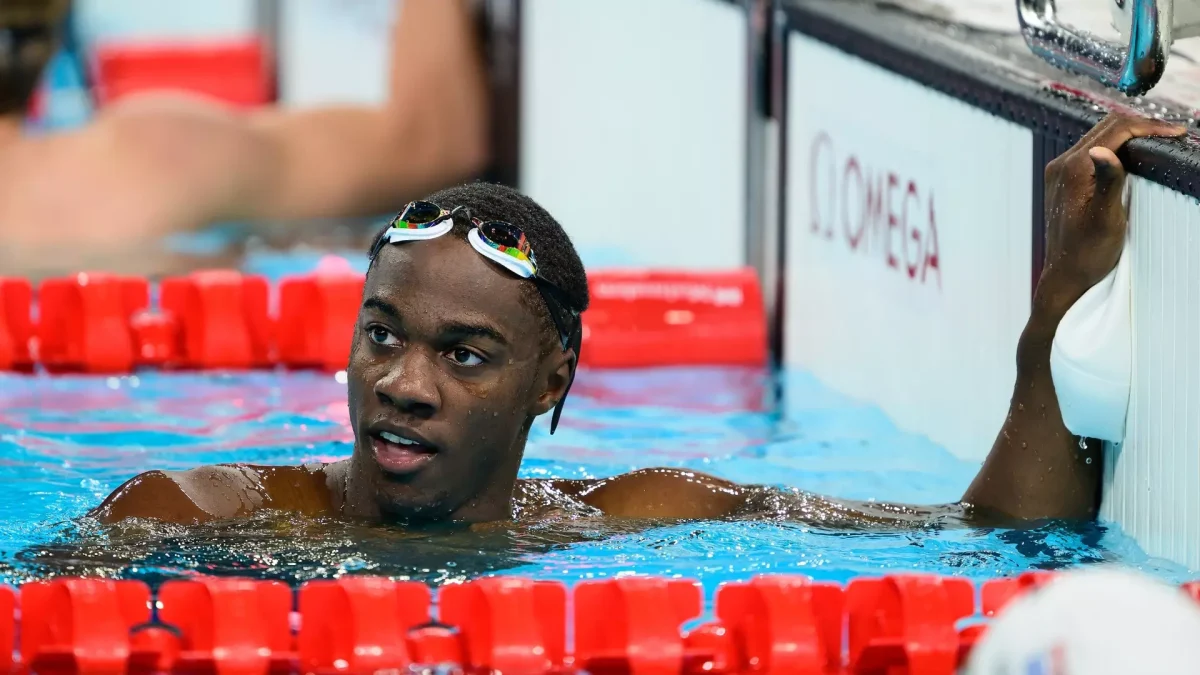
Before calling it quits, however, Ssengonzi decided to pursue one final milestone: swimming at the 2024 Paris Olympics. For three months leading up to Paris, Ssengonzi intensively trained, finally having to adopt the singular, high-pressure “Division I specialist” mindset he had bypassed years prior.
This mindset shift paid off big time when he dived into the blocks in Paris. Competing against the world’s most elite athletes, Ssengonzi clocked a 53.76 second time in the 100-meter butterfly—the fastest time for that event in Ugandan history.
However, despite his Olympic success, Ssengonzi decided to follow the traditional UChicago pipeline into a full-time consulting role.
While he had spent four years preparing exactly for this transition, joining multiple business clubs and preprofessional programs, the reality of the corporate world lacked the intensity of high-level competition. Within six months, he realized that the professional track he had prioritized over swimming was beginning to take a toll on his well-being.
“I went, I worked, and the main reason why I quit work was I felt like everything that I cared about was atrophying,” Ssengonzi admitted. “Mentally, physically, socially—all the things I really cared about. I was doing it for a job I didn’t really care about that much.”
When he quit his job, Ssengonzi gave himself the chance to reshape his life around the pillars of “body, mind, and soul.” He found that nothing anchored those pillars quite like swimming did.
Now on a gap year, Ssengonzi operates on his own schedule, taking a cerebral approach to the sport by self-training and coaching himself through video and technique analysis. He no longer sees swimming as something with an expiration date, but something he thinks “will always be part of [his] life even if it’s just at a fan capacity.”
As for what comes after the pool, Ssengonzi is keeping his options open.
Whether he continues to swim or pivots to an entirely different field remains to be seen. For now, he’s thinking in 4-year chunks, setting his sights on the Los Angeles Olympics in 2028 where his fellow Maroons will be cheering him on.