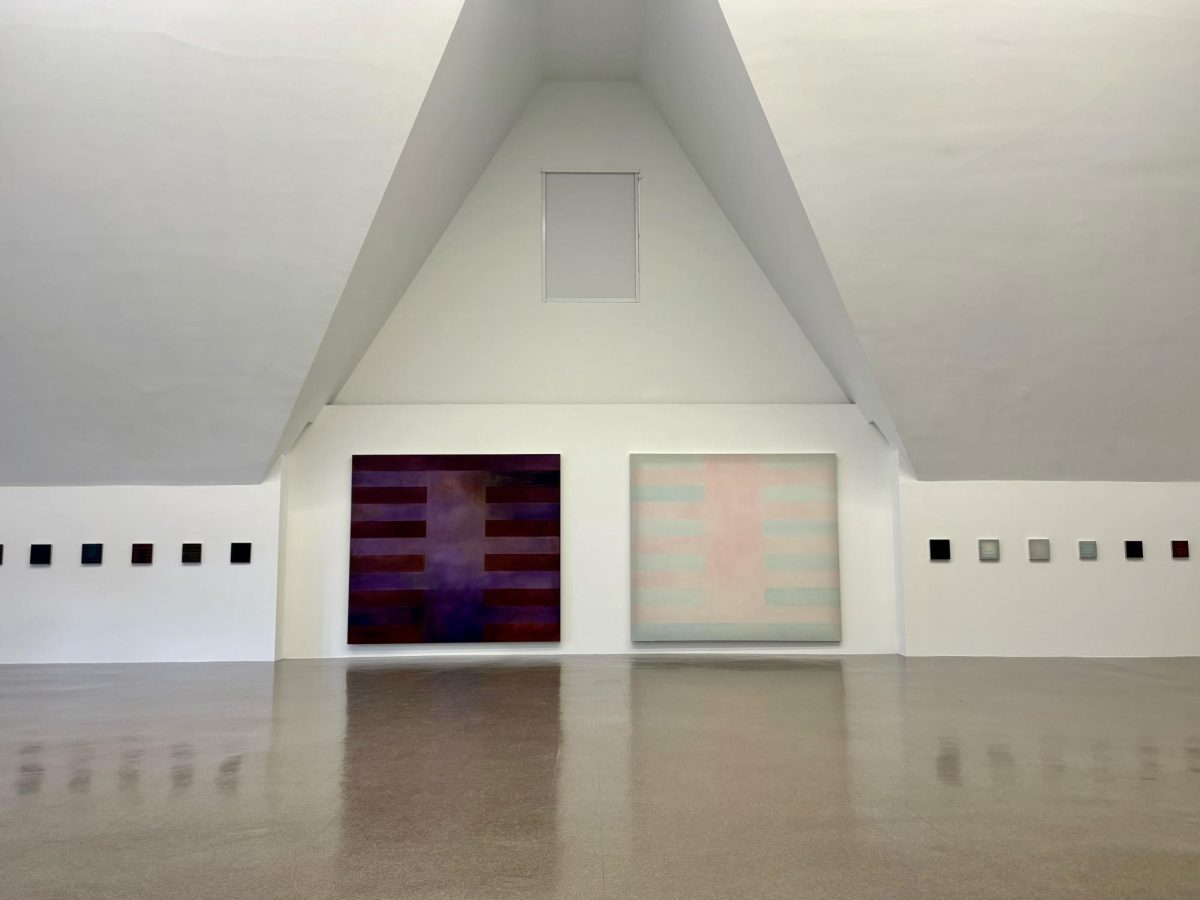
Change is the only constant. Rendered in color, this mantra becomes a live exhibit of 64 hexagram paintings placed around the circumference of a jarringly empty room. Though the paintings vary in size and color, their consistent hexagram design creates the impression that they constitute different ways of looking at the same idea. This exhibit belongs to UChicago’s Renaissance Society, a contemporary art museum located on the fourth floor of Cobb Lecture Hall.
Leah Ke Yi Zheng’s Change, I Ching (64 Paintings) is based on I Ching, an ancient Chinese divination text loosely translated as “Book of Changes.” The I Ching dates to the Zhou dynasty and presents the future of the universe as a series of fluctuations between yin and yang. In practice, the text offers guidance on the timing and unfolding of potential outcomes. One divination method involves tossing three coins six times, where the result of each toss corresponds to one line in a hexagram. The ensuing hexagram corresponds to one of 64 in the book, which reveals a unique prediction.
All 64 hexagrams in the exhibit come directly from I Ching, and all share the same basic structure: six horizontal lines spanning a square canvas, some filled and others broken down the middle. Upon entering the room, the viewer is confronted with two seven-foot hexagrams on the opposite wall. One is painted in dusky shades of purple and the other in pastels, displaying patterns that are nearly identical but not quite: the purple hexagram has a filled line at the top and a broken line at the bottom, an orientation that the pastel one flips. A cursory glance raises the assumption that these images encapsulate the duality of the human experience—light and darkness, yin and yang.
Yet, turning around reveals the remaining 62 multi-colored hexagrams spaced evenly along the faces of the room, calling attention to the fact that change itself is varied. The multiplicity of material enhances this idea: Zheng’s silk canvases are painted with either oil or acrylic paints, stretched across cherry or mahogany wood. While oil paint produces a deeper, more traditional chromatic experience, acrylic paint creates vivid colors characteristic of modern art. Zheng’s choice of material metaphorically bridges the gap between her devotion to ancient philosophy and her identity as a contemporary artist.
Of her pieces, my favorites were the three that decorate three of the four windows on the left wall of the room. The fourth is left empty, leaving an unobstructed view of real life unfolding across the street: bare trees shivering under the snow and people swarming in and out of the Franklin McLean Memorial Research Institute. Perhaps this aesthetic choice invites the viewer to consider change in action before turning back to the fixed exhibit.
An interesting effect is created when light enters the windows, which causes the exhibit itself to change in color and opacity: darker colors—like the dark purple captured in the image above—appear glossier, while lighter colors appear brighter and almost translucent. The interactions between light and color play into the study of change, as the eye’s perception of color is inextricably dependent on the presence of light. I watched in real time as the paintings changed from matte to glossy, evoking a sense of wonder at the transitory nature of perception.
Like the title of her work suggests, Zheng intended the exhibit to be perceived as a whole rather than the mere sum of its parts. The geometry of the room serves this concept well, as the tapered, triangular ceiling and the strategically incorporated windows lend nuance to an otherwise two-dimensional exhibit. Walking around, I was struck by how much the space seemed tailored to Zheng’s pieces, with corner windows jutting out to shine light on canvases hanging right in front.
After taking one last look at the exhibit, I still harbored questions about the room itself. The gallery attendant—Tatiana Sky, a master’s student in the University’s Department of Visual Arts—happily fielded them, revealing that Zheng had, in fact, requested alterations to the Cobb room: the wall with the two largest canvases had been elongated by one foot, and certain windows had been covered so that only one wall allowed external light inside. In other words, Zheng had transformed the room into an active participant in her art.
Change, I Ching (64 Paintings) is on view at the Renaissance Society through April 12.