The Public Safety Advisory Council (PSAC) held a public webinar on February 5 addressing recent public safety developments on and around campus, including a drop in robberies and new crosswalks to improve pedestrian safety.
The University of Chicago Police Department (UCPD) has not yet observed Immigration and Customs Enforcement (ICE) activity on campus, Chief of Police Kyle Bowman said at the meeting. “We haven’t had any of our officers come across any… ICE agents.”
The Maroon has tracked seven ICE in Hyde Park since October 2025.
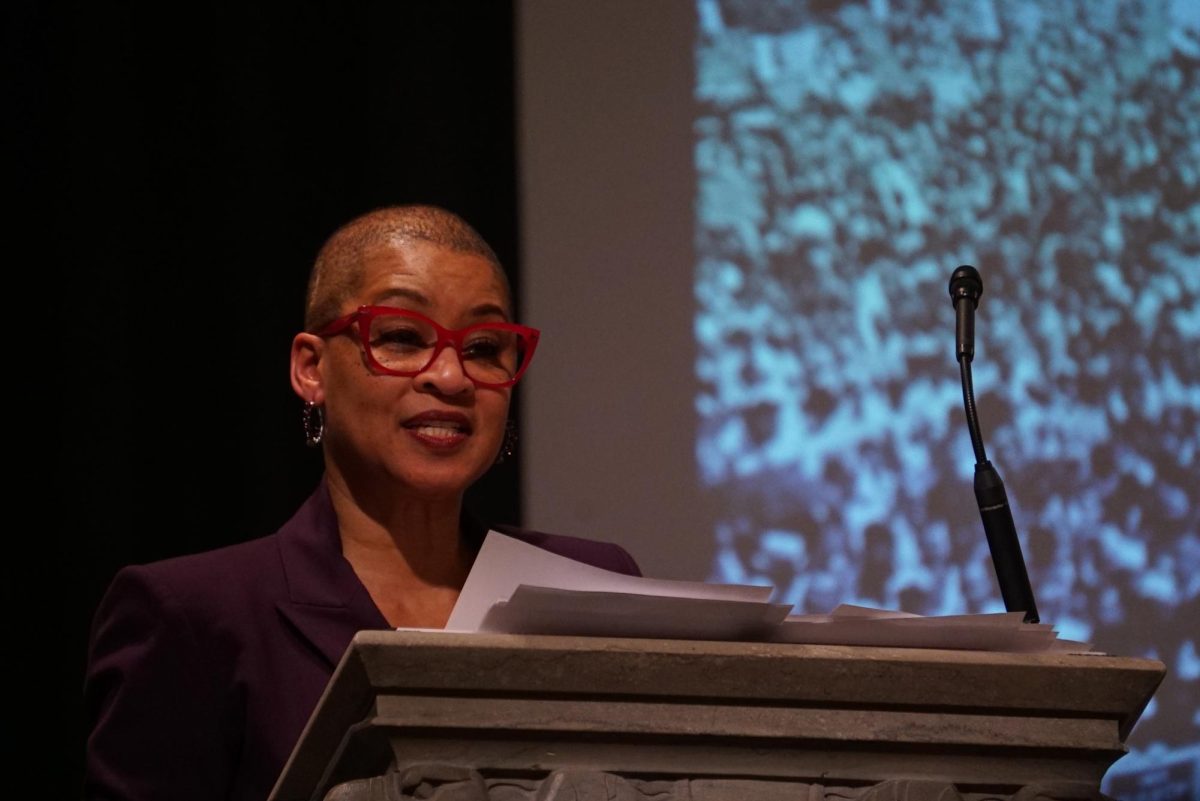
Facilitated by PSAC Chair Sharon Fairley, the council heard presentations from Bowman, Assistant Vice President for Campus Safety Michael Kwiatkowski, and Associate Director for Campus Environment Katie Martin Peck.
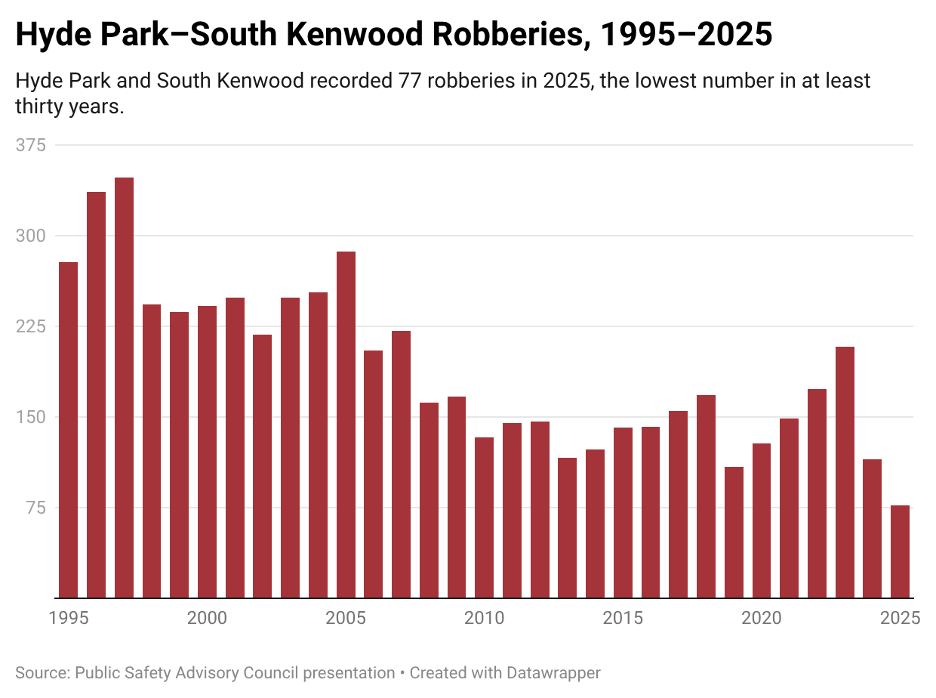
Bowman announced that there were 77 robberies recorded in Hyde Park and South Kenwood in 2025, a 33 percentage point decrease from 2024, marking the first time in at least 30 years the total number of robberies has been below 100. The area, one of three community areas served by UCPD, spans from 47th to 61st Street and Cottage Grove Avenue to Lake Michigan Avenue.
Yet Bowman is wary of viewing the sudden decrease without regard for the larger historical context.
“There’s definitely a pattern. As we bring numbers down over the years, numbers tend to turn back up,” Bowman said. Counts from the past decade are indicative of this trend. Area robberies fell to 109 in 2019 before steadily increasing to a post-pandemic peak of 208 in 2023.
Neighborhoods patrolled by UCPD, including Hyde Park, Kenwood, Oakland, and Woodlawn all saw violent crime drop by more than 20 percent last year.
Bowman credited some of the recent successes to internal changes at UCPD. “We really have taken a look at how we approach things, also with our patrol tactics, in terms of specifically where we’re assigning our patrol cars, in conjunction with the [University] Safety Ambassador Program,” he said. “A lot of the measures we put into place the past two years have contributed to success.”
Bowman also attributed the downturn to a citywide decrease in violent crime. According to him, Chicago a 36 percent decrease in robberies and a 21 percent drop in violent crime in 2025, compared to 41 percent and 25 percent drops, respectively, in UCPD areas.
The University’s Safety Ambassador Program, which posts ambassadors throughout campus and surrounding neighborhoods in high-visibility uniforms, implemented new accountability measures in 2025. “[Lytx], a driver tracking system that tracks the officer’s safe driving habits and logs unsafe driving, distracted driving, and overall driving habits, [sends] an alert if an officer [is] distracted driving or on the phone while driving. That’s immediately sent to the management team, and they take immediate action to remediate those practices,” Kwiatkowski said at the meeting.
The fleet of Safety Ambassador vehicles, which features large, neon-green light bars, is also due for refurbishment by the end of February. “Our vendor recently moved to a new equipment supplier, and the new light bars that they have been installing are brighter than the legacy light bars that were installed on our previous fleet of vehicles,” Kwiatkowski said. “We’ve identified the vehicles that have the light bars that are operating at a higher intensity, and we’re hoping to have that replacement completed by the end of February.”
Peck also discussed recent pedestrian safety changes on campus. Following a Facilities Services study that identified areas to prioritize for safer pedestrian movement, Facilities focused on the western crossing connecting Woodlawn Residential Commons to Midway Plaisance. The study accounted for both pedestrian activity and the number of reported incidents at different intersections; the Midway experienced the most vehicle collisions on campus in 2024.
“At University and 60th, we had many pedestrians crossing at a diagonal at an area that was not explicitly marked as a crosswalk, and so that quickly rose to the top as one of our priority intersections to do additional enhancements at,” Peck said.
In 2025, a concrete bump-out was installed to reduce pedestrian travel distance at the intersection. Now, the addition of a second formalized crosswalk and pedestrian crossing signage has standardized the crossing. The intersection of South University Avenue and East 55th Street was also enhanced similarly, with flashing pedestrian lights installed where South Greenwood Avenue and South University Avenue meet East 55th Street. These lights, called rapid flashing beacons, were also added to many Midway crossings.
“What we came up with was an idea of improving the baseline level of safety for pedestrians throughout the entire zone, so making sure that we touched all of the crosswalks in that area and brought them up to a higher baseline level,” Peck said. “That was where we got into things like flexible bollard bump-outs, painted areas, and concrete curve bump-outs, along with some other strategies.”