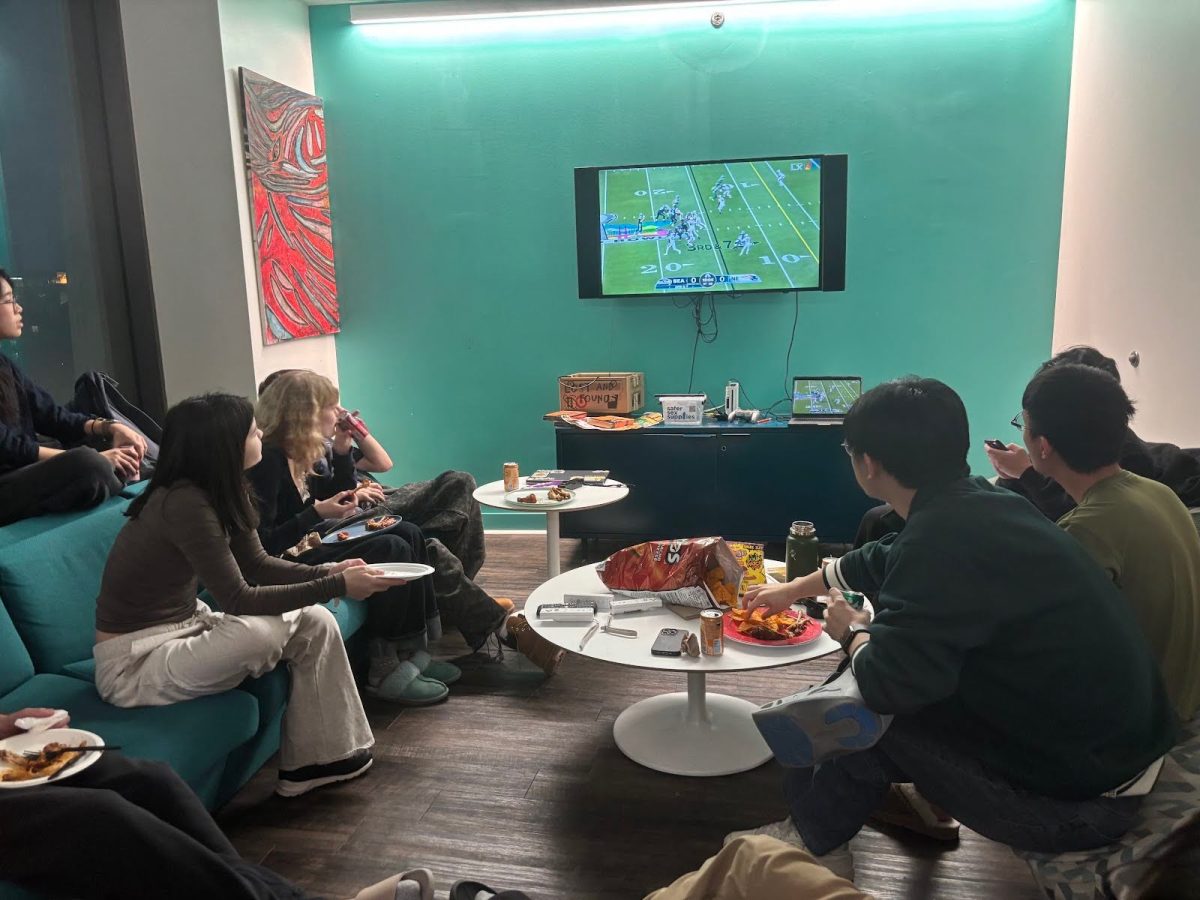
11 years is a long time to hold a grudge, but at an institution that still argues about the Peloponnesian War, the 2015 “interception at the one-yard line” is practically a current event. Watching the Seahawks secure their 29–13 Super Bowl win on February 8 felt less like a sporting event and more like a collective exorcism performed in a dorm lounge. There was something deeply satisfying about Drake “Drake Maye” Maye failing to perform Tom Brady–level clutchness in real-time—at least according to the strong Seahawks contingent within Campus North Residential Commons.
While Chicago-favorite Caleb Williams was unfortunately missing from the big match, tensions were still running high between the desire for a Seahawks revenge and a Patriots dynasty resurrection. Surprisingly, that tension didn’t turn into a seminar about the ethics of labor unions in professional sports but instead into something much simpler: a room full of people locked in on an average-sized wall-mounted TV.
By the middle of the first quarter, the wings had been devoured, the couches had been firmly claimed, and the casual Super Bowl observers started to filter in. In a regular watch party, there are only three categories of a Super Bowl audience: the die-hard fans, the casual fans, and those who have no idea what’s going on. At UChicago, there is a fourth category: the international student.
American football is aggressively American. The Super Bowl is the biggest demonstration of the red, white and blue in pop culture. So, to an international student, where the word “football” usually conjures images of Lionel Messi or Cristiano Ronaldo, the Super Bowl can seem like a fever dream. Campus North was no different.
Confident assertions of “That’s the Philadelphia Patriots” and “That’s a penalty kick, right?” circulated in conversations among students while die-hard fans explained the rules as best as they could. Yet it was difficult to explain a touchdown to an international student when both teams refused to score anything but a field goal during the first three quarters.
Unsurprisingly, the common room reached capacity when the first half ended, and the words “halftime” and “Bad Bunny” echoed through the halls. Room volume reached an all-time low as the first image of Bad Bunny in a field of human sugarcane stalks appeared onscreen. The current political climate and the discourse surrounding the Puerto Rican artist’s halftime show spurred a very UChicago discussion on the symbolism of each shot, though this conversation soon died out when the actual football reappeared onscreen. The dorm’s anti-football ensemble retreated back to their dorms to finish their sosc essays due in five hours.
Prior to the first touchdown scored by Seattle’s tight end AJ Barner, the few Patriots fans in the dorm clung to the same hope that had defined the Patriots’ 2010s dynasty run; their belief in rising star Drake Maye kept them from the brink of desperation. That is, until Maye made NFL history by becoming the most-sacked quarterback in a single playoff run, with a sixth sack coming in the fourth quarter by Seattle’s iron-wall defensive line.
For non-football fans, which comprised most of the dorm’s population, this Super Bowl wasn’t the best representation of what the Super Bowl can be. 2017’s Super Bowl with the iconic Brady comeback and 2009’s Santonio Holmes’ game-winning touchdown come to mind as memorable 21st century Super Bowls. Statistically, this Super Bowl may be remembered as a more boring one, along the lines of the 53rd Super Bowl’s legacy as the lowest-scoring Super Bowl of all time. Had the Seahawks not scored the game’s first touchdown at the start of the fourth quarter, halting their reliance on kicker Jason Myers’ right leg, this Super Bowl could have been the first to end without any touchdowns.
For most students watching, the real questions came with the advertisements. Nostalgia kept memories of past Super Bowls with Budweiser’s Clydesdales and a Pepsi campaign in mind. However, the onslaught of advertisements for generative AI and sports betting was what viewers were presented with. In a community like UChicago, this began a lengthy discussion on the ethics of generative AI and advertising for gambling, lasting until an image of a bald eagle extending its wings from behind a Clydesdale entered the screen. Amidst this conversation, the awkwardness of AI-generated young Ben Affleck and other celebrities in Dunkin’s ad was momentarily forgiven by students.
But like any Super Bowl, there were fans gained, fans angered, and fans relieved. For Seattle natives in the dorm, this Super Bowl victory was a breath of fresh air during the trenches of midterm season. For New England fans, this loss was just another item to add to the long list of disappointments and stresses the UChicago quarter system can bring. Though the most disappointed man in the country might have been Drake Maye after that underwhelming performance.
Despite what public perception may imply, a Super Bowl viewing at UChicago is no different than most watch parties across the country. While there may be less fans around, the passion is still high, the wings are still delicious, and the “How is a 60-minute game four hours long?” comments still persist.