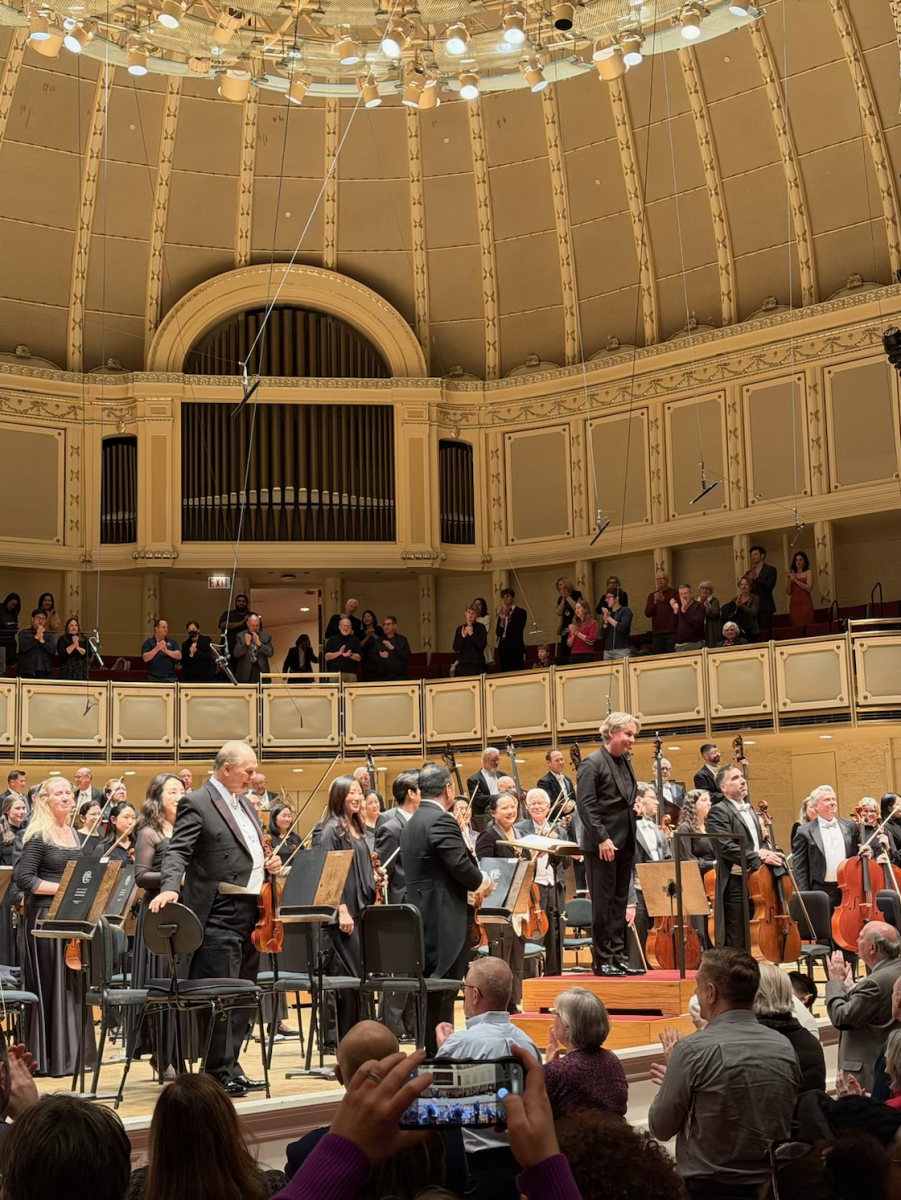
In their first concert back home after a West Coast tour with Music Director Emeritus Riccardo Muti, the Chicago Symphony Orchestra (CSO) got right back to business with an intense and demanding program led by guest conductor Esa-Pekka Salonen and pianist Daniil Trifonov.
Salonen, in the first of two consecutive weeks performing with the CSO, made a rare foray into the work of Anton Bruckner with his Symphony No. 4, aptly titled “Romantic” by the composer. Trifonov, though famous for his interpretations of weightier repertoire like the concertos of Johannes Brahms and Sergei Rachmaninoff, performed a less flashy but equally rich piece: Ludwig van Beethoven’s Piano Concerto No. 2.
The link between these pieces is both historical and thematic. Like nearly all composers in the Romantic Era, Bruckner was very much inspired and influenced by Beethoven. For one, Bruckner composed nine symphonies, leaving his ninth unfinished before his death—making him one of the many victims of the “Curse of the Ninth,” which followed many great symphonists after Beethoven, including Franz Schubert, Antonín Dvořák, and later Gustav Mahler. Six of Bruckner’s nine symphonies, including the Fourth, open with soft rumbles in the strings before crescendoing into powerful main themes, creating a mysterious atmosphere—a clear nod to Beethoven’s Ninth.
These two selections depict the composers in the early phases of their careers, still finding themselves and discovering their unique sounds. Despite its title, Beethoven’s second piano concerto was actually the earliest of his many iconic works in the genre to be composed, and merely the second to be published. He began composing it as a teenager before struggling with it for several years afterward, an early indicator of his perfectionism. Though the piece is classical in style and form, with a lightness and elegance characteristic of Wolfgang Amadeus Mozart, it offers glimpses of the Beethoven to come: sudden flashes of drama, radical modulations, and abundant dynamic contrast. It is Beethoven as he is *becoming* Beethoven, eager to distinguish himself from his predecessors but still figuring out how.
Across the three movements, Trifonov masterfully balanced the soft touch necessary for a classical concerto with drama and emotional depth. In the first movement, he notably included the lengthy and technically demanding cadenza, which Beethoven added eight years after its premiere in 1801, showcasing the pianist’s skill and virtuosity. In the Adagio, his more sensitive side came through, bringing out Beethoven’s subtle lines with beautiful color and expressivity. The final movement burst with excitement and passion. Salonen led the orchestra with poise and control, supporting rather than overpowering Trifonov while injecting energy where necessary.
After a well-deserved ovation, Trifonov encored with Osvaldo Golijov’s rhythmic *Levante*, once again displaying his pristine technique.
Following the intermission, the audience was greeted by an orchestra that had nearly doubled in size. Extra strings filled the stage, woodwinds expanded, and the brass section grew threefold. These added forces may seem excessive to the first-time listener, but they are necessary to the vast sonic landscape of Bruckner’s works, which have led them to be nicknamed ‘cathedrals of sound.’ The CSO is one of only a few orchestras outside of Germany and Austria that can do justice to this music. Thanks to its long history of music directors, including Fritz Reiner, Sir Georg Solti, and Daniel Barenboim, each of whom championed Bruckner’s music and shaped the orchestra’s identity, an affinity for the Austro-Germanic repertoire is built into the CSO’s sound. The heart of that sound, of course, is its unmistakable brass section, which possesses all the depth and weight required to perform Bruckner’s symphonies at a high level.
Like Beethoven, Bruckner was notoriously self-critical. The Fourth Symphony, like nearly all his works, underwent years of revisions before satisfying the composer and, consequently, comes in several different versions.
As men, however, the two composers could not have been more different. Beethoven was passionate, short-tempered, and confrontational; Bruckner was a shy, paranoid, and deeply religious man who spent much of his life obsessed with death. Despite each of their struggles, their music shares the same sense of hope and optimism—the same desire to break free and see beyond.
Though Bruckner was a far later bloomer than Beethoven, not writing any significant symphonic works until he was 40 years old, the Fourth still shows the composer in the process of discovering his voice. Its vast scale and bold climaxes suggest confidence and grandeur, but beneath it all lie reticence and contemplation.
As personal and introspective as Bruckner’s music may be, it might as well speak for all of humanity. Each repetition of a phrase—even those which may seem dull or long-winded on first listen—is like a burning question, insisting upon the same unresolved tension. It represents the universal feeling of having a nagging thought, a fear or stress that you cannot escape. His symphonies may be long, but if you find the patience and focus necessary to enjoy them, the reward is cathartic, cleansing you of your anxieties and purging you of any existential concerns. While Bruckner offers ample room for interpretation and creative freedom, a good performance of his work must stay true to this spiritual character.
Salonen and the CSO rose to the occasion. The first movement was the best of the four. Salonen’s direction was controlled, opening softly and building up steadily before unleashing Bruckner’s fiery climaxes with full force. The opening horn solo was mystical and atmospheric, with expertly played slurs on the ascending octaves. After an intense crescendo, the main brass theme struck like thunder, and I couldn’t help but jump in my seat every time it returned.
While brass fortissimos and piercing climaxes may be enough for a satisfying opening, the second movement demands a completely different tone. It requires patience and restraint so that Bruckner’s long and lyrical musical arcs can adequately come through. Although the CSO’s sound was warm and smooth, especially in the strings, Salonen’s tempo was slightly faster than a traditional Bruckner Andante, which made it hard for the music to fully sink in.
The third movement, filled with reiterations of the same central theme, is difficult to pace, but Salonen and the CSO sustained a solid momentum throughout. At no point did it seem to drag or wane; rather, it maintained the perfect amount of energy and rhythmic drive necessary to keep the audience on the edges of their seats.
Though balancing the forces of such a huge orchestra demands a high degree of precision and management, sometimes a conductor must allow the music to breathe—in other words, to let the musicians play freely without micromanaging every note (a Bruckner performance that misses this often winds up being very boring). In the fourth movement, Salonen and the CSO achieved the perfect balance, resulting in a performance that felt deeply rather than mechanical.
The final minutes of the fourth movement make up one of the most famous finales in classical music. After a short pause that gave the performers (and the audience) a moment to catch their breaths, it began with a familiar soft, shimmering tremor in the strings and a variation of the opening melody of the first movement. Salonen paced the ensuing crescendo carefully, continuously glancing at musicians across the orchestra to indicate dynamics and phrasing. When the brass entered at full volume, the sound was not merely loud, but also clear and unified—forceful without excess. In this finale, Bruckner does not attempt to resolve every tension or to answer every question; instead, he offers us a path forward, a way to find our place in a world with endless problems and uncertainties. Where lesser composers might opt for manufactured profundity and feigned triumph, Bruckner suggests that by looking inward, we can find strength and acceptance.
With yet another triumphant performance, the CSO proved itself to be one of the best orchestras in the world, uniquely capable of tackling the most challenging music in the classical canon.