What do we refer to, really, when we speak of the horizon? A fixed boundary where the earth meets the sky? Horizon Lines: Reimagining Potentiality challenges a stable definition. Artworks placed throughout the first and second floors of the Cochrane-Woods Art Center distort, multiply, and eliminate the notion of the horizon, provoking the conclusion that the term is wholly abstract, mutable, and emotionally charged.
Curated by Anju Lukose-Scott, a fourth-year in the College, the exhibition destabilizes expectations. This premise is exemplified by Lukose-Scott’s own work, Untitled. A gelatin silver print both acknowledges the horizon as a familiar mental image—an unwavering line where the sea appears to end—and hints that this image is changeable, with a fluid fingerprint standing against the scene.
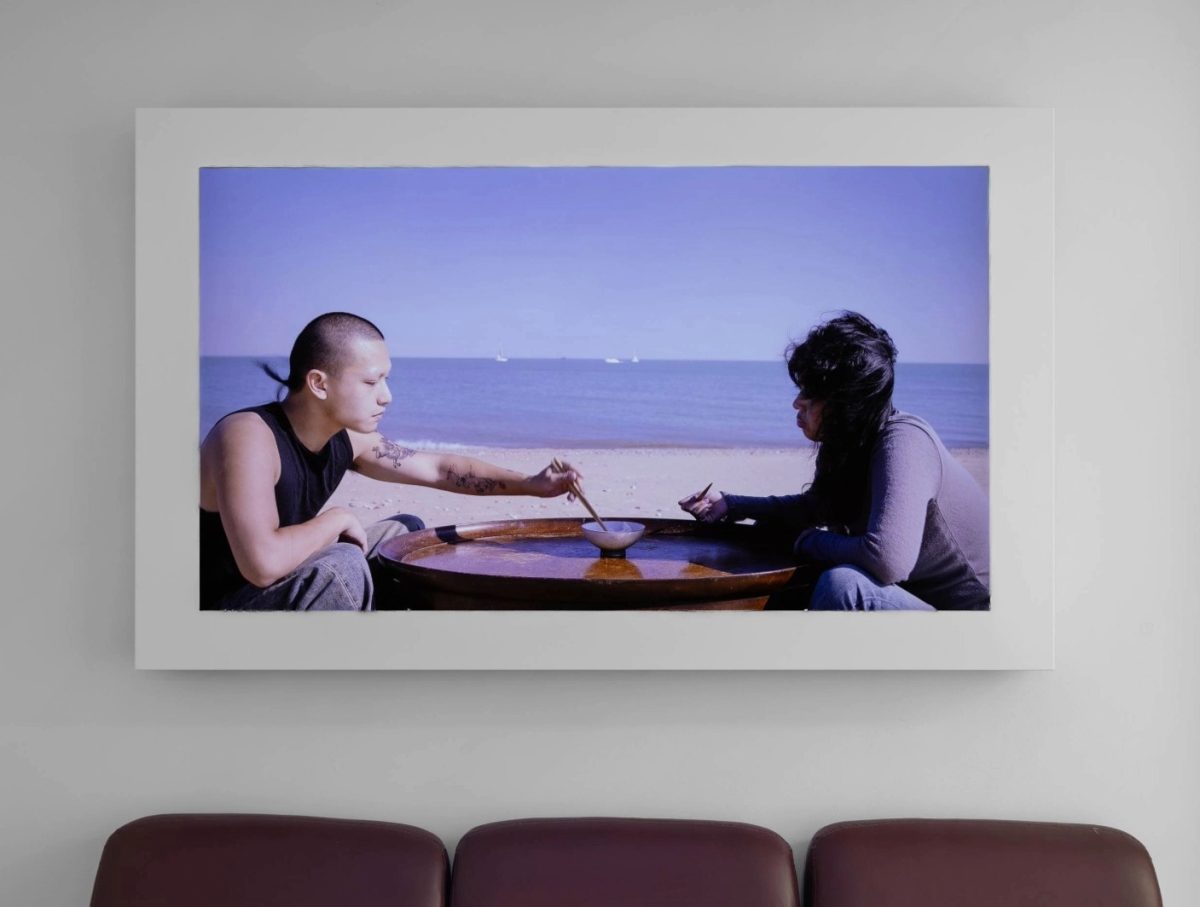
Moving through the exhibition reveals the horizon as a backdrop to human narratives. Fred Miller’s photographs of Apsáalooke Tribe members ensnare a moment of apparent stability, where the grassland’s certain boundary fails to disclose the epidemics and territorial loss to come. Here, the horizon cannot be trusted. On the second floor, you will encounter Magicfeifei’s rice is a beautiful thing, but rice and rice are two different things. Over the course of four hours, Magicfeifei and her friend Isaac Duan consume a bowl of rice on the shore of Lake Michigan, grain by grain. The stability of the waves behind the two figures mediates the absurdity of the action and the discomfort of its duration, lending an atmosphere of certain calmness. Immovable and comforting against the flux of human change, the horizon quietly elicits gratitude for its presence.
And yet, selected works demonstrate that the horizon can function as an actively disruptive presence, too. Walking up the staircase, you’ll encounter Joel Snyder’s richly hued cyanotype Detroit Publishing Company. Deep blue mountain peaks loom over a solitary traveler, poised to observe his surroundings at the center of the print. Here, the horizon is traced by jagged rock, becoming a material barrier that evokes a sense of hopelessness. Zarouhie Abdalian’s Gaza, Earth illustrates the Earth rising over the lunar horizon, a swirling sphere eerily breaking into an otherwise empty white expanse. Reworking the Cold War image of Earthrise, the work situates the horizon as a site where cosmic imagery narrates the geopolitical realities of the Middle East as a proxy battleground. Gauze embossing on the paper reference bandages of war, instilling persistent unease, while theories that the word ‘gauze’ originating from the city of Gaza more explicitly anchor the work to the region’s conflict. With this scope, the horizon becomes layered and sinister.
What if the horizon were not distant at all, but something tangible? Nazafarin Lotfi’s No Horizon (#4) evokes topography through its crevices and peaks of papier-mâché, squashing the horizon somewhere between intersecting ridges. Lukose-Scott’s …nowhere at all references critic and Black Feminist scholar Hortense Spillers’s 1987 essay “Mama’s Baby, Papa’s Maybe.” Spillers writes that, in the context of the transatlantic slave trade, the ocean is a charged abyss that signifies the removal of human identity. In Lukose-Scott’s piece, viewers are invited to turn on a projector and cycle through fingerprints chemically stained onto negatives of Lake Michigan. Each click offers a different blurred or shaky view of the water, echoing the tumult of Spillers’s essay. Two twisting negatives are also shown, echoing waves in material form. The tactile rendering of the aquatic horizon intensifies the work’s emotional impact.
Before or after other interpretations of the horizon, you may wander into the building’s first-floor lounge. In it, three viewfinders from Anika Steppe’s A New Horizon series face out toward the window. The illuminated color slides draw on three photographs from the exhibition, tying the space back to the larger narrative. Glancing through the lens projects these photographs onto the courtyard outside, introducing foreign horizons into a familiar setting. This work alludes to a key takeaway from the exhibition: given the subjective understanding of the horizon through the eyes of each artist, it no longer feels distant, but rather intimately tied to our lived experience.