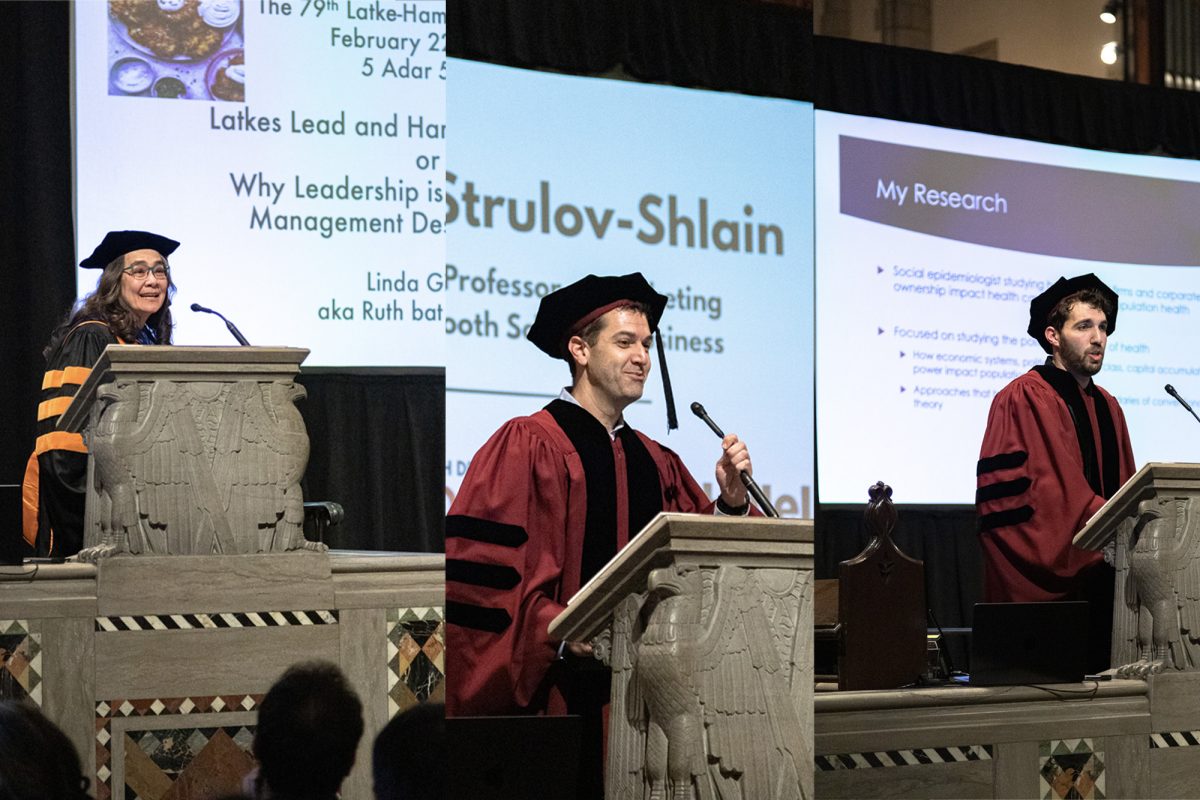
Three professors took to the stage in Rockefeller Chapel to settle the age-old debate of which Jewish delicacy is superior at UChicago Hillel’s 79th annual Latke-Hamantash Debate on Sunday.
The event previously featured Milton Friedman, Martha Nussbaum, and Leo Strauss, each relying on their expertise in their respective disciplines to make the case for their favored food.
This year’s debate was organized around the concept of “Snackonomics” and featured Linda Ginzel, a clinical professor of managerial psychology at the Booth School of Business extolling the merits of both foods; Avner Strulov-Shlain, an assistant professor of marketing arguing in favor of the latke, a fried potato pancake; and Joseph Dov Bruch, an assistant professor of public health sciences defending the hamantash, a triangular cookie with a fruit-based filling.
Rabbi Daniel Kirzane of Hyde Park synagogue KAM Isaiah Israel, who earned his MA in Religious Studies from the University of Chicago Divinity School, delivered opening remarks. Kirzane quipped that he discovered an ancient tablet in the Institute for the Study of Ancient Cultures, proving the debate between latkes and hamantashen dates back thousands of years.
Ginzel, whose research and teaching focuses on leadership and management, made the case for the positive qualities of each food. She compared latkes to leaders, visionaries who can transform and motivate others (in this case, the classic toppings of applesauce and sour cream). “The latke says: ‘We’ve been through enough, let’s fry something,’” she said. “A latke inspires. A latke says, ‘Follow me into the kitchen.’ A latke says, ‘Sit, eat, everything will be okay without applesauce.’ That is leadership.”
By contrast, hamantashen, she said, are “managers” who provide the structure necessary to keep an organization running smoothly. “Leaders burn bright, management burns steadily,” she said. However, both are necessary to success, because “without both, there is only salad.”
Ginzel then used gematria, a system in which letters in the Hebrew alphabet are assigned to numbers, to prove the difference between latkes and hamantashen was the number six, which in Hebrew means “and.” In other words, everybody has been asking the wrong question: “It is not ‘either or,’ it is ‘and.’” Ginzel then pronounced the debate over.
Strulov-Shlain drew on the principles of behavioral economics, his own research focus, to make the case for the latke as the superior food.
He used inattention, choice architecture, and prospect theory to demonstrate that the consumer ultimately preferred the latke through their economic habits, as proven by made-up data.
He argued, for example, that the structure of the hamantash meant consumers did not fully understand the product they were eating. Just as someone might register to stay at a hotel at one price only to later find out that they have numerous fees to pay, he said, so too might an unsuspecting snacker find that a hamantash contains poppy seeds rather than chocolate.
However, the latke is “an example of radical transparency, right? It’s a potato! It was always a potato; it will always be a potato. In the struggle against inattention, exploitation, the latke clearly wins.”
He also examined how hamantashen represent an uncertain choice for consumers where they do not know the corner where they should begin eating the cookie and used the Kahneman-Tversky function to show that data demonstrates consumers’ preferences for latkes over hamantashen.
Strulov-Shlain ended his presentation by contrasting the two foods. “The latke is not merely a potato pancake; it is a behavioral economic phenomenon, an object of profound cultural attachment. It activates powerful psychological mechanisms of value and loss, while the hamantash is a dry cookie shaped like a hat.”
As the last speaker, Dov Bruch, a social epidemiologist studying the political economy of health, sought to contrast the supply chain of hamantash and latke production.
He first noted that just as hospitals have been taken over by private equity firms, resulting in higher costs and mixed impacts on quality, a rising number of latke mixes have also been bought out by private equity. While he acknowledged that this was not applicable for people who made their latkes at home, a far more insidious process was afoot in the potato economy.
“While your bubby has been making latkes for decades, a big potato industrial complex has grown, taking over the entire latke industry,” he said. “And this latke supply chain, highly concentrated, industrialized, and financialized, includes seed monopolizers, big oil overlords, petit potato bourgeois, and households alienated from their labor, replaced by speculative latke mixes.”
He explained that, when adjusted for inflation, potato prices have increased rapidly since 2000. By contrast, he noted that the price of flour, used to make hamantashen, has remained mostly the same.
In closing, he declared that, compared to the monopolistic practices of the latke political economy, “the hamantashen is a countermovement, certainly counter to what you’ve heard before. It offers a decentralized resistance pastry that represents communal giving, equity, shared blessing, and ultimately, purity. It is the anti-monopolistic baked good.”
After the event, guests were invited to the Hillel House for a reception where they could sample the two foods for themselves, in the spirit of UChicago academic inquiry.