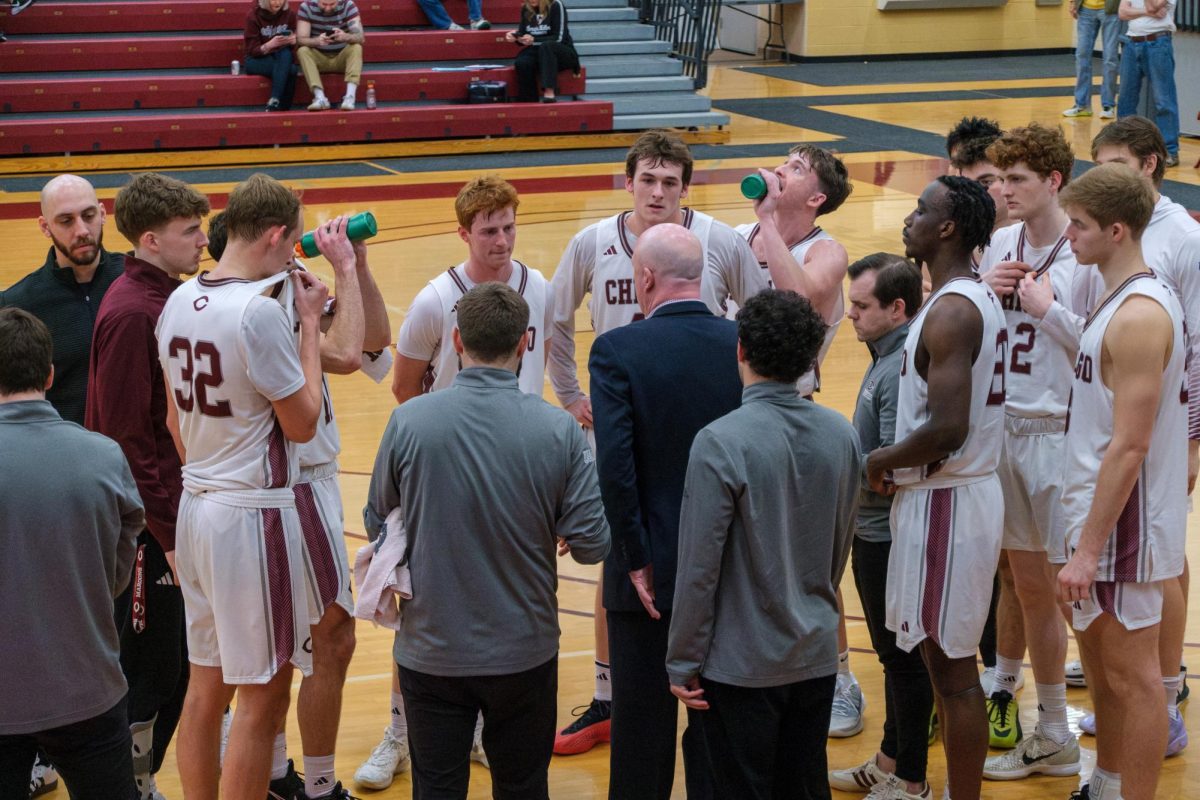
When one thinks of UChicago, sporting excellence rarely comes to mind. However, through humility, hard work, and athletic brilliance, UChicago men’s basketball is actively defying this reductive stereotype.
The team’s record, at the time of writing, is 21–3 (11–2 in UAA conference play), with highlights including a dominant 30-point win against #22 Trinity (Texas), a commanding 23-point victory against conference-rivals #8 WashU, and a thrilling 10-point comeback win against current #1 Emory at home. After the Emory win, the team was briefly the #1 team in the nation (they are currently #2), marking the second time this feat has been attained in the program’s history—the first time being in 2001.
This success builds upon a breakthrough season last year, when the team achieved a regular season record of 18–8 and reached the NCAA Division III Men’s Basketball Tournament for the first time since 2008. Unfortunately, they lost by one point in the first round against a strong Saint John’s (Minnesota) team—a thrilling game with multiple late lead-changes and a missed UChicago layup at the buzzer.
Head coach Mike McGrath, who is in his 31st year with UChicago men’s basketball (27th year as Head Coach), described the loss as “devastating,” but acknowledged the motivating role the defeat has had on the team this season. “It was so hard to accept that our season was over. We had such a special group and such a special team,” McGrath said.
However, despite the heartbreak, McGrath was confident that this setback would help in the long run, developing a hunger within the team to avenge this defeat—a hunger that is currently propelling UChicago men’s Basketball to a greater postseason success in 2026.
This sentiment is shared by fourth-year guard Joe Berry, who recently became the 19th Maroon in program history to score 1000 career points. For Berry, the first-round exit, despite the disappointment, was evidence of great progress for UChicago men’s basketball.
“I know [the loss] has been a motivating factor for me. I know it’s been a motivating factor for a lot of guys on the team. We got a small taste of it, what we were really chasing. This year, our goal is to go a lot deeper in the tournament,” Berry said.
The elevation of UChicago men’s basketball from postseason hopefuls to national championship contenders cannot be attributed to a singular factor. However, the impact of new players Shane Regan (guard) and Nick Roper (forward)—both graduate students who transferred to UChicago this year—cannot be understated.
Regan and Roper are incredibly experienced Division III players, having significant individual and team successes during their respective undergraduate basketball careers.
Regan led Wesleyan (Connecticut) to its first Final Four appearance in program history during the 2024–25 season, scoring 559 points—an all-time school record. Roper was the key player in a successful Illinois Wesleyan team, appearing in the Sweet Sixteen as a senior and Elite Eight as a freshman.
Both, predictably, have been excellent for UChicago so far, with Regan averaging 19 points, five rebounds, and five assists and Roper averaging 16 points, eight rebounds, and two assists – the team’s two most productive players this season. This exceptional output has not gone unnoticed, with both Regan and Roper being included in the Trevor Hudgins Top 25 Watch List for the 2025–26 season—an honour that recognizes their achievements throughout their entire collegiate basketball careers.
In UChicago’s recent away game at Rochester, Regan became the first player in UChicago men’s basketball history to record a triple-double, finishing with an astounding 12 points, 10 rebounds, and 11 assists. This, combined with a career-high 33-point outing two days later at Emory—a dramatic 94–97 overtime loss earned Regan a spot on D3hoops.com’s National Team of the Week. He is the second Maroon to receive this honour this season, joining senior guard Eamonn Kenah, whose own selection followed an exceptional opening weekend performance in wins against UC Santa Cruz and Trinity (Texas).
When asked about the value that Regan and Roper bring to UChicago’s roster this season, McGrath noted that their recruitment broke from an established precedent within the men’s basketball program.
“We haven’t actively recruited transfers typically over the years,” McGrath said. “We decided to go with these two guys this year in part because we knew what we were getting. We knew where they were coming from. We knew what they had accomplished—it was very clear. A lot of times when people are transferring, it’s because things hadn’t gone well for them somewhere else. This was a case where it had gone really well for them somewhere else.”
Regan gave further insight into his recruitment to the Maroons, making clear that both academic and sporting considerations informed his decision to transfer to UChicago.
“When I entered into the portal, I was really looking to prioritise my long-term future and get to a great school and then hopefully combine that with awesome basketball. When I visited UChicago, I felt like it really fit the mould. I saw that last year the team was in the [championship] tournament. They were making the right strides and had a really good group coming back. I felt like I could make a really positive impact on the team and add some success. So far, I think I’ve been doing a pretty good job at that. And then when you combine that with being at the Booth School of Business, it’s been a great experience as well and I’m learning a lot in the classroom.”
The addition of Regan and Roper to UChicago’s roster has instilled a belief within the team that they can beat any opponent—a belief that has been proven at many games throughout the season. When asked about the importance of Regan and Roper’s playoff experience for achieving UChicago’s postseason ambitions, Kenah was ardent in his response.
“Oh, that’s going to be the difference maker. Shane made it to the Final Four last year. Nick, I can’t remember how far he made it last year, but deeper than we did. It’s going to be night and day. What they bring to the table, both basketball-wise, but also just IQ-wise, it’s so valuable for us.”
While acknowledging that their current success is predicated on a focused, game-by-game approach, those within UChicago men’s basketball are unafraid of making their lofty ambitions for this season known.
“What I have said, and what I haven’t shied away from, is that we have a dream, a collective dream to compete for a National Championship and to win it,” McGrath said. “It’s a dream that we’re striving towards and it keeps us motivated every day. But we also know that what we do every step along the way is really important.”
After stressing the primary importance of the final conference games of the regular season, Kenah echoed McGrath’s desire.
“Our ultimate goal, like we said from the beginning of the season, is we want to win a National Championship…. That’s the plan.”
Beyond the introduction of Regan and Roper, Coach McGrath credits a culture of hard work and friendship, led by the program’s stalwarts, Kenah and Berry, as the key ingredient in his team’s comparative success this season:
“What set us apart this year is they’re just completely invested in each other and the success of the basketball team,” said McGrath. “They’re really close. They’re really tight. We want to have great personal relationships in the basketball program first. But the ability to translate that into how you play… this group’s been exceptionally good at that.”
This culture of collective investment, where team success is foregrounded and prioritised above all else, has helped shape the character with which the team play, fostering a unified resilience against on-court adversity.
On the rare occasions when the team lost games this season, these disappointments have been met with an emphatic response. After falling by three points to #15 Illinois Wesleyan early in the season, the team bounced back immediately, winning their next 12 games. Recently, after a surprise 21-point loss to #20 NYU, the team put together two straight 50-point second-half performances, beating Rochester and #1 Emory at home.
At an academically intense school like UChicago, this level of buy-in requires immense personal sacrifice on the part of the players. During the season, the team plays twice a week, supplemented by four to five team practices, extensive game film analysis, and two scheduled team lifts. Most players extend their commitment even further, getting additional lifts in and organizing separate practices with coaching staff to work on individual skills. If the team is traveling, they will practice at 6 a.m. on Thursday before immediately heading to the airport. Players must stay on top of their academic work while on-the-road, fitting in problem sets, course readings, and essays among games on Friday and Sunday, team practices on Saturday, and the unpredictability of domestic travel.
With regard to home games, the team has been buoyed by the level of support they have been shown this season by students and the wider campus and Hyde Park communities. UChicago men’s basketball has drawn an average home attendance of 535 spectators, with members of the program keen to stress the positive effect that energetic home support brings to their performance.
“It makes the biggest impact in the world. You just feel so much better when you’re at home and you have a crowd fighting behind you, talking to you—it’s just the greatest thing,” Berry told the Maroon.
“I think [the fans] might underestimate the role that they play,” said Kenah. “When people show up and are loud, I think that can really have an effect on the outcome of our games.”
It is no surprise then that two of the team’s best performances at home this season—their win against conference rivals #5 WashU (1283 attendees) and win against #1 Emory (734 attendees)—have come when fan support has been at its strongest.
UChicago men’s basketball has a chance to achieve something incredible this season, with the UChicago community able to play a key role in actualizing the team’s National Championship ambition. In a game often decided by such tight margins, student support could be the difference, especially during the postseason.
Having attended a few games myself, I highly recommend the experience. Firstly, the standard of basketball is incredibly high, with athletic prowess and tactical aptitude on full display. Furthermore, there is much entertainment to be found off the court, with UChicago home games supplemented by cheerleading and band performances, enthused arena announcers, and a dedicated contingent of Greek life ultras.
However, despite the success of this season, the question of longevity remains. To what extent is the success experienced by UChicago men’s basketball sustainable, and can one expect this success to continue in years to come?
The team will look very different next year, with starters Regan, Roper, Berry, and Kenah all playing their final season of collegiate basketball. However, those within the program are confident that the future of UChicago men’s basketball is in safe hands.
Second-year forward Daniel Cochran, the final member of this season’s starting five, is key to this transition. He has had a fantastic season so far, averaging 10 points, eight rebounds, and two assists—numbers that will surely rise as he steps into an expanded role next season.
Furthermore, the strength of UChicago’s bench has been an invaluable asset this season, with third-years like Noah Pit (forward), Phillip Lawrence (guard), and Luke Smith (forward) well-equipped to play more minutes next year. This, combined with a talented crop of second and first-years, whose development has greatly benefitted from the experience and expertise of the current roster, strongly dispels the notion that the success of this season is one-off.
Additionally, if the program continues actively recruiting players like Regan and Roper, leveraging UChicago’s academic brilliance while selling the prospect of becoming a student-athlete at the college, then future success is inevitable. As highlighted by Regan, the academic draw of UChicago is incredibly enticing during the recruitment process—a comparative advantage UChicago enjoys over many of its Division III rivals. This enduring advantage, now combined with the success of the past two seasons that have garnered significant recognition and visibility, will likely increase the attractiveness of UChicago men’s basketball for talented prospects seeking both academic and sporting excellence throughout their time in college.
Ultimately, seasons like these have the power to self-reproduce, with the success of this year potentially securing successes for years to come.