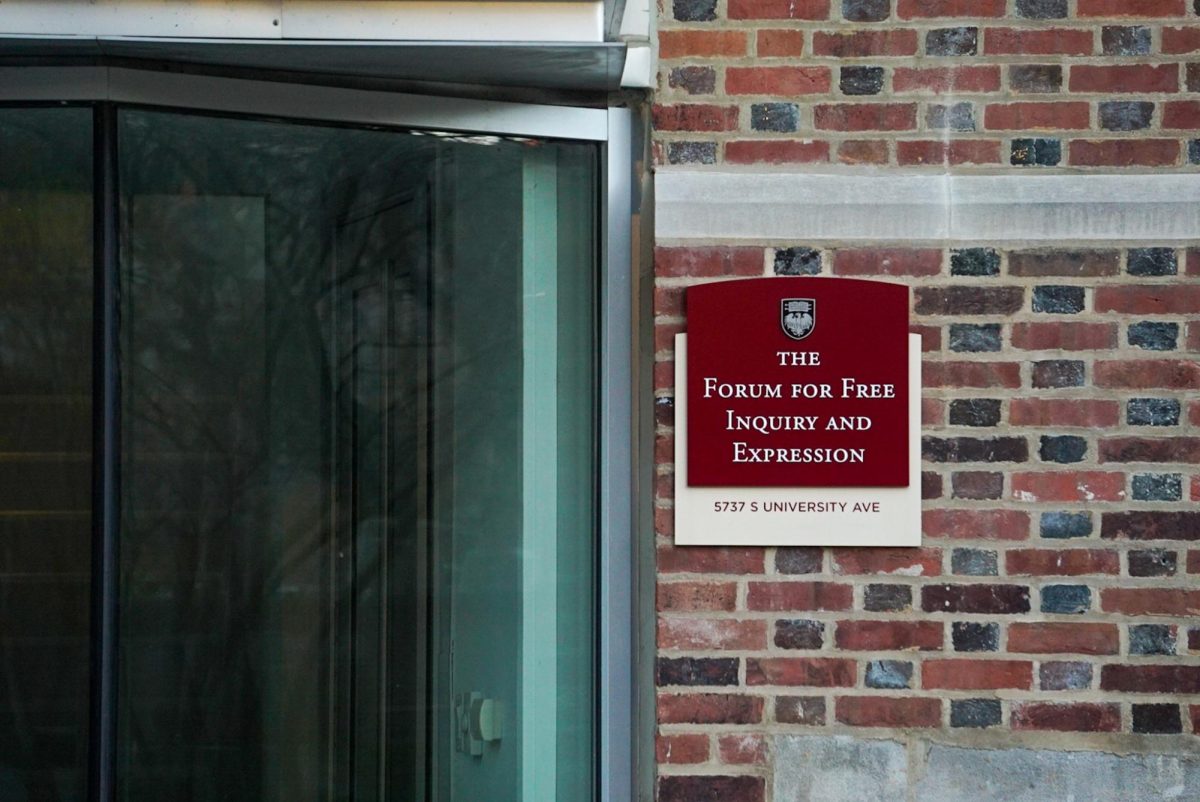
The University of Chicago Crime Lab appointed Kenneth Corey as executive director of the Policing Leadership Academy (PLA) on January 28. Corey will serve as the PLA’s second executive director, taking over from founding Executive Director and Crime Lab founder Roseanna Ander.
Corey previously worked for the New York City Police Department (NYPD) as a beat officer and as chief of training before becoming the four-star chief of department, NYPD’s highest-ranking uniformed officer. He has been closely involved with the development of the PLA since its launch.
Ander formed the PLA as part of the Harris School of Public Policy’s Crime Lab in May 2023. The PLA aims to “prevent violent crime, support officers, and improve fairness and effectiveness in policing,” according to an overview released in February 2026.
The Crime Lab and the PLA have received donations from Citadel Investments CEO Kenneth Griffin, GCM Grosvenor CEO Michael Sacks, and the Sue Ling Gin Foundation Trust.
“We like to think of it as a Booth Executive M.B.A. for policing middle managers,” such as the Chicago Police Department’s district commanders or parallel titles in other cities’ policing organizational structures, Corey told the Maroon.
According to Corey, PLA’s participants typically oversee between 150 and 300 officers and are responsible for over 100,000 citizens, and departments often give them “no education to prepare them for that particular role.”
“There is very little leadership development that goes on in policing as a profession,” he said.
Corey explained that the PLA’s methodology is to first teach officers in cities with the 100 highest violent crime rates in order to make the largest impact from the start of the program. Reaching 600 “middle managers” in 100 cities would be enough for the PLA to achieve the impact on homicides that it wants, he said.
By training these “middle managers” to better oversee their staff—not over-policing or “flooding an area” when not necessary—police departments can plan for far fewer hostile and violent interactions with officers. Thus far, the PLA has graduated 135 alumni from 90 U.S. jurisdictions, hailing from departments accounting for the highest proportion of homicides in the U.S.
Corey says the training gap the PLA attempts to bridge comes mostly from budget difficulties. “The budget in the NYPD is $6 billion, and yet 94 percent of that goes just to pay personnel,” Corey said. “Every time they want to tighten the belt… one of the first things that’s going to get cut is training, because there’s no mandate anywhere to do it.”
According to the NYPD’s preliminary budget for fiscal year 2026, 92 percent of the $5.8 billion adopted FY2025 budget went toward personnel costs. Line-item training expenditures increased by $16.4 million between the adopted and final FY2024 budgets, which were published in separate reports.
In Illinois, basic training for incoming officers is mandatory, but any further training conducted as an officer’s career progresses is far less regulated.
The PLA works with each cohort for five months, giving lectures and assignments covering leadership, strategic thinking, trauma-informed and emotional intelligence, and communication, culminating in the presentations of capstone projects the officers plan to implement in their own departments.
“The capstone is an actual problem; it’s not a theoretical or academic exercise,” Corey said. “They usually kick [the capstone] off in month three or four, so that by the time they present it to us at the end, they’ve already gotten some early results and are starting to make some real-world adjustments.”
For the past two cohorts, the PLA has required participants to complete capstone projects as part of their curriculum. The PLA does occasional check-ins on these projects to gather data for its ongoing five-year efficacy report, but does not work directly with the precincts to implement the projects, according to Corey.
“Some of them have got really tremendous results; some of them have gone from being small neighborhood initiatives to now being full-blown, citywide initiatives in some major cities,” Corey said.
One capstone project based in Philadelphia studied “community engagement as a crime-fighting technique.” According to Corey, the program was so popular that it expanded across the entire Philadelphia Police Department (PPD).
This capstone project, headed by PPD 12th District Captain Joseph Green, grew to include 14,000 instances of community engagement, where officers check in with citizens on the streets and in local schools and businesses. In the wake of these engagements, his district reported decreased numbers of homicides, shootings, and traffic stops.
Looking ahead, Corey said the PLA under his leadership will focus on data-driven policing, particularly after the five-year report is completed in 2027. “The bar on knowledge, particularly around using data to drive decision-making, was so much lower than I thought it was,” he said. “Things that I would’ve assumed that people at this level of the organization would’ve used for a number of years, they don’t, and they haven’t been exposed to.”
For Corey, the combination of professional policing experts and data scientists at PLA is “the best of both worlds.”