Tuesday’s midterm elections will decide which parties control both the U.S. House of Representatives and the U.S. Senate. While most polls signal a Democratic wave, many House, Senate, and gubernatorial races across the country remain competitive.
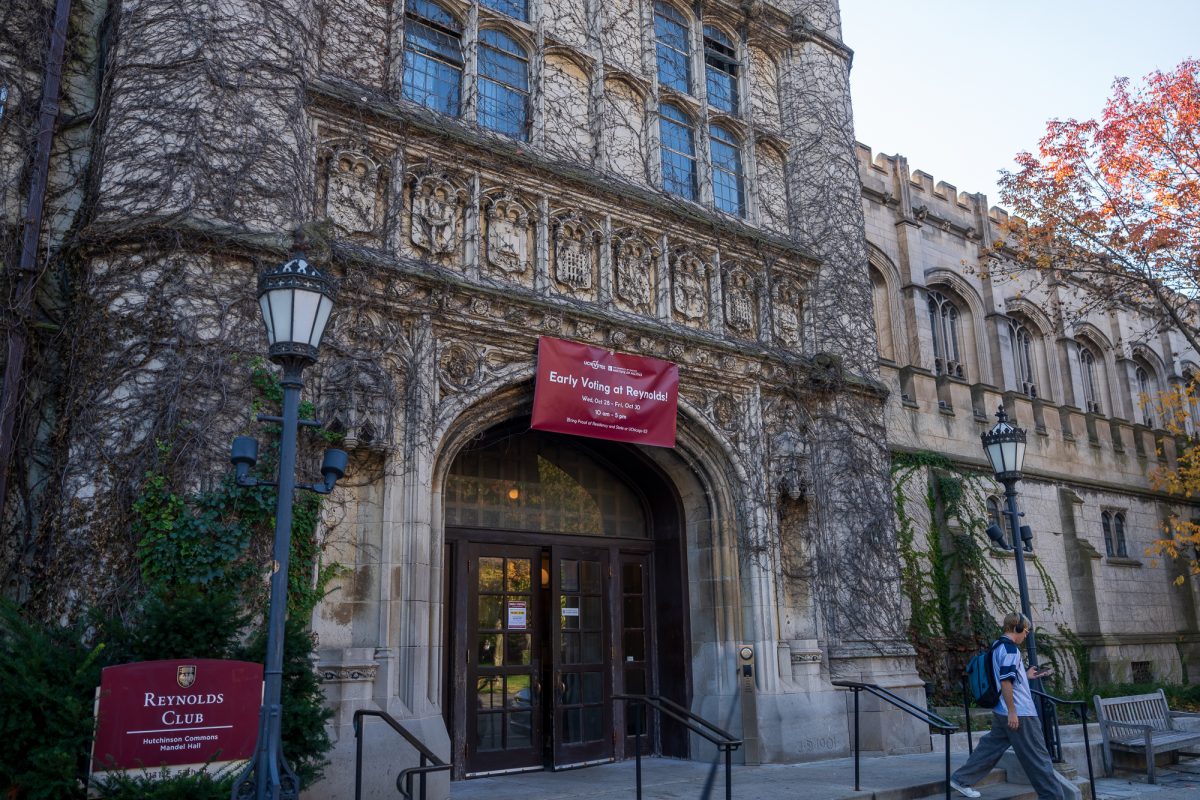
UChicago students can choose whether to vote in Chicago—where a range of state and local races are also on the ballot—or in their home states. The Maroon spoke with students, many of whom cast their Illinois ballots during early voting at the Reynolds Club last week, to learn more about what issues are motivating UChicago community members to vote this election cycle.
Students can register to vote on Election Day at their polling place by showing two forms of valid identification, with at least one showing proof of residency. For students living on campus, a housing confirmation document can be found in the MyHousing portal. Voters can find their polling places by visiting the Illinois State Board of Elections website.
Many students emphasized the importance of the youth vote—and policies that are impactful to young voters—in the election. “I think it’s really important to vote because there are a lot of scary things happening, and things that really affect all Americans and young people,” said Grace McDermott, a first-year graduate student at the Crown School of Social Work.
Students cited local education and the potential impacts of local races on Chicago schools as issues important to them. For first-year and Chicago native Rebecca Figueroa, having officials who are invested in the quality of local communities matters. “I just really hope [winning candidates are] actually interested in improving the communities, specifically in Chicago,” Figueroa said. “We know a lot of public schools in this area are underfunded, so I really hope someone who is from Chicago, that actually cares about the public school system and the communities of Chicago, wins.”
Elections that will impact education policies and funding in Chicago include local elections like the races for city treasurer and the Chicago Board of Education, as well as statewide elections like the gubernatorial race.
Students also expressed concerns about the state of national politics but said they viewed the election as an opportunity for change. “I hope that [these midterms] will be a bit of a rebuke to the behavior that we’ve been seeing, especially at the top, but even within our own state legislatures, because I’m very concerned about corruption and cronyism that we’re seeing in American politics,” third-year Naimisha Chakravadhanula said.
Chakravadhanula noted an advertisement ran by Vivek Ramaswamy, the Republican candidate for Ohio governor, featuring Democratic candidate Amy Acton’s estranged mother calling Acton a “liar,” as an example of unacceptable behavior currently in politics. Acton and her mother have not spoken since 1978, when Acton’s stepfather pleaded not guilty to raping her and fled Ohio with her mother to avoid prosecution. The ad has been widely condemned, including by prominent Republicans.
“I’m hoping that kind of behavior doesn’t get rewarded,” Chakravadhanula said. “I feel like [the outcome of this election] can really set norms for American politics going forward.”
“Oftentimes people think that their vote doesn’t really matter, [that] it’s just one small part, but I think it does.” Figueroa added. “For the smaller [elections], like for the Circuit Court judges, I think people often don’t realize how important those ones are.”
In Illinois, statewide elections will decide the governor, lieutenant governor, attorney general, secretary of state, comptroller, treasurer, and the Illinois House of Representatives. Locally, community members can vote for Cook County Board president, assessor, sheriff, clerk, treasurer, and Board of Education president and members.
Voters in Chicago, and in Hyde Park specifically, have historically been overwhelmingly Democratic. McDermott and first-year Oscar Mendez Ramirez said they supported Democratic candidates including J. B. Pritzker, who is seeking his third term as Illinois governor. Pritzker cites more affordable healthcare, refurbished infrastructure, and protection against “Donald Trump’s attacks on education, healthcare, and the economy” as notable accomplishments during his first two terms.
Pritzker is running against Republican candidate Darren Bailey, whose campaign focuses on issues including education quality, community safety, and decreasing taxes and government spending.
Chakravadhanula, originally from Arizona, voted by mail to reelect incumbent Arizona Governor Katie Hobbs, who took office in 2022 and is now running against Republican Congressman Andy Biggs. Hobbs is running on a platform that highlights her efforts to make housing more affordable; coordinate local, state, and federal governments to secure the border; and protect the state’s water supply.
But traditionally Democratic voters are not the only ones who want Democrats to win this cycle. Kyle Bassalik, a second-year and former staff writer for the Chicago Thinker, UChicago’s conservative student publication, told the Maroon that he hopes Democrats take control of the House and Senate.
“I think [Democrats] need to take control of at least one of the branches of government in order to stop the executive branch from abusing their power,” Bassalik said, citing “blatant misuse of the justice system to deport and displace immigrants” and “blatant attempts to rewrite the Constitution in their own words with Trump’s executive orders”—such as an attempt to eliminate birthright citizenship—as practices he specifically opposed.
Bassalik said that ordinarily he “would lean towards the Republican Party, but I don’t really support them at the moment.” Bassalik said he would not be voting this year because he missed his home state’s mail-in ballot deadline.
“Economics has been my number one issue for most of my political career, but I would say it’s taken a backseat in these elections with the power abuses I’ve seen [from] the current administration,” he continued. “I think that economics is very important—I think it’s the most important part of a nation—but I don’t think that [the Republican Party] truly represent[s] even my fiscal policy.”
Like in previous years, UChicago Democrats (UCDems) has also been involved in this year’s midterms, canvassing and phone banking for candidates including Michigan Senate candidate Abdul El-Sayed and Alaska Senate candidate Mary Peltola. Fourth-year Oliver Zajac, co-president of UCDems, said he hopes that students focus on affordability as a main issue when voting.
“I would really encourage people to think about the impact their vote has on other people’s lives, and to have empathy in that practice,” Zajac said.
He added that he wants students to think about the candidates’ character in addition to their policies. “The candidates that Republicans have put up around the country are bad people. In a lot of these races, there are people who lie about core parts of their life story and make false promises that they’re never going to keep,” Zajac said. “If you’re willing to vote your values and look for good people who are intelligent and have integrity and want to actually improve the lives of their constituents, you’re also going to end up with Democratic candidates.”
Second-year Daniel Lopez, another member of UCDems, added that students should keep in mind the importance of checking executive power, especially concerning issues like immigration, research funding, the war in Iran, and gas prices. “It’s unchecked, and we need balance and accountability,” Lopez said.
A spokesperson for UChicago College Republicans said that no members were available to interview before the time of publication.
Editor’s note, November 3, 10:36 a.m.: This article has been updated to correct information about Amy Acton’s stepfather. He pled not guilty to raping her.