


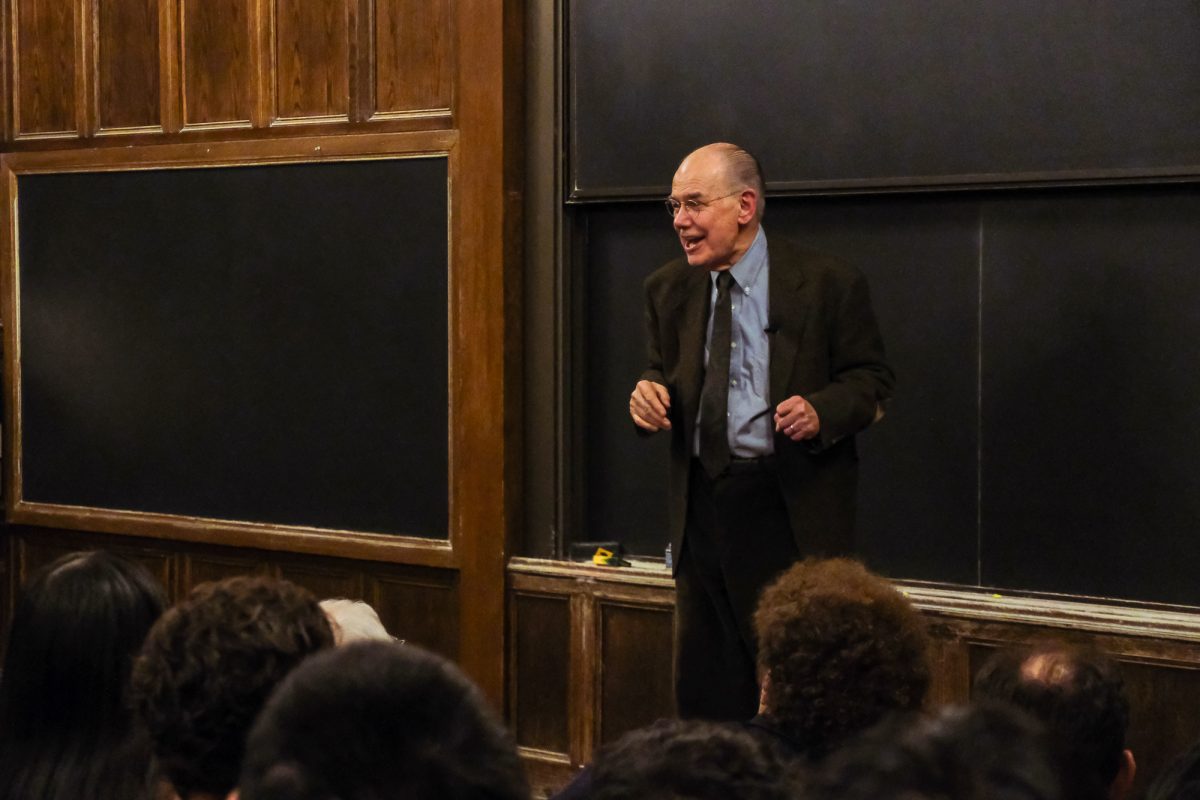
The Chicago Center for Contemporary Theory (3CT) hosted a talk by John Mearsheimer, the R. Wendell Harrison Distinguished Service Professor of Political Science, on Thursday about the U.S. government’s January 3 capture of President of Venezuela Nicolás Maduro and his wife First Lady Cilia Flores.
His lecture, followed by 45 minutes of Q&A, covered three overarching topics: President Donald Trump’s overall approach to using military force, the invasion of Venezuela, and the recent protests in Iran.
Mearsheimer, who has taught at the University since 1982 and is known for his theory of offensive realism in international relations, focused on Trump’s selective willingness to use military force to achieve foreign policy objectives. While Trump shies away from conflict with “great powers” like China and Russia, according to Mearsheimer, he threatens “middle and lower powers” and has attacked seven nations in his second term.
“He’s using military force liberally, with a light touch, and that allows him to use it often,” Mearsheimer said.
Trump justified the special forces operation in Venezuela with the Monroe Doctrine—an 1823 warning against European interference in the Western Hemisphere—which Mearsheimer believes is inapplicable.
Trump initially alleged that the invasion was a response to narcoterrorism, also claiming that “hostile regimes” were gaining influence in Latin America, notionally violating the Monroe Doctrine. Mearsheimer rejected this claim, noting that, while Russia and China have formed economic ties in the region, including in Venezuela, there is no evidence of military alliances. “The Monroe Doctrine is all about keeping military forces out of our backyard, not preventing economic intercourse,” Mearsheimer said.
While Mearsheimer initially assumed the invasion aimed to overthrow Maduro’s socialist regime, he now views it as “good old-fashioned imperialism.” But imperialism, Mearsheimer said, is “a losing enterprise,” in which the expense of resurrecting the Venezuelan oil industry will far outstrip the benefits.
Mearsheimer argued that, unlike presidents who pursued regime change to establish democratic governments, Trump has not made moves to depose Venezuela’s authoritarian government, due to what Mearsheimer views as his reluctance to put “boots on the ground.” Trump has not strongly pushed for opposition leader María Corina Machado to become acting president and has said he will ensure cooperation using economic leverage, not military force, in the future.
“When things eventually settle in Venezuela, what’s he going to do?” Mearsheimer said. “There’s going to be a very powerful temptation to put boots on the ground to fix the problem—I think this is going to end up as a huge black mark on the United States and on the Trump administration.”
Mearsheimer ended his lecture with a discussion of recent protests in Iran, which were initially sparked by economic discontent and Iran’s 12-Day War with Israel in June but later expanded into wider criticism of Iran’s theocratic government. The government shut down all internet services on January 8 and declared that the protests had ended on January 21. Several thousand protesters were killed during the events.
Mearsheimer posited that U.S. strategy in Iran is a “tag team” operation largely driven by Israel’s desires. “What the United States and Israel want to do in Iran is get rid of the regime and then break the country apart—no democratization—because then it’s not a threat to Israel,” he said.
He made repeated comparisons to the nearly 14-year Syrian Civil War, arguing that the U.S. typically destabilizes regimes through a four-step process.
First, Mearsheimer said, Trump applied a strategy of “maximum pressure” to cripple the economy and generate protests; second, CIA, Mossad, and Secret Intelligence Service (MI6) agents were inserted to fuel violence among demonstrators; third, the American mainstream media began to propagate a story about one-sided violence perpetrated by an evil regime; finally, when protests reached a tipping point, the U.S. planned to intervene as a savior.
“I don’t want to deny that there are some legitimate reasons for protests [in Iran],” Mearsheimer said. “But you have to understand that the U.S. has wrecked their economy for the purpose of creating [protests].”
Though Trump has repeatedly threatened to use military force in Iran, Mearsheimer believes he has been restrained by his advisors’ inability to guarantee a decisive victory.
Without protests, U.S. military intervention would only feed nationalism in Iran, according to Mearsheimer. “The historical record is very clear on this: when you bomb a country, you bring the population together.”
Moreover, Israeli Prime Minister Benjamin Netanyahu personally requested that Trump refrain from attacks. “Netanyahu understands well that very little has changed since June 2025, and Israel is no better able to defend itself [from Iran],” Mearsheimer said.
Trump has largely toned down his threats, though he announced on January 23 that “an armada” is headed to monitor Iran.
Mearsheimer predicted that U.S. policy toward Iran will remain an unresolved challenge, since sustained pressure risks pushing Iran further toward nuclear development. Venezuela, on the other hand, will worsen under continued U.S. involvement.
He emphasized that, alongside a desire for swift, conclusive military victories, the president’s foreign policy approach is underpinned by a contempt for international law and multilateral institutions.
“He’s a unilateralist: he dislikes allies almost as much as he dislikes adversaries.”
Matthew G. Andersson, '96, Booth MBA / Jan 29, 2026 at 3:46 pm
Professor John Mearsheimer often provides in his public speaking, good examples of what might be called the “Chicago School,” if by that phrase is assumed a mature, rational, fact-probing intellectual posture. Like many professors, he trades on a theory. There are occasions when he may appear to “fit” events into his great power theory, or in contrast to others. This can indeed be explanatory, but its assumptions and inductive line must be interrogated, as all theories rest on them. The Political Science department at UChicago is rather Left-leaning in its ideology, and Mearsheimer stands out selectively as an exception, though he appears tempted by a “personality” theory of political economy to accommodate or animate public audience reception, and podcast metrics. His record appears somewhat opportunistic in those formats that second-guess White House intentions based on secondary information that has not been tested. Still, he remains pragmatically mannered, and pragmatism is a distinctive Chicago tradition that has largely spoiled. Readers may enjoy “Are Some Podcasters Undermining US National Security?” and “Leftists Love Institutions, Hate Theory,” in American Thinker, in January 2026. Mearsheimer’s professional embrace of China may undermine his objectivity.
David Rosenberg / Jan 29, 2026 at 12:00 am
Mearsheimer is an old dog performing old tricks. Alas, actual dogs do not enjoy tenure and can be put out to pasture whilst we are condemned to suffer indefinitely the obnoxious vanities of stale professors.
Ira Stoll / Jan 27, 2026 at 10:52 am
I clicked the hyperlink in the sentence that says “Israeli Prime Minister Benjamin Netanyahu personally requested that Trump refrain from attacks.” It leads to a news article in the New York Times that says, “Qatar, Saudi Arabia, Oman and Egypt, all partners of Washington, have also been asking the Trump administration not to attack Iran, said an official from a Gulf Arab nation.” Why would Mearsheimer and the Maroon news article focus solely on Israel and Netanyahu and not mention the Arab countries? It seems consistent with Mearsheimer’s previous work on Israel and U.S. foreign policy, which has been widely discredited. (See, for example, Leslie Gelb in the Sept. 23, 2007 New York Times; Bret Stephens in the November 2007 issue of Commentary; the book “The Deadliest Lies” by Abraham Foxman). The Maroon and its readers would be better off treating Mearsheimer’s claims with the skepticism they deserve rather than just letting him prattle on unchallenged.
There are Iranians bravely standing up to a brutal regime. To chalk it all up to U.S. economic pressure and to “CIA, Mossad, and Secret Intelligence Service (MI6)” does not do justice to the courage of the Iranians, who deserve our admiration and support.