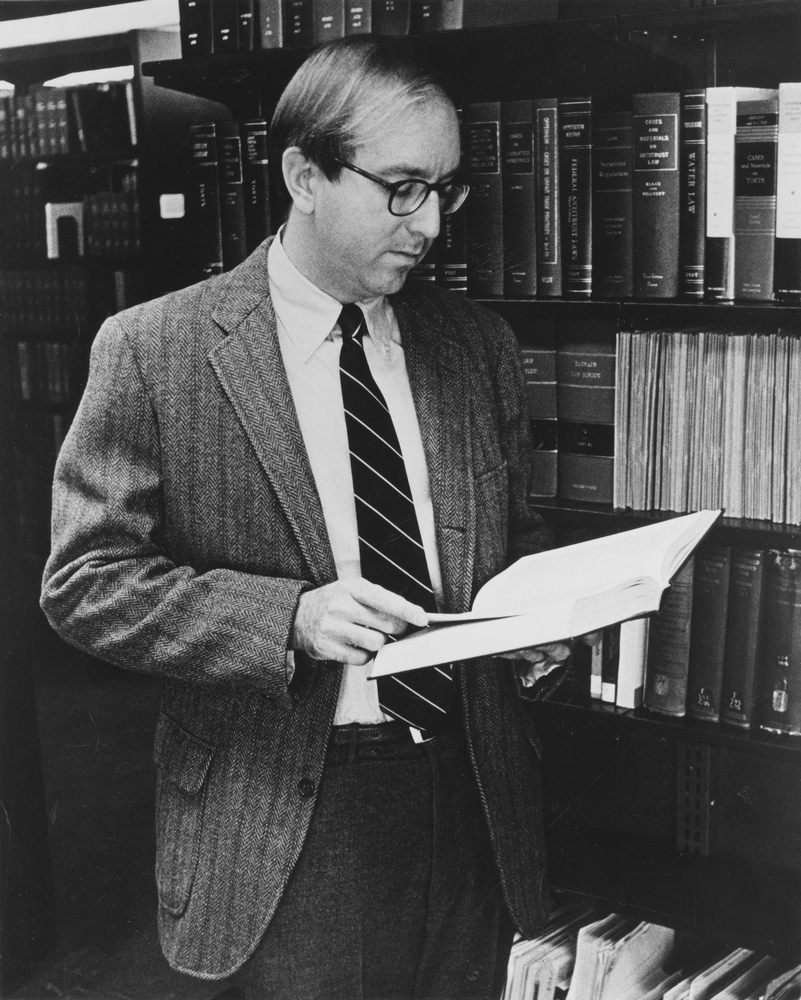
Richard Posner, a longtime University of Chicago Law School professor and former federal appellate judge who is widely considered to be one of the most influential legal scholars of all time, died on November 10. He was 87.
The cause of Posner’s death was not immediately available.
Posner was known across the legal profession for his extensive opinions, having written more than 50 books, over 3,300 legal opinions, and numerous scholarly articles, essays, book reviews, and blog posts on a vast array of topics both in and outside of the law. According to a 2021 study, he is the most-cited legal scholar of all time.
“There has never been a legal scholar quite as prolific, influential, and endlessly curious as Dick Posner—he was a giant whose influence on our legal system, the field of law and economics, and on our law school cannot be overstated,” UChicago Law School Dean Adam Chilton said in a Law School statement.
He is survived by his wife Charlene, sons Kenneth and Eric—another professor at the law school—and four grandchildren.
Posner joined the Law School faculty in 1969 and was appointed to the Seventh Circuit of the U.S. Court of Appeals in Chicago by President Ronald Reagan in 1981, serving until 2017 and acting as the circuit’s chief judge from 1993 to 2000. During his time on the court, he was known for his tough and sometimes unrelenting questioning during oral arguments, as well as his clear conversational tone and occasionally outlandish approaches to decisions in his opinions.
“As a law and economics scholar and torts professor, I doubt there has been a week that’s gone by since I started teaching at the Law School where I haven’t talked about one of Dick’s ideas or opinions,” Chilton said.
When he was 33, Posner published The Economic Analysis of Law, pioneering the field of law and economics and contending that the economic consequences of laws should be considered in all aspects of the legal system. He argued that the objective of the law should not be to protect rights or promote general happiness but rather to maximize the wealth of society.
He once proposed abolishing adoption agencies and allowing pregnant women to sell unwanted babies on the free market to stop black-market adoptions, and he was also in favor of legalizing marijuana and LSD. In his book Sex and Reason, he briefly entertained the idea that it might be best not to punish the crime of rape if the rapist enjoys the act enough to outweigh the harm to the victim, but quickly disregarded it, concluding that rape must be criminalized in order to protect the “consensual sex market” in the same way that theft is criminalized to protect commercial markets.
Despite his intellect and relentless work ethic, Posner was never seriously considered for the Supreme Court, according to his biographer, William Domnarski. When a vacancy in the Court opened in 1987, Posner was passed over by Reagan—not because of his more controversial thought experiments, Domnarski wrote, but because Reagan wanted to appoint an “originalist,” or someone who prioritizes the original meaning of the Constitution in legal interpretation.
Posner, on the other hand, disdained opinions filled with legal jargon and the strict nature of most legal reasoning. “I pay very little attention to legal rules, statutes, constitutional provisions,” Posner said in a 2017 interview. “A case is just a dispute. The first thing you do is ask yourself—forget about the law—what is a sensible resolution of this dispute? “The next thing, he said, would be to see if a recent Supreme Court precedent or some other legal obstacle stood in the way of ruling in favor of that sensible resolution.
“The answer is that’s actually rarely the case,” he continued. “When you have a Supreme Court case or something similar, they’re often extremely easy to get around.”
For most of his career, Posner’s prioritization of economic utility over morals generally led him to conservative results, though he distanced himself from the Republican Party in his later years on the bench, taking more liberal stances on issues like abortion and same-sex marriage. He said in a 2012 interview that he had “become less conservative since the Republican Party started becoming goofy.”
Following the 2008 financial crisis, Posner wrote in his book A Failure of Capitalism that he had begun to question the rational-choice economic model that had guided his legal philosophy, believing that it failed to take into account what mattered in a legal decision.
Posner wrote the majority opinion in Crawford v. Marion County Election Board, which the Supreme Court affirmed in a landmark 2008 ruling protecting voter identification laws. When he had made the ruling in 2007, Posner said, “there hadn’t been that much activity in the way of voter identification,” and “we weren’t really given strong indications that requiring additional voter identification would actually disenfranchise people entitled to vote.”
He later expressed regret about the decision, noting in his book Reflections on Judging that measures like the Indiana law in the case are “now widely regarded as a means of voter suppression rather than of fraud prevention.”
In 2014, Posner authored the opinion in Baskin v. Bogan that struck down Wisconsin and Indiana’s same-sex marriage bans. During oral arguments, Wisconsin’s attorney general cited “tradition” as a reason for maintaining the ban, prompting Posner to respond, “It was tradition to not allow Blacks and Whites to marry—a tradition that got swept away.” He called the state’s ban on same-sex marriage derived from “a tradition of hate [and] savage discrimination.”
In the opinion, Posner wrote, “Heterosexuals get drunk and pregnant, producing unwanted children; their reward is to be allowed to marry. Homosexual couples do not produce unwanted children; their reward is to be denied the right to marry. Go figure.”
Posner was a self-described “cat person.” In a 2001 interview with the New Yorker, he said, “I have exactly the same personality as my cat. I am cold, furtive, callous, snobbish, selfish, and playful, but with a streak of cruelty.” He was known to illustrate arguments in his opinions with elaborate cat-related metaphors and examples.
In the case of Eike v. Allergan, a class action lawsuit in which the plaintiffs claimed eye drops made by six pharmaceutical companies were too large, Posner compared the plaintiffs to cat owners that were complaining about the cost of raising a cat and subsequently sued the breeder that had sold it to them.
In this scenario, Posner wrote, “The breeders had made no misrepresentations, concealed no information, answered all questions of prospective buyers truthfully. Nevertheless many of the buyers are dissatisfied. They think—maybe correctly—that the cat food is needlessly expensive and the fountain a fragile luxury.”
“Yet would anyone think they could successfully sue the breeders? For what? The breeders had made no misrepresentations. Had a prospective buyer asked one of the breeders what the annual cost of maintaining the cat would be, the breeder would, let’s assume, have given him a realistic estimate. There would be disappointment in the example given, but no cause of action,” he wrote.
In a 1992 review of Sex and Reason, his friend and Law School colleague Martha Nussbaum, the Ernst Freund Distinguished Service Professor of Law and Ethics, wrote that Posner “combines a passion for exposing humbug and pseudo-profundity with an odd but genuine sort of social compassion, a delight in shocking the self-righteous with a love of human diversity and freedom.”
“Long after the deeply flawed theories have been forgotten,” she continued, “we will remember, and profit by, the wit and the courage of his attacks on bigotry, folly, and cruelty.”