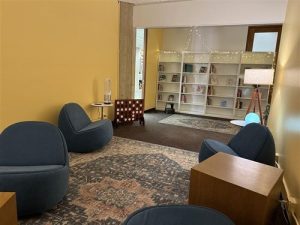
The Maroon Oasis, a room configured to support student well-being during study sessions, opened on March 27 in Room 163 of the Regenstein Library. It is open during regular library hours. The installation includes “comfortable seating” and “games, puzzles, and activities” like the spring Reg Reads book club meeting.
The organizers state that “device use is generally discouraged,” describing the Oasis as a “low-tech space.”
The library has also hosted programming in the space, including “Textile Works-in-Progress” sessions, where students were invited to bring personal knitting, crochet, or other textile projects, as well as a “Puzzle Party & Exchange” held on April 22.
Additional programming has included a discussion for the Reg Reads book club and a workshop on creating zines and paper crafts. Some events, such as the book club, require registration on the library website.
According to event listings, activities are scheduled throughout the quarter, typically lasting between one and two hours.
Kristy Lueshen, student success librarian, said the Maroon Oasis will “serve as an engagement [and] wellness space for students to take a break from studying,” including “spending time on a jigsaw puzzle, chatting with a friend, or reading a book.”
She added that the space’s design with “soft seating, low lighting, games/puzzles and a book collection primarily featuring arts & crafts,” was meant to provide “a respite from the rigor of UChicago’s academics.”
Lueshen said planning for the Oasis began “almost a year and a half” before its opening, inspired by her work with students. Lueshen noted that she had “noticed an increase in student stress across the board,” and that the space is intended to signal that “it’s OK to take a break.”
Regarding programming, Lueshen said her unit selected events that “aligned well with the space,” including a zine-making workshop where students can make self-published, small-circulation booklets often made by hand using paper or digital platforms like Canva.
Lueshen said the Oasis was designed as a low-tech environment because “the room is definitively not a study room,” adding that students are not allowed to reserve it and that the space is intended to remain open for general use. She said that “detaching from technology can help you reset and relax.”