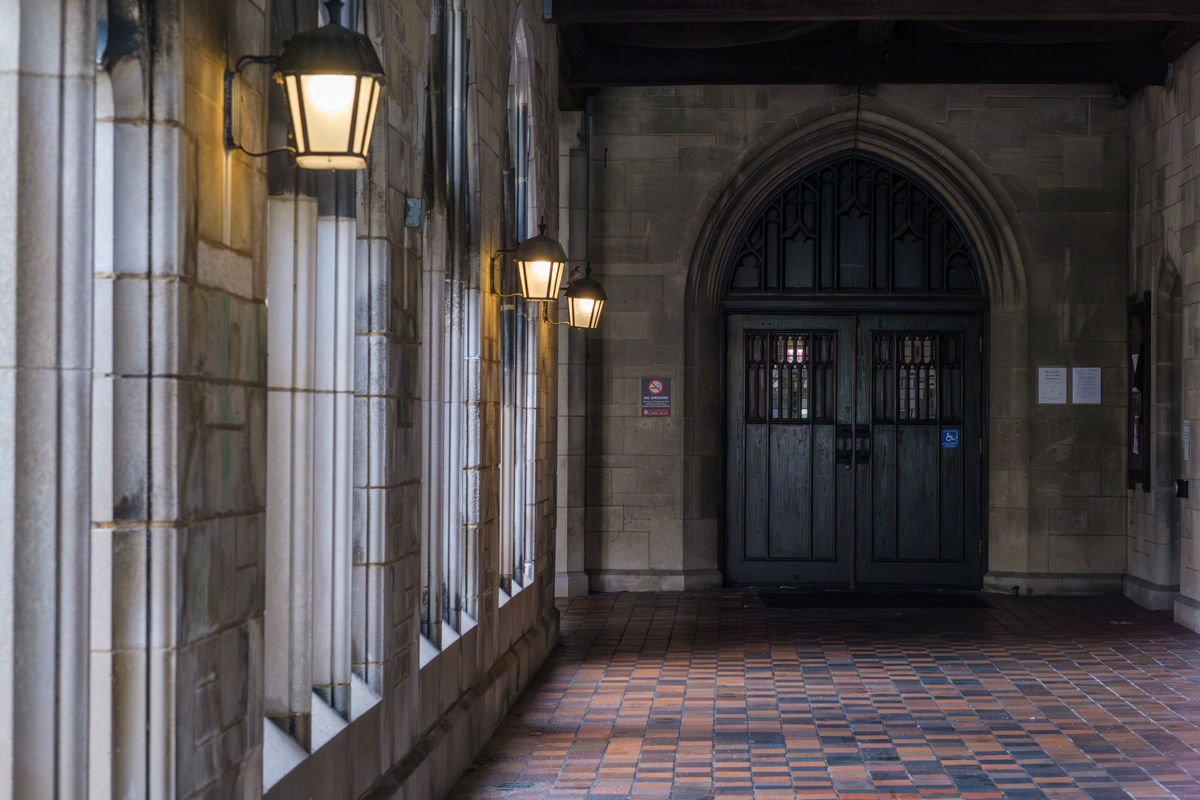
In 1931, an administrative memo on Ida Noyes’ unpopular refectory revealed that, though the building itself was constructed as a women’s clubhouse, its first floor was virtually coeducational—“a common meeting ground for men and women.” The unnamed author doubted that the space would remain reserved for women as the already coeducational institution more readily integrated but said the University was obligated to maintain Ida Noyes as a women’s clubhouse.
When the University was founded as a coeducational institution, it was ahead of several other institutions, especially schools in the northeast. Yale only began admitting women in 1969, and Columbia College wasn’t integrated until 1983, with the delay partly owing to the university’s women-only college, Barnard. By contrast, Stanford was founded in 1885 as a coeducational institution.
But an observer would not know that the University admitted women if they looked at the University’s recreational facilities in the early 20th century. The pool tables at the Reynolds Club and Hutchinson cafeteria were mainly used by the men of the University, and the building that is now Bartlett Dining Commons was a men’s gymnasium, former dean of the College and historian of the University John W. Boyer said in an interview with the Maroon.
The Reynolds Club didn’t have an explicit policy excluding women, and women were free to enter the building. When businessman La Verne Noyes made his 1913 donation to build a women’s clubhouse in honor of his late wife, most students were from the Chicago area, Boyer said. Before 1940, several fraternities functioned as a de facto housing system for male students at a university which, at the time, had a severely limited housing system, Boyer wrote in The University of Chicago: A History. Female students, having no sorority houses, commuted from Northern Chicago and even the suburbs. That left fewer women on campus outside of class hours, as women often chose to begin their commutes home as soon as classes concluded.
Who, then, would the new women’s clubhouse serve? The University had a considerable population of female graduate students, likely living in Hyde Park, who didn’t have a recreational space of their own, Boyer said in an interview with the Maroon. Ida Noyes would eventually develop into a space largely for undergraduate recreation, but it was then-University President Harry Pratt Judson’s general conviction that undergraduate education should be of secondary importance to the University.
In 1916, Ida Noyes Hall was furnished with all the same amenities as the spaces available to men: a gymnasium, a pool, a locker room, a cafeteria, and more. In 2026, 113 years after the building’s completion, none of those facilities remain as other facilities have integrated. The building now primarily functions as the home to various RSOs, the Maroon, the Pub, speaker events hosted by organizations like the Chicago Center for Contemporary Theory and the Institute of Politics, and career fairs.
The Donation and the Planning
La Verne Noyes was born in 1849 to a family of Iowan pioneers. He met his wife, Ida Smith, at Iowa State College and used his background in physics to become an inventor. In their early years of marriage, the learned couple found themselves struggling to physically handle Webster’s Unabridged Dictionary, and Ida suggested to La Verne that he construct a holder. He designed a wired bookholder, patented the design, and quickly made a fortune from the product. The pair moved to Chicago, and La Verne went on to pioneer the Aermotor Company, which made steel windmills.
By the turn of the 20th century, Noyes was one of the wealthiest individuals in Chicago. He was a major philanthropist in the Chicago area, serving as a governing-member of the Art Institute of Chicago and a trustee of both the Lewis Institute and of the Chicago Academy of Sciences. He was also involved in politics, testifying before Congress multiple times in support of various initiatives of Theodore Roosevelt. Following World War I, Noyes donated $2.5 million to pay for the tuition of UChicago students who fought in the war. It was generally a time of expansion at the University. According to Boyer’s book, University’s finances stabilized under the presidency of Harry Pratt Judson, and UChicago soon saw large donations by Julius Rosenwald and Hobart William, as well as John D. Rockefeller’s final gift to the University in 1910.
As evidenced by the name of the building he financed, Noyes’s donation was mainly motivated by his love for his late wife, who had died just a year earlier in 1912. Ida Noyes was herself a deeply educated woman, having studied briefly at the Art Institute of Chicago in addition to her time at Iowa State. There is no evidence to suggest, however, that the couple had particular commitment to the education of women. “As for Mr. Noyes’s motivation, it’s kind of a mystery, other than that he wanted to honor his wife,” Boyer said in the interview. “I’m sure he wanted to help students, too, so it was a kind of convergence.”
Ida Noyes Hall’s cornerstone reads “[a]s a memorial to such a woman—winning in personality, a lover of literature and art, wise in philanthropy, democratic in friendship, skillful in leadership, devoted to her home and her country—Ida Noyes Hall is dedicated to the life of the women of the University of Chicago.” A portrait of Ida Noyes sits on the second floor of the building, one of the few on campus named after a woman.
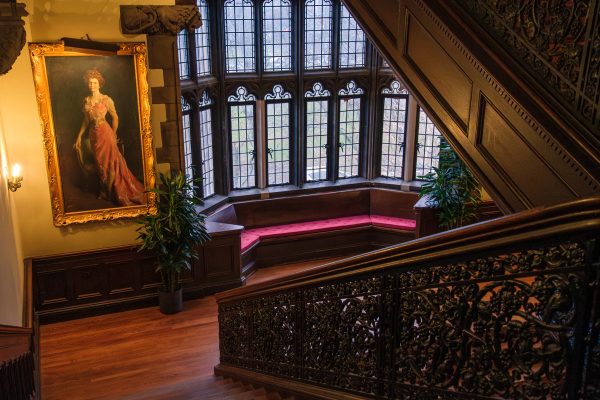
Ida Noyes Hall’s architecture is notable in comparison to other the buildings on campus. The building was designed by Sheply, Rutan, & Coolidge, the architectural firm that had designed Harper Memorial Library, Bartlett Gymnasium, and much of the University quadrangles, as well as the Art Institute of Chicago and Stanford University’s quadrangles. Though three stories tall, Ida Noyes Hall’s design makes less of an effort to emphasize its verticality than other neo-gothic buildings on campus. Instead, the building was conceived by planners to resemble a Tudor house with its steep roofs, evoking something more “domestic in feeling,” the cornerstone reads.
Marian Talbot, then-dean of women, said at the laying of the cornerstone on April 17, 1915, “Tolerance, sympathy, kindness, the generous word and the helpful act, all typical of the woman we commemorate, will be the contribution of the women who go forth from Ida Noyes Hall to take part in the upbuilding of the new civilization which is to come,” according to Thomas Goodspeed in A History of the University of Chicago (1916). The dedication of the building was part of the University’s celebration of its 25th anniversary.
Following the laying of the cornerstone, the construction of Ida Noyes marked “a great change in student life at the University,” wrote the Daily Maroon in 1915 before offering a less-than-generous characterization of the women of the University and a bold promise for what Ida Noyes Hall would bring for them. “To the woman from a strange place and new to the life of Chicago, in whom the instinct for battling self-preservation is not as strong as it is in the man,” the Daily Maroon wrote, “Ida Noyes Hall stands as a welcome, a haven, and a promise of greater enjoyment of life, and consequent enrichment of the joys of being.”
Early Years
Through the following decades, Ida Noyes was a home for women’s activities and clubs. For example, during World War I, when the University mobilized to support the war effort, Noyes donated sewing equipment to the hall which was later used to produce clothing for donation to a nearby nursery.
Boyer told the Maroon that Ida Noyes did not remain a women’s area for long. From its opening, men, typically the guests of women, were allowed on the first floor. They were not only allowed but encouraged to dine at the cafeteria following the construction of International House in 1932. However, the Daily Maroon suggested in 1938 that only “a few men brave the hordes of women who patronize the Ida Noyes dining room.” Soon enough, Boyer said, International House’s now nonexistent dining hall was enough to force the Ida Noyes refectory to shutter, leaving the Cloister Club as an event space.
Indeed, many events took place in Ida Noyes that had men in attendance, such as a 1924 formal gathering for third-years in the College. “Ours [had] been a fairly unruly university,” Boyer said, in comparison to peer institutions at the time that were not coeducational or that had separate colleges for men and women. “So I suspect that if women students or men students wanted to go someplace, I don’t think someone was standing at the door, saying, ‘You can’t get in there.’ It’s a big urban university; it’s always been marked by a great deal of personal freedom,” Boyer said.
From the 1930s to the 1960s, Ida Noyes was home to some student organizations that may sound similar to RSOs seen today, including the International Folklore Dance Society, the Dames Tea Club, and the Haskalah Club. The Maroon relocated its offices to Ida Noyes Hall in 1955; meetings were previously hosted primarily in Reynolds Club, as well as, in earlier years, in Cobb Hall and the since-demolished Lexington and Ellis Halls.
Integration, the Pub, and the Cinema
The next major round of construction was the opening of the Pub in 1974. The Woodlawn Tap, or “Jimmy’s,” had served students and community members for decades by that point, but the Pub sought to be an on-campus bar open only for students, faculty, and alumni. It took the place of what was once part of the women’s locker room, an indication that Ida Noyes Hall had, by then, become less of a space for women’s athletic recreation and more of one for general student life. The Gerald Ratner Athletics Center did not begin construction until 2000, and the earliest indication of women using Henry Crown Field House comes from 1978.
The Pub’s interior decoration, with Tiffany-style lampshades and sparse lighting, was intended to remind the University community of the 1920s and 1930s on campus, the Maroon reported in 1974. Skip Landt, then-director of student activities, said that they were initially going to hang up a photo of Rockefeller and William Rainey Harper, the University’s first president, such that it looked as if they were walking to the bar. “But we changed our minds and they will be walking away, which is Harper’s more natural inclination,” Landt told the Maroon in 1974.
On November 8, 1974, the Pub officially opened to the University community, selling yearlong memberships for $2 (today $14). Back then, the Pub would’ve been open to nearly all undergraduates, as the Illinois drinking age was only raised to 21 in 1980. Boyer recalled that his daughter worked as the door supervisor for the Pub at one point, checking guests’ IDs. In its early days, the Pub was more often home to live music, hosting Jazz vibraphone performances and a Rolling Stones cover band.
The biggest renovation to Ida Noyes came in 1986 with a donation from former Trustee Max Palevsky (Ph.B. ’48, S.B. ’48) to convert the gymnasium into a movie theater, which various organizations could use during the day for lectures or screenings, and where Doc Films would screen films in the evenings.
Doc Films hosted renowned filmmakers such as Alfred Hitchcock, John Ford, and Maya Deren from the 1950s through the 1970s, and the Max Palevsky Cinema—furnished with 475 seats and a stereo sound system—was better-suited for accommodating distinguished guests than Cobb Hall. To inaugurate the cinema, Doc Films presented Something Wild (1986) with director Jonathan Demme—who would go on to make Silence of the Lambs (1991)—in attendance.
Palevsky was a financier and a pioneer of computer technology, that his time at UChicago “changed his life.” Like La Verne Noyes, Palevsky made large donations to the University at many other points, helping build the Max Palevsky Residential Commons as well as establishing the Palevsky Professorship in History and Civilization, currently held by James Evans.
The Future of Ida Noyes Hall
Major work on Ida Noyes Hall has been sparse since Max Palevsky Cinema’s opening. In 1995, the Masque of Youth mural on the third floor was restored. In 2007 the University underwent efforts to repair the roof and facade of the building. Finally, in 2008, the Booth School of Business built a study space where the pool once was.
In April, the University announced a $50 million donation by David Rubenstein to renovate and modernize the building. The University has stated that previously existing architectural elements will continue to be called Ida Noyes Hall while the additions will be referred to as the David M. Rubenstein Commons. No specific plans for the renovation have been made public.
Many have raised concerns that Rubinstein’s donation—which vastly exceeds La Verne Noyes’ original donation of $300,000 ($10 million when adjusted for inflation)—will make much of Ida Noyes’s facilities temporarily unavailable. The University has declined to confirm or deny this speculation.