Wolfgang Amadeus Mozart’s Requiem Mass is the composer’s incomplete swan song. The history of the piece is almost as dramatic as the composition itself, complete with masked figures and Mozart’s dying breaths. The story goes that Mozart received the commission from a masked patron who remains unknown. Whether it was one of his rivals or the ghost of his father, the story does not say, but it is enough to let the imagination wander. The story was also dramatized in the movie Amadeus written by Peter Shaffer. The legend of the Requiem also claims that Mozart was poisoned by a rival and wrote the piece as his own Requiem Mass, dying partway through its composition.
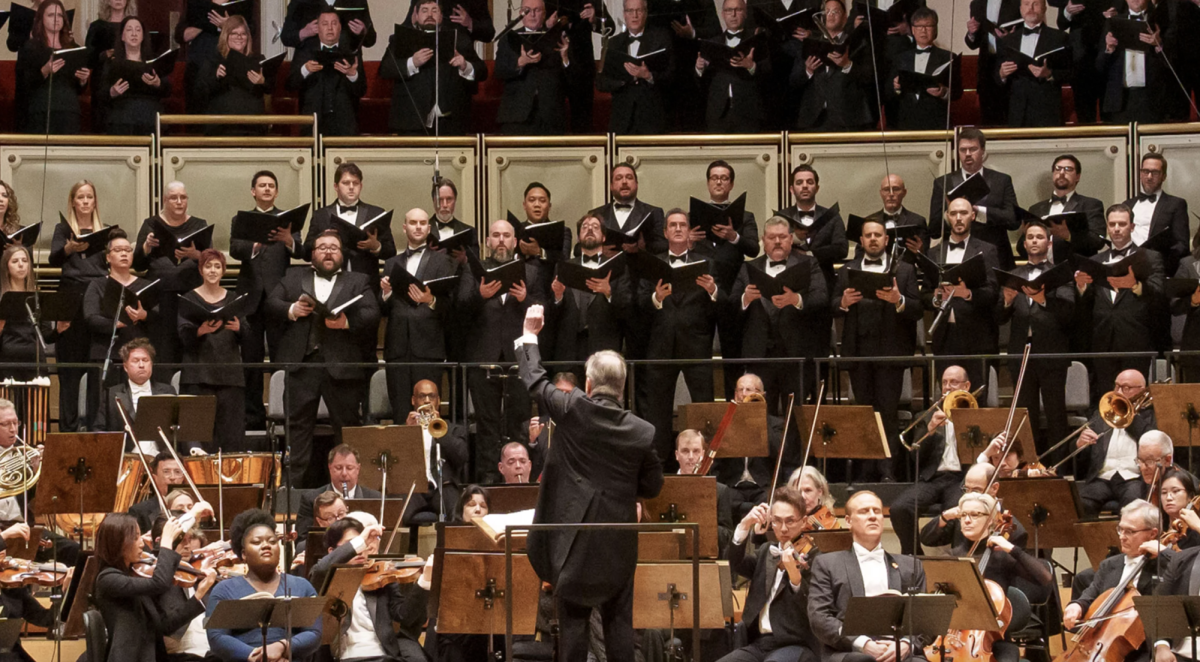
Since Mozart himself was never able to finish the Requiem, performing it requires consideration of how much should be added or changed. Such a question is never easy, and it becomes impossible when it’s about Mozart—one of the greatest composers to ever live. The comments on the piece from the provided program notes written by Phillip Huscher even mention how the task of completing the Requiem was offered to and refused by a number of master composers. The task was finally accepted by Franz Süssmayr—one of Mozart’s students who accompanied the composer on his deathbed, whom the composer called an ass and a blockhead. Now, over 200 years after Süssmayr took on the impossible task, conductor Manfred Honeck provides us with a fresh arrangement of the Requiem Mass unlike anything we have ever seen before, incorporating Gregorian chants and other pieces by Mozart into the performance.
Before all the mortal panic of the Requiem, the audience was first treated to Ludwig Beethoven’s Coriolan Overture and Joseph Haydn’s Symphony No. 93. Placing an overture—a musical introduction to a work of theater—at the beginning of the concert helped add to the feeling that the Requiem is not a normal piece of music, but rather a powerful narrative work. Beethoven’s piece was written for an unrelated play but is now associated with Shakespeare’s tragedy Coriolanus—a connection drawn by Richard Wagner. Seeing this piece through the light of a tragedy helped the audience understand the music which follows, as it has that dramatic tone which gets the audience acclimated to what will follow in the Requiem but overall kept you feeling secure by maintaining a lighter tone. In this sense it was a proper overture for the Requiem. The second piece was Haydn’s Symphony No. 93, one of the six he composed when he left Vienna for London after the death of his patron. When Haydn left Vienna in 1790, he did not know that it was the last time he would say goodbye to Mozart, and this piece premiered just two months after Mozart’s death. Symphony No. 93 had a relatively lighter tone which washed out the dramatic taste left over from Beethoven and pacified the audience before the Requiem began. Starting with these lighter pieces truly impressed the feeling that the Requiem is not an easy piece, and the contrast between them was jarring.
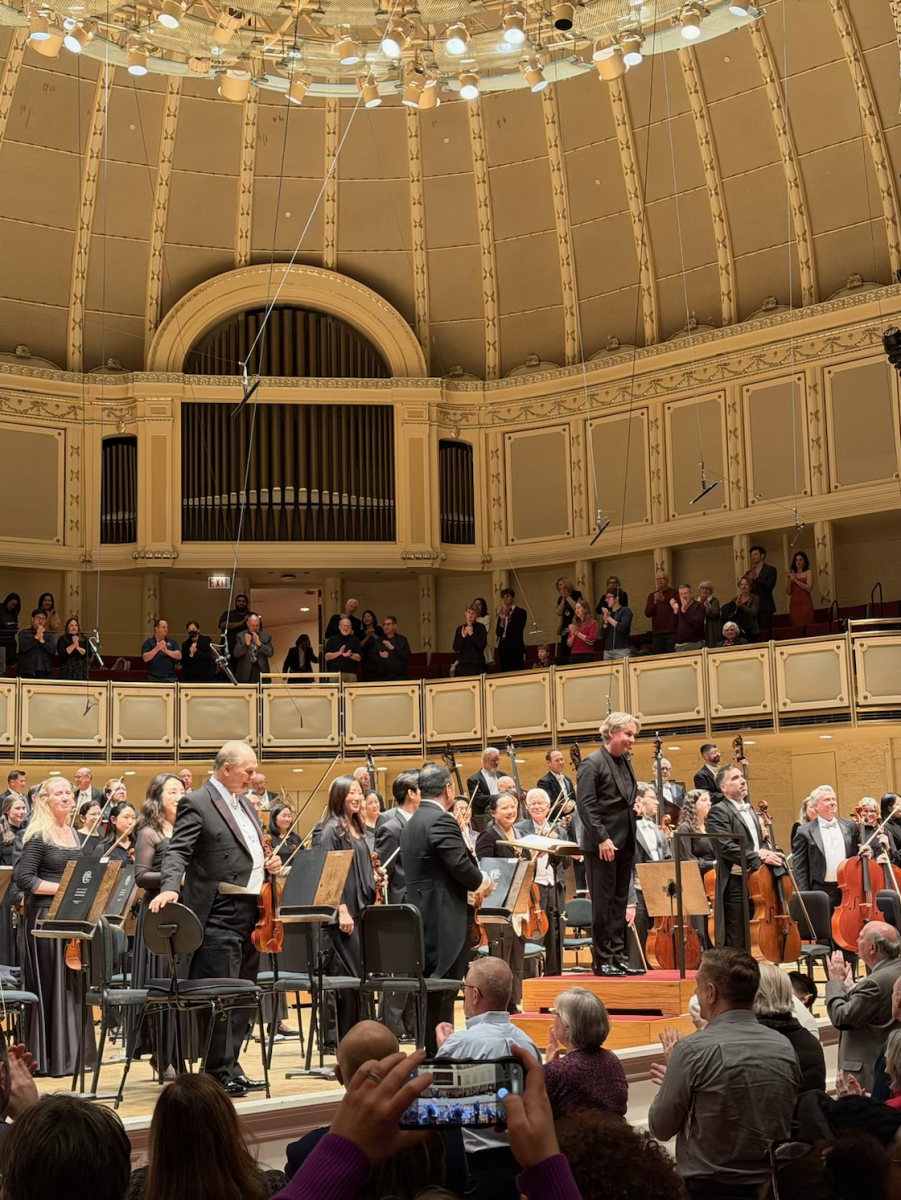
Following these appetizers, the audience came back from the 20-minute intermission to an illuminated auditorium, as expected. However, the lights did not dim. The conductor came out, there was the expected applause, but the lights stayed on. For a brief second, I wondered if there was a malfunction with the lights. I kept holding onto this thought as an even longer pause brought in the tolling bells to signify that the piece had begun. However, the lights remained on, and it was harder to concentrate my thoughts on the music—but I have yet to attend a funeral that was unequally lit.
Keeping the lights on during the performance made it hard to lose oneself in the music, but I like to think that’s the point. It forced the audience to grapple with the fact that one day each of us will have our own requiem. A performance of this piece that shies away from questions of mortality is hardly a performance of the Requiem. This emphasis on this funereal nature is one of the most significant ways that Honeck distinguishes it from other performances of Mozart’s final piece. It is a bold move that I had not seen before, and it shows Honeck’s deep understanding of the Requiem.
Following the bells was a sobering performance of the Gregorian chant Requiem aeternam, a soft and breathless request unto the Lord to grant eternal rest to the dead. After the first Gregorian chant concluded, the orchestra performed Mozart’s Maurerische Trauermusik (Masonic Funeral Music), two more Gregorian chants—Exaudi orationem meam and In quacumque die, respectively—and another piece by Mozart, Laudate Dominum—before reaching the Requiem itself.
The transition into the Requiem Mass was slow. The first piece, “Requiem aeternam,” was a gentle introduction, immediately contrasted with the begging terror of “Kyrie.” The size and power of the chorus here truly drove home the feeling of a mass of people begging for forgiveness in any way they can think of as it came together with the percussion ringing out like the banging of a door.
“Dies irae,” perhaps one of the most famous pieces from the Requiem, is very difficult to get exactly right. It requires a proper balance between characteristics which are easy to muddle together. The piece has terror, panic, fear, and despair all in one. Making the subtle differences between these seemingly similar emotions clear is essential to performing “Dies irae,” and this rendition perfected that balance between a punchy panic and a spiraling despair. While the orchestra might not have the size to elicit this effect on its own, it was the power of the chorus which was able to force this feeling in a way that I haven’t seen from other performances.
After the panic of “Dies irae,” I was stunned by the elegance of the soloists in the “Tuba mirum,” which truly emphasizes the array of emotions to be found in the Requiem. After the soloists stunned us in “Tuba mirum,” the power of the chorus returned in “Rex tremendae.” This piece is truly one where the audience was truly able to feel the full effect of these singers as every “rex” declared had a full weight behind it.
While the chorus cooperated in “Rex tremendae” to punch the listener with a direct weight, the “Recordare” followed it with an elegant display of cooperation from the soloists. It is in moments of contrast like these that this performance was able to exemplify Mozart’s genius in his final composition.
The strings in “Confutatis” had a less panicked feeling than I am used to, but the final effect left me with a more dramatic impression than I have seen before. The strings in “Confutatis” were more collected and controlled—driving home the impression of the cruel nature of eternal damnation. The vocals, which softened at first, came back with a confidence that matched and then surpassed the strings, working to further emphasize this ultimate message.
“Lacrimosa” also deviated from what I usually expect from performances of the Requiem, as the strings were not nearly as lamentable as traditionally expected. However, the vocalists again came through with a rising sensation that perfectly expressed the lamentations of the piece.
It was after the “Lacrimosa” that this production differentiated itself in the most dramatic way. After “Lacrimosa,” the Requiem Mass was interrupted by a Gregorian chant: “Christus factus est.” While this was an unexpected choice, it was a welcome one, as the contrast between the Gregorian chant and the “Domine Jesu Christe,” which came right after, left me with a favorable impression. The swaying drama of the “Domine Jesu Christe” required a calming afterword which the “Christus factus est” provided well.
The other surprising choice was that, after “Domine Jesu Christe,” “Lacrimosa” was reprised with a second—albeit shorter—performance of it. The drama of this reprisal might not be immediately apparent to people who don’t follow classical music, but my jaw dropped. This was a dramatic change. Honeck was making Mozart repeat himself—as if he hadn’t been able to say it properly the first time. This dramatic repetition shouldn’t have come as a surprise though: this rendition is full of them. But that is what made this performance so special. Few performances have forced me to experience the emotional variety of the Requiem, and it is through these changes that Honeck was able to elicit these reactions. This dramatic choice was a perfect end to a performance which was full of such choices, and as this second “Lacrimosa” ended, it was followed with a pause that felt a couple seconds too long, which led us into our final piece of the night, Mozart’s “Ave verum corpus,” before finally concluding with three more strikes of the bell. This conclusion for some might seem striking, since it leaves us halfway through Süssmayr’s original composition of the piece after only performing the first four parts. Yet this half-length performance echoed Mozart’s half-lived life which, ending at 35, did not detract from how much life he lived.
Counterintuitively, it is the unfinished nature of the Requiem that has allowed it to become one of Mozart’s greatest works. Rather than ending the conversation, the performance continued it. The Requiem stands as a challenge to inspire and be taken on by those brave enough to claim they can fill the shoes of one of the greatest composers to ever live. We won’t ever know what exactly Mozart’s vision was, but by constantly trying we can help keep him—and the classical tradition as a whole—alive. This is no easy task, but Honeck managed to achieve it in a well-lit auditorium.