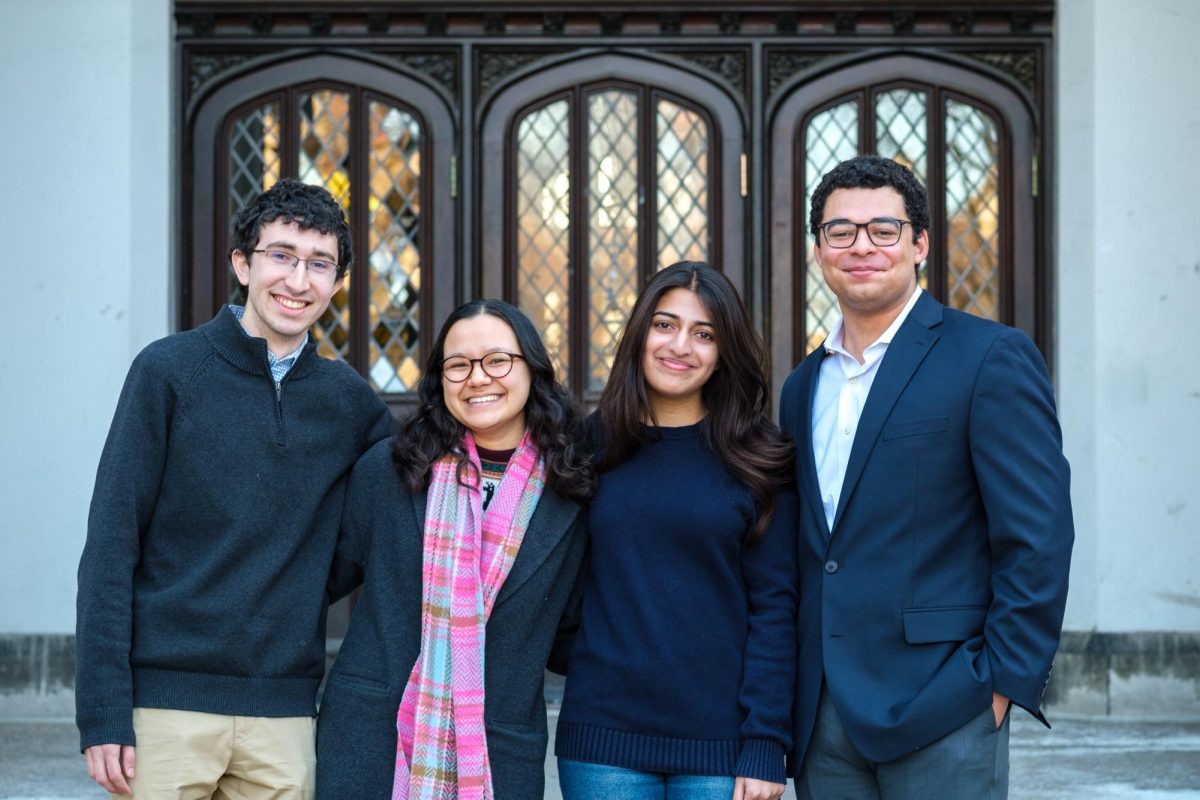
Joe Zhang, a fourth-year, and Samuel Levy (A.B. ’24) were selected to represent UChicago in the 2026–27 Scholar program. Zhang and Levy will accompany 148 other students from Harvard, Princeton, and other universities in the Schwarzman Scholars program’s 11th cohort.
Established in 2015, the Schwarzman Scholars program was inspired by the Rhodes Scholarship and promotes itself as a way to “strengthen understanding between China and the rest of the world.” More than 1500 students from 107 countries and 490 universities have participated in the program since its inception, and fewer than three percent of applicants are accepted.
The host institution, Tsinghua University, is part of C9, China’s designation for its top nine universities. It stands alongside Peking University as the top two colleges in the C9, with Peking best known for the humanities and Tsinghua for STEM.
Zhang, who studies economics, was drawn to the Schwarzman Scholars’ global studies program because of his experience “competing in a wide range of international competitions, from investment arbitration to insolvency disputes, [which] exposed me to legal reasoning in settings that closely mirror real-world dispute resolution,” he told UChicago News.
During his time at UChicago, Zhang has worked with various legal institutions and the World Peace Forum, an annual non-governmental peace conference, and he currently serves as an assistant coach for the College’s moot court team. While at Tsinghua, he plans to research “international security and Chinese foreign policy, focusing on the intersection of law and global governance,” according to his Schwarzman Scholars profile.
“Schwarzman is more than a chance to study Global Affairs; it’s the chance to learn alongside a cohort whose experiences range from public service to tech entrepreneurship,” Zhang wrote in a statement to the Maroon. He hopes to work with China International Economic and Trade Arbitration Commission, an international arbitration firm.
“Learning alongside peers from diverse sectors, from entrepreneurs to policymakers, offers a perspective I simply cannot get in a traditional classroom. That exchange is vital because effective legal frameworks aren’t built in a vacuum,” wrote Zhang.
Levy graduated in 2024 with bachelor’s degrees in political science and global studies and spent a term at National Taiwan University in 2024 as a Boren Scholar in the International Chinese Language Program. He has also studied at the Kivunim Institute in Jerusalem. Levy could not be reached for comment.
Since February 2025, Levy has worked for the Department of Justice as an internal affairs specialist. In a LinkedIn post about becoming a Schwarzman Scholar, Levy wrote, “After spending years studying China’s history, policymaking, and language, along with U.S. foreign policy toward China, I am incredibly excited for this opportunity to study directly in China.”
Levy thanked his mentors and professors from UChicago in the post, citing UChicago’s Institute of Politics and the Office of National Fellowships as sources of guidance and advice during his undergraduate years.
“UChicago provided me with my initial introductions to Chinese affairs and the Mandarin dialect of the Chinese language,” Levy told UChicago News. Classes are taught primarily in Mandarin at Tsinghua, which will allow Levy to continue his study of the language and pursue “similar insights on China throughout my time with the program” to what his study of Chinese affairs at UChicago provided.
“I know that Schwarzman Scholars and Tsinghua University also have an incredible network of faculty and I’m excited to learn from their perspectives while taking advantage of every opportunity possible during my year in Beijing,” he said.