The Griffin Museum of Science and Industry (MSI) on October 13 broke ground on a $22 million renovation to reopen its historic south entrance. The project is part of a broader effort to expand access to the Jackson Park landmark, even as preservation advocates criticize a separate proposal for a massive new north entrance.
The south portico renovation will reopen the museum’s original entrance for regular public use for the first time since the 1893 World’s Fair. Construction is expected to finish in late 2027, with the $22 million total cost primarily supported by a $10 million donation from the Richard H. Driehaus Foundation.
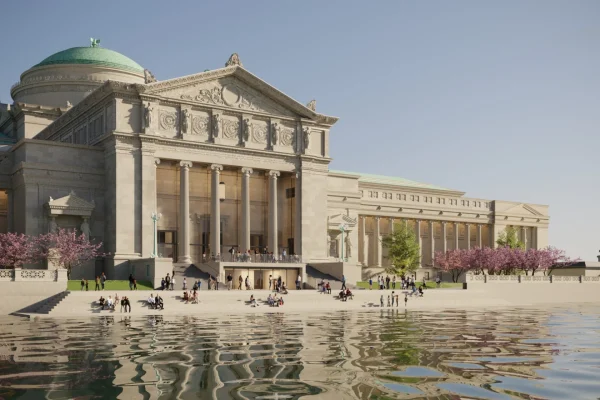
Plans for the project include a new ADA–accessible entrance and a café with an outdoor terrace overlooking the Columbian Basin and Jackson Park. Large glass panes will be installed between the portico’s historic columns, creating an enclosed overlook.
The renovation comes months after the June opening of the nearby Obama Presidential Center (OPC), which has brought renewed attention and activity to Jackson Park. Museum officials hope the south entrance will help connect the two cultural institutions.
“That is the original entrance,” MSI president and chief executive Chevy Humphrey told the Chicago Sun-Times in June. “We want to celebrate that history, but we also want to show how we’re modernizing.”
At the October groundbreaking, Humphrey credited her conversations with residents for inspiring the project. “The community felt we had our back to Jackson Park and asked us to open our doors once again, which is exactly what we’re doing with this project.… We want everyone to feel like they belong here,” she said.
State Representative Curtis Tarver, who represents the MSI in the Illinois General Assembly, praised museum leadership for investing in the South Side and urged them to “keep charging forward until we get to [the] ultimate vision, which is making [the MSI] free again.” Adult general admission at the MSI currently costs $25.95, although UChicago students receive free admission.
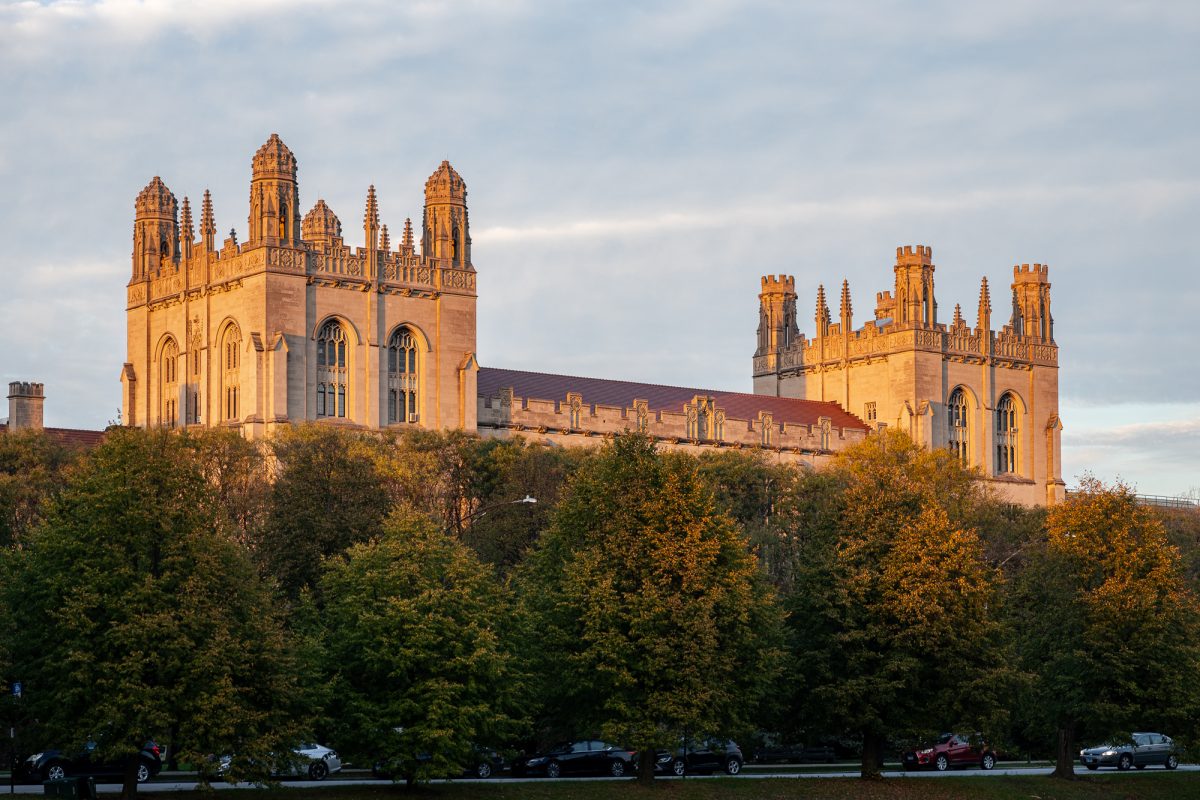
The building that now houses the MSI originally served as the Palace of Fine Arts during the 1893 World’s Columbian Exposition, when visitors approached its southern steps by boat across the lagoon. It was the only World’s Fair building built with masonry rather than plaster and wood (to protect the artworks within in the event of a fire) and consequently remained standing after the fair’s end. The building reopened as the Museum of Science and Industry in 1933, with its primary entrance shifted north. The existing subterranean lobby was constructed in the 1990s.
The south entrance is only one part of MSI’s transformation.
In September, the museum unveiled plans for a new welcome hall outside its north entrance along 57th Drive. The proposed glass-and-limestone pavilion would stretch 458 feet across the museum’s front lawn and rise nearly 30 feet tall. It would replace the current underground lobby with a more direct entrance.
The two projects a being led by RAMSA, a New York firm known for its neotraditional designs, including the George W. Bush Presidential Library, the Museum of the American Revolution, and the recently opened Raclin Murphy Museum of Art in Notre Dame, Indiana. The firm’s design for the MSI’s new north welcome hall, however, is highly contemporary.
The proposed facade has drawn criticism over its potential impact on the museum’s historic facade and surrounding green space. Chicago Sun-Times architecture critic Lee Bey called the proposal a “carbuncle in the park,” arguing that the addition would overshadow the landmark building.
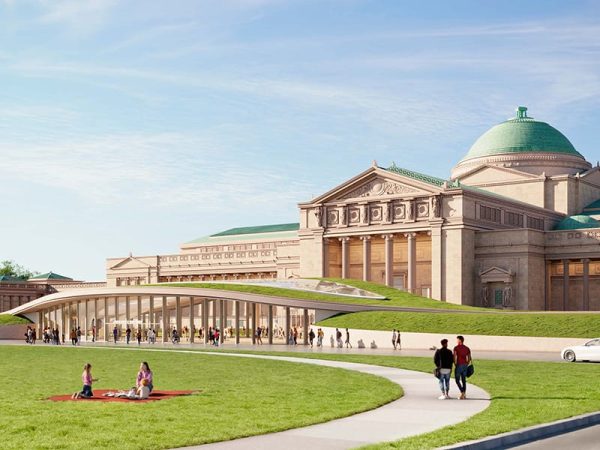
Staff at the Chicago Park District, which owns the property, harshly criticized the proposed north entrance’s bulk, layout, and lack of alignment with the historic structure before ultimately approving the project.
At the groundbreaking, Bey told the Maroon he appreciated the “more subdued” architecture of the reopened south entrance, as well as Humphrey’s intention to “open up” the museum to the South Side.
The renovations follow major philanthropic investments in MSI. In 2019, billionaire hedge fund founder Kenneth Griffin donated $125 million to the institution, the largest gift in its history, prompting the museum’s official renaming in 2024. The museum has not specified how much, if any, of that donation will fund the proposed north entrance.
Beyond MSI’s renovation, efforts to improve navigation throughout Jackson Park are also underway.
In March, U.S. Representative Robin Kelly (D-Ill.) announced $1.2 million in federal funding to improve pathways linking MSI, the OPC, and the Garden of the Phoenix, also known as the Osaka Garden. The funding will support upgrades including pathway repairs, lighting, and safety improvements.
The investments aim to make Jackson Park easier to navigate as foot traffic around the presidential center increases. But another historic connection remains unresolved: the Clarence Darrow Memorial Bridge, located south of MSI across the Grand Basin.
Built in 1880 and designed by Burnham and Root, the bridge has been closed to pedestrians since 2013 due to structural deterioration. Preservation advocates have pushed for repairs that retain its historic limestone and ironwork rather than replacing the structure outright.
The Chicago Department of Transportation has repeatedly delayed the bridge’s restoration timeline, now set for fall 2028, according to Preservation Chicago.
The bridge has previously been the subject of community preservation efforts, as residents have sought assurances that reconstruction will preserve surviving elements of the original design. Its continued closure leaves a gap in the park’s historic pedestrian network.