It’s not every day that a giant fly buzzing over a naked body is projected onto a screen. You can witness this characteristically provocative film until February 22 at the Museum of Contemporary Art (MCA) in Yoko Ono: Music of the Mind. The seminal retrospective is an evolution from a Tate Modern exhibition that traces the trailblazing artist’s career. Although best known for her artistically prolific and romantic partnership with Beatles singer John Lennon, Ono’s creative oeuvre extends far beyond her late husband. That the 92-year-old’s pioneering work in contemporary art still feels fresh is a testament to this. A boundary-defying spirit pulsates through every curated artifact from Ono’s imaginative world.
Upon entering the sprawling exhibit at the MCA, I did in fact feel that I was exploring a previously unknown territory of my mind. The museum’s floor-to-ceiling windows and airport-like corridors evoke a liminal space perfectly suited to a famed conceptual artist. With art that poses a riddle for viewers to answer, Ono’s intention is to “induce music of the mind in people.” She labels the “mind-world” as a space where ideas transcend the confines of the individual and time. In this boundless territory, spectators are invited to explore their imaginations and memories.
In keeping with Ono’s artistic philosophy of provocation, the exhibition is structured to allow viewers to intimately partake in the worlds of Ono’s creations. Overtaking the hallway is a collection labeled “Personal Is Political.” In Wish Tree (1996–present), viewers are called to write their hopes on paper and hang them on a tree. The lush trees are a nexus of activity, and viewers become a part of the art piece as they mill about and hang their hopes. The sociality of the activity fulfills Ono’s desire for you to “ask your friend” to also make a wish.
The piece was surprisingly emotional, and I recalled memories of hawthorn trees in Ireland. I felt a visceral connection to my past wishes and my future desires. One of Ono’s goals is to cultivate a personal relationship with art that exceeds typical boundaries. Wish Tree is a great example of this.
While the wishes were oriented towards the future, Ono’s other works implicate viewers in the present. In The Blue Room Event (1966), a white chamber recreates a show Ono has staged many times in her career, in places including New York, Lyon, and London. Participants walk through a room inscribed with scribbles that share a different interpretation about what the room could be like. By using imaginative powers, the viewer is bidden to extend the possibilities of the environment at hand. A gentle smile came on my lips as I read, “Find other rooms which exist in this space,” prompting me to create a blueprint in my mind’s eye. The room challenges the solid fabric of society but also summons us to participate in its fashioning. It exemplifies Ono’s driving question: “What are the boundaries of the viewer and designer in creating art?”
This is true, too, in Unfinished Work (1966), a risky challenge to traditional assumptions about art. In Ceiling Painting/Yes Painting (1966), visitors ascend a step ladder with a magnifying glass to read a small word on the ceiling. John Lennon was one of the adventurous visitors who first climbed the ladder. He reflected upon reading “Yes” as the word, “So it was positive… I felt relieved.¨ Rather than making an empty, alienating statement, Ono’s purpose was to build a caring dialogue with her audience. It was this alignment between the Lennon and Ono’s galvanizing missions that permitted the two artists to dovetail their paths and commence a romantic and artistic relationship.
The book Grapefruit (1964) embodies Ono’s desire for viewers to improvise with her like an adaptation of melody. She includes more than 200 prompts for readers to answer with physical action or mental exploration. In Smell Piece II (1962), she implores the viewer to “[s]end a smell to the moon,” challenging challenged them to engage in Ono’s active imagination.
Grapefruits are deeply significant for Ono, resembling “East and West, the two cultures in [her] life.” She resonates with the fruit’s hybridity, with her own identity steeped in Japan and the United States. By enfranchising viewers, the set of instructions invites a democratic exchange, granting them creative authority on par with the artist herself. You can tell that many of these works were born amidst America’s hippie movement; much of Ono’s project seeks to eliminate social categories and boundaries, treating them as distractions to higher aesthetic aims.
Yoko Ono: Music of the Mind also gives the viewer a look into Ono’s life and motivations. The first piece of Grapefruit, Secret Piece, captures Ono’s origin story as an experimental artist. As a child she was highly sensitive to sound and coped by hiding in a dark room at her parents’ house. She would cover her ears in gauze and watch a lit match flicker and burn. On a ripped notebook page, she expresses musical notes for a song that is meant to give a melodic soundtrack to “[t]he woods from 5 a.m. to 8 a.m. in summer.” Through memory, Ono escapes into a beautiful sonic landscape even when her surroundings have a tumultuous tempo.
Interspersed throughout the exhibit are opportunities for museum-goers to actively partake in Ono’s imagination. In Play it by Trust (1966), viewers are prompted to play a game of chess with only white pieces. In Mend Piece (1966), three tables are placed at which viewers can stitch broken ceramic fragments together with supplied tape, scissors, and twine. The “completed” pieces are artfully placed on display shelves. By tangibly interacting with these objects, the spectators play with the elements of Ono’s mind.
Ironically, given the name of the show, the aural experience of Music of the Mind is quite disorienting. Except for a closed-off room where viewers can listen to music Ono produced from 1968 and 2018, there is no consistent soundscape beyond a background hum of museum-goers and tour groups. From time to time, a loud banging even jarringly echoes through the space. I identified the source, Painting to Hammer a Nail (1961), where one may pound a hammer, suspended from a nearby string, against a canvas. While provocative, the deafening banging unsettles an otherwise harmonious experience. Perhaps the curators could have chosen a less disruptive painting to present—then again, maybe it was meant to draw us out of our complacency.
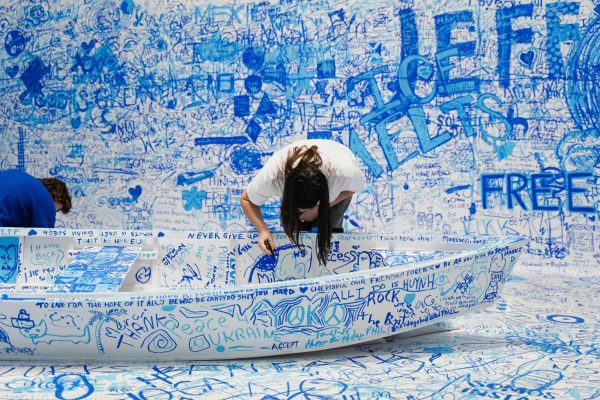
The last room Add Color (Refugee Boat) (1960) already bears the marks of engagement. Viewers are asked to scribble their own messages in blue markers on the white—now mostly blue—walls. Many are scrawled political messages in response to the second presidency of Donald Trump, such that the piece recalls Ono and Lennon’s famous activism during the Vietnam War. Frenzied handwritten messages of “No Kings” and “Fuck ICE” color the walls. It is a sharp reminder of how, even today, Ono’s work blurs the line between museums and the outside world.