


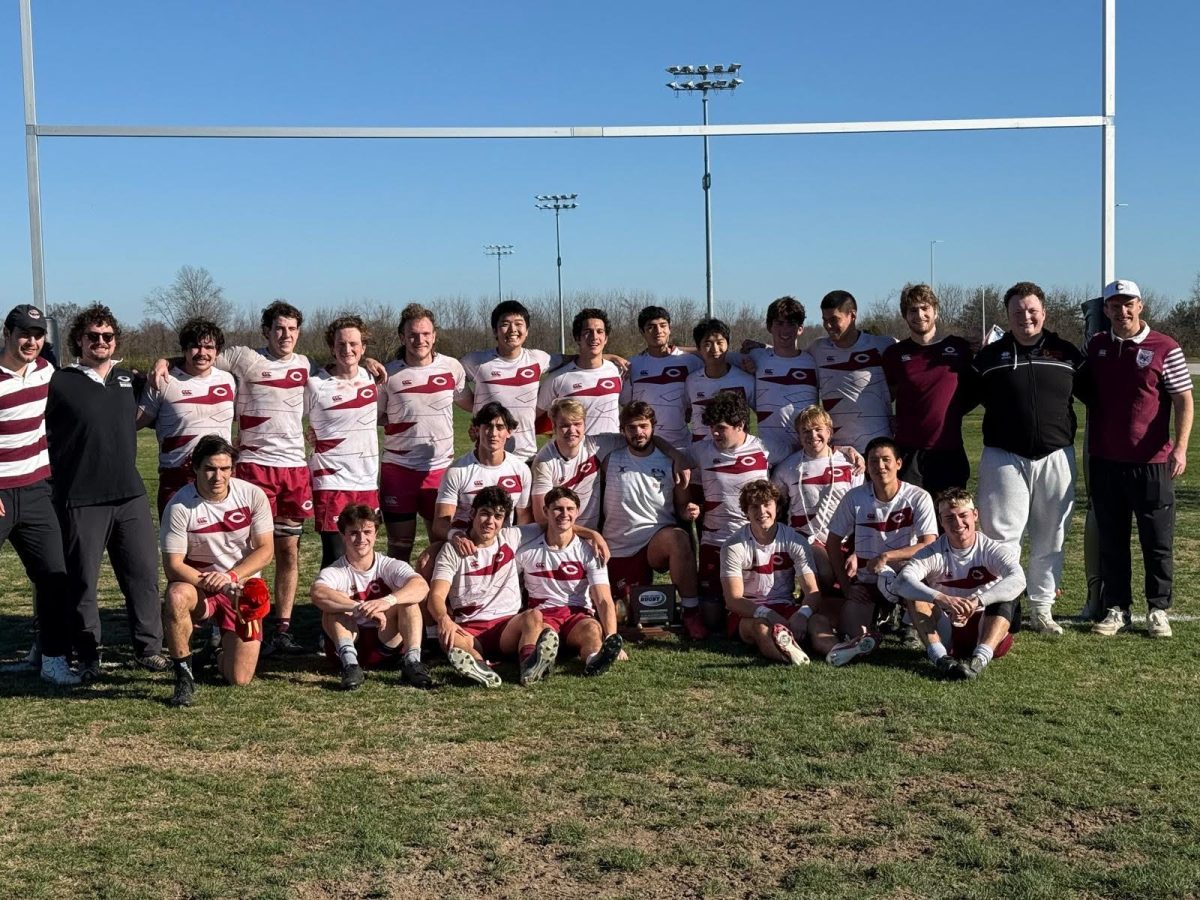
If you’re walking around the south side of campus on any given weeknight, you’ll probably hear a clamor rise from the Campus South Athletic Field. Peering through the fence, you’ll catch sight of one of the fastest growing spectacles in the United States: college rugby.
UChicago features both a men’s and women’s rugby team, both of which have seen a significant increase in membership over the last decade. In 2025, the men’s team made a run to the Division II National Championship, marking the beginning of a new era of excellence for UChicago Rugby.
Only two years ago, the men’s squad failed to qualify for their conference playoffs. Last year, however, the team earned one of the national tournament’s coveted 16 qualifying spots, completing a historic turnaround that instilled a key confidence in the returning players.
“It was definitely a game-by-game scenario to see if we’d make it to the national semi-finals and the final, though coming off a strong season last year and making it to the top 16 definitely showed that we had nationals potential from the start,” second-year forward Diego Orrego explained.
Importantly, last year’s loss in the first round did more than just prove the program’s ability to compete with the nation’s best teams: it put a chip on the team’s shoulder that would prove pivotal in the team’s playoff run. “At the very beginning of the season, I think for most of us the goal was to get past the round of 16. Last year we got knocked out in that first round and that really stung,” forward Tomi Rossini told the Maroon.
With a boosted assurance in the team’s ability and the prior year’s early tournament exit motivating the group, they were poised to make a deep run.
Beyond their in-game chemistry, this year’s team was remarkably close off the field as well. First-year hooker Ben Lozovsky attested to the team’s tight knit nature: “We have a lot of fun off the field, whether it be on the way to games or just hanging out socially outside of rugby. It’s a really great, supportive community that’s constantly encouraging us to be better both mentally and physically.”
In reflecting on the season, many players emphasized the eclectic nature of the squad. “It was such a joint effort from everyone on the team. We have a super diverse team with lots of people from different backgrounds, and every single person contributed in some way,” noted second-year flanker Jack Allison.
The squad’s diversity allowed the team to bond not only over their shared love of rugby but also over their respective cultures. Orrego shared one such instance, recalling, “In our seven hour road trip to Springfield, Missouri, I was in a car with three Brits, so it was a bit of a cultural exchange as they talked about stories from the UK and watched cricket—the Ashes had just started—while we drove through the middle of America on superhighways and stopped at a Buc-ees for some brisket.”
Many members of the squad can often be spotted together at the dining halls, in the gym, and even at the Pub. The team’s cohesion proved especially helpful down the stretch with the upperclassmen taking on a particularly important role in that team dynamic. “Once we hit playoffs, we were all aware that it was win or go home, so a lot of us were playing with those upperclassmen and people that were graduating in mind. We all wanted to make them proud and send them off in a way that was fitting,” second-year center Caius Mischlitsch explained.
The Maroons’ regular season was a massive success. The team knitted together quality win after quality win, even accomplishing an upset 52–21 rout of Northwestern behind third-year Joe Baldwin’s five tries.
After earning a spot in the Great Midwest Conference Tournament, the Maroons cruised to the semifinals, where they faced Loyola University Chicago. Loyola came into the game as a familiar foe for the Maroons, having presented the team with one of its toughest challenges of the regular season in a tooth-and-nail scrap that concluded in a 21–21 draw. However, the rematch was an entirely different story as the Maroons sailed to a 35–10 victory. After beating University of Northern Iowa, who had won the last three conference championships, in a decisive 38–15 win, the Maroons booked their ticket back to the Nationals.
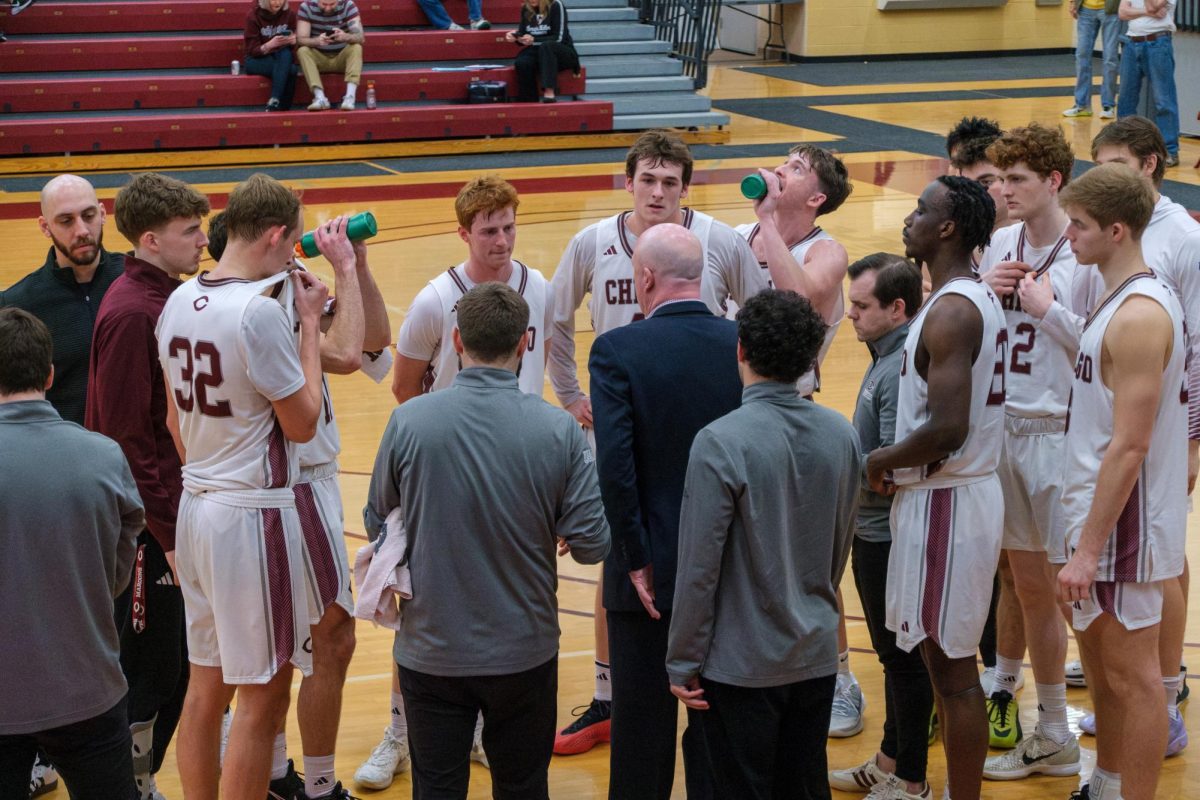
After besting Benedictine College in the Round of 16, the team faced their hardest opponent yet, Colorado-Mesa University. While the Maroons got off to a fast start, taking the lead 17–7 in the first half, they found themselves down 31–17 in the 50th minute and lacking in momentum. As the returning players watched their lead collapse into a sizable deficit, they had flashbacks to the prior year’s early tournament defeat. “I remember the moment when we had all gathered under the huddle thinking back to last year’s Round of 16 game and just thinking ‘not again.’ In that moment I think it was the first time I thought we would lose that season,” admitted third-year hooker and team president Mateo Rampoldi.
Yet, what seemed to be a replay of the prior season’s exit wasn’t to be, with Rampoldi recalling the match as the most pivotal point of the season. “I can’t remember what was said in that huddle, but I knew we were all determined that, win or lose, it would not be as easy as that last score,” Rampoldi described. “We held ourselves accountable, regrouped, and ended up winning the match 43–38. Being able to come back like that showed how badly we wanted that Final Four spot and how hard we had worked on the season up to that point.”
It was determination that characterized this team. From their unexpected triumph over Northwestern early in the season to their statement win against Loyola Chicago in the Great Midwest Conference Semifinal, the Maroons simply refused to give in.
That unlikely victory over Colorado-Mesa propelled the squad to the first Final Four appearance in program history, a spectacular turnaround for a team that had failed to make regional playoffs just two years before.
After a convincing 42–26 triumph over Grand Valley State in the Final Four, their storybook season finally came to an end against the top-ranked team in the nation, University of Vermont. Ending their run in the National Championship, UChicago Men’s Rugby had proven themselves on the biggest stage in college rugby only two years after failing to make their conference playoffs.
Looking back on their run, it’s impossible not to notice how far the program has come in recent years. After years of struggling to compete within the conference, the Maroons seem poised to dominate on the national level for years to come. Rampoldi reflected on the development he’s seen in his time on the team. “The amount that [the program has] changed since my freshman year is insane. We didn’t have a coach, we didn’t qualify for conference playoffs, and the mentality was trying to take everything one game at a time and just try to win. Even up until last year, we only had about 18 people show up consistently to matches. We had never been ranked nationally, and there wasn’t an established board. Now, we have a group of at least 25 players who are ready to go on any given gameday, we’re conference champions, we have an incredible coach with tons of professional rugby experience, and we’ve set the bar unbelievably high for ourselves by making the national championship.”
UChicago Rugby has officially arrived on the national stage, and they’re here to stay.
Pedro (the small guy) / Mar 2, 2026 at 9:52 pm
Lets go UChicago Rubgy!!