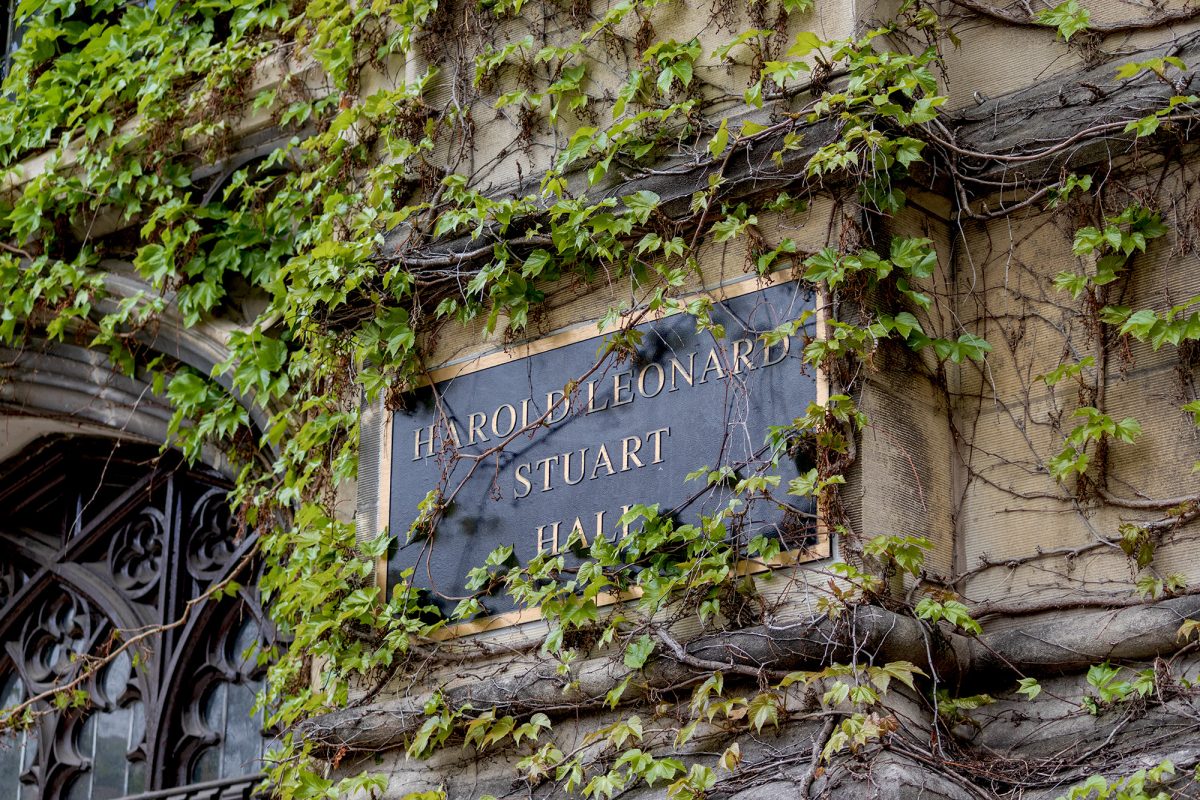
The University of Chicago Law School will host the U.S. Court of Appeals for the Federal Circuit this week as part of the court’s 2026 out-of-town session, which will include visits to six Chicago-area law schools.
Beginning at 10 a.m. on Wednesday, a panel of three judges will hear oral arguments in pending appeals in cases ranging from patent infringement to termination from the Department of Homeland Security (DHS). Students and members of the public will then have the opportunity to hear from the judges about the court and the legal profession.
Established in 1982, the Federal Circuit Court of Appeals is one of 13 federal appeals courts in the U.S. and the only one organized by case type rather than geographic location. The court primarily hears appeals dealing with patent and trademark law, international trade, and some claims brought by federal and other public officials. It does not hear appeals from criminal or state civil courts.
Among its most notable decisions, the Federal Circuit in 2025 affirmed a ruling by the U.S. Court of International Trade that President Donald Trump could not use the 1977 International Emergency Economic Powers Act to impose tariffs to correct trade imbalances or combat the flow of illegal drugs into the United States. The decision was later appealed to the U.S. Supreme Court, which ruled 6–3 in Learning Resources, Inc. v. Trump that the tariffs were unlawful.
While normally located in Washington, D.C., the Federal Circuit has held an out-of-town session—when it temporarily relocates to cities across the country to hear oral arguments and interact with law students—in nearly a dozen cities since its establishment. UChicago hosted a similar session in 2018.
“Chicago is a great legal city, and I know that firsthand from my time teaching at Chicago-Kent [College of Law],” Chief Judge Kimberly Moore said in a press release. “The Federal Circuit serves the entire country, and sessions like this give law students and members of the public an opportunity to see the court at work. We look forward to hearing cases across Chicago and meeting with students.”
Rather than hearing cases individually, like most trial courts, or as a complete group, like the U.S. Supreme Court, federal appeals courts hear most arguments in assigned panels of three judges. Appeals court decisions can be reheard en banc by the entire court, or cases can be first heard en banc in particularly complex or consequential cases.
“Visitors will see an official session of a federal appeals court, with real cases and real consequences for the parties. The proceedings follow the same procedures we use at our courthouse in Washington,” Moore wrote in response to questions from the Maroon. “Observing oral arguments gives people an opportunity to see how judges consider competing legal arguments and question attorneys before reaching a decision. That firsthand view can help make an unfamiliar process more understandable.”
During its sitting at the Law School, the panel of judges will hear appeals in six cases: three were previously decided by the U.S. Patent and Trademark Office, one was decided by the Merit Systems Protection Board (MSPB)—a “quasi-judicial” agency created to adjudicate disputes about the hiring and firing of federal employees—, one is a patent infringement case decided by the U.S. District Court for the Northern District of California, and the final case is a breach of contract case against the U.S. government decided by the Court of Federal Claims.
The MSPB case, John C. Lee v. Department of Homeland Security, concerns a former Immigration Services Officer who was fired in 2017 after he was convicted of making false statements during an internal DHS investigation. The MSPB upheld Lee’s termination, finding that he had “eroded the necessary public trust and confidence in the agency’s officers,” and that he had previously been warned about his conduct.
Notably, this week’s hearing will be the second time Lee has brought the case before the Federal Circuit Court of Appeals. Lee appealed the MSPB’s original decision to the Federal Circuit, which ruled in 2024 that the MSPB had correctly applied the law but may have considered improper evidence in determining whether Lee’s termination should have been upheld. On petition for review, the Board declined to offer Lee the chance to make his case again and upheld its previous decision.
“We value the opportunity to meet with the local legal community and hear about the work attorneys are doing in different parts of the country,” Moore wrote. “Those connections are especially meaningful for a court with a nationwide jurisdiction.”
Prospective attendees of Wednesday’s arguments are encouraged to familiarize themselves with the court’s rules before arriving.