


More than 100 University employees and students from across five campus labor unions gathered on the main quad on Wednesday, rallying in protest of the University’s sweeping budget cuts and in solidarity with the Division of the Arts & Humanities, which faces a major restructuring and an admissions pause announced over the summer.
The rally featured speakers from Graduate Student United–United Electrical (GSU–UE), UChicago’s chapter of the American Association of University Professors, Faculty Forward (FF), National Nurses United (NNU), the Committee of Interns and Residents, and Students for Justice in Palestine. Together, the unions represent over 7,000 workers at the University, including graduate students, tenure-track and non-tenure-track faculty, nurses, and resident physicians. A representative from Students for Justice in Palestine also spoke at the rally.
“[We] don’t accept the narrative that these cuts are necessary or inevitable,” Alicia Badea, a Ph.D. student in the Germanic studies department and a member of GSU–UE, told the Maroon after the rally. “We want to put people over profits and… [show the administration] that we have power and that we are organized and that we want to protect our livelihood.”
Over the summer, the University announced that in addition to departmental mergers in the Division of the Arts & Humanities and graduate admissions pauses across over a dozen programs, it would reduce its overall internally funded Ph.D. population by 30 percent by academic year 2030–31 and cut the hiring rate of tenure-track faculty by 30 percent. These measures are part of a broader effort to cut spending by $100 million over the next few years and to balance a $288 million deficit as of fiscal year 2024.
“[These changes] will ensure that the University of Chicago is more resilient and in a strong position to continue to thrive,” University President Paul Alivisatos wrote in the initial letter to faculty in August.
Badea said that these changes had been “announced top down… with no input from the people they would affect.” The changes, they added, would be especially damaging to smaller departments like their own.
“We have eight Ph.D. students left—most of us are a cohort of one, [me] included,” they told the crowd. “What is 30 percent of one each year? My department has to fight to be allowed to admit one to three students over just a few years.”
Excluding Germanic studies, the four smallest departments under Arts & Humanities are Slavic languages and literatures, comparative literature, Classics, and South Asian languages and civilizations, which reported seven, 21, 21, and 22 doctoral students in the registrar’s spring quarter 2025 census respectively. The Maroon previously reported that the University was considering reducing language instruction and dissolving any departments with fewer than 15 tenure-track faculty—a category which all five of these departments fall under—as a part of its restructuring efforts.
Badea added that the reductions would likely also lead to “fewer classes, fewer types of classes, larger class sizes, [and] fewer teachers for more students.”
Several speakers linked the cuts to a broader trend of corporatization at the University. GSU–UE president and molecular engineering Ph.D. student Evan Yamaguchi described the University as having “profit-driven motives.” FF steward and Hindi instructional professor Jason Grunebaum noted that the University has been increasingly acting “in ways more typical of a for-profit institution,” echoing Badea’s concerns about the future of language departments.
“Our Ph.D.s go on to get great jobs because of the language training they’ve had here that’s offered nowhere else in the world,” Grunebaum said. “When admin sees a few students registered in our language classes, they suddenly see precious pennies that wouldn’t even amount to a rounding error for an institution sitting on a $10 billion endowment.”
As of October 18, the my.UChicago portal indicates that almost all Hindi and Bosnian/Croatian/Serbian courses have fewer than five students enrolled per section for autumn 2025—across eight and three courses offered respectively—placing them well below the University’s reported average class size of 18 students.
Yamaguchi also called for greater budget transparency, recalling GSU–UE’s experience with bargaining for and ratifying its first-ever contract in 2024.
“They constantly said, ‘There’s no money, there’s no money, there’s no money,’” he told the Maroon. “And then finally, once 2,000 grad[uate] workers decided to pledge to strike, suddenly there is $20 million for the raises that we wanted—and that’s not even the full package that we won. So we know that the University is not being fully transparent about their finances, and until they show us exactly what money is [and] isn’t there and how it’s being spent, we think that we know that there’s money.”
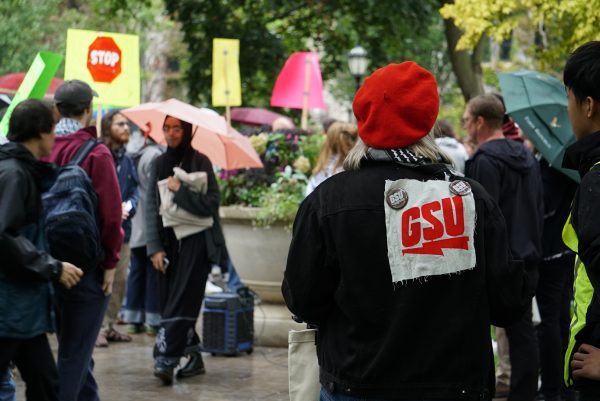
(Damian Almeida Baray)
Badea argued that the University has misrepresented its financial troubles in recent statements by framing them as a result of the Trump administration’s attacks on higher education rather than “decades of financial mismanagement.”
“If one of the goals of the Trump administration is to dismantle higher education, why is UChicago doing it for them?” Badea said.
In addition to departmental cuts, the University also announced earlier this year that it would be reducing unrestricted funding to all centers and institutes by 20 percent, encouraging all centers to focus on securing external revenue sources.
At the rally, Gina Samuels, an associate professor at the Crown Family School of Social Work, Policy, and Practice, explained that the Center for the Study of Race, Politics, and Culture has already begun to feel the effects of these funding cuts. She said the center was “forced” to close its Beyond Prisons program—which focused on “expanding the opportunities for teaching and learning with those who are justice system–impacted”—last week and that she recently learned it is “no longer a funding priority of the University.”
“This news is the final stake in our coffin,” Samuels said. “Lacking any assistance from our development office to fundraise, the Race Center has been sentenced to our death.”
Although several of the unions present at the rally are not currently engaged in active contract negotiation—such as GSU–UE and NNU, whose current contracts expire in 2027 and 2029 respectively—Yamaguchi emphasized that the University’s funding cuts impact all employees and students regardless of department and shape the five unions’ demands as a collective.
“[We want] to make sure that we’re building bridges across the different units at this University,” he told the Maroon after the rally.
“We as graduate workers demand no pauses, no mergers, no cuts,” Badea said. “Defend, don’t defund, higher education.”
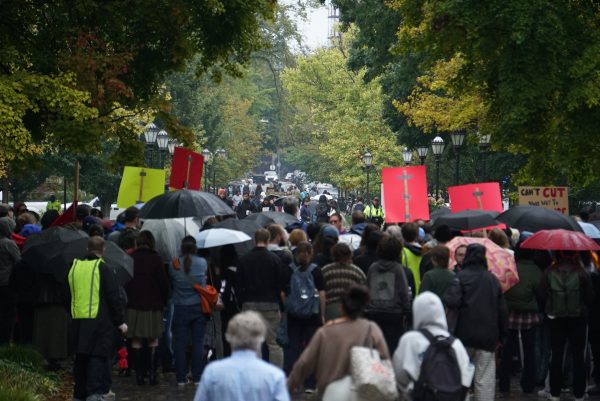
(Damian Almeida Baray)


Aaron Wineberg AB’24 / Oct 18, 2025 at 9:19 pm
While I sympathize those who are disheartened by these cuts, I hope these grad students ultimately realize they are net consumers of university resources and they are in no position to be making demands. These cuts are a necessary step to ensure the university remains competitive for future generations— including for those in their departments. Unlike STEM PhDs, humanities grad students are, mostly, not funded by external research grants. Rather, the university subsidize their education itself. Despite their claims of being workers, grad student responsibilities as a teaching assistant by no means covers the incredible cost of their education. Further, thanks to recent union actions, their stipends have doubled over recent years. This creates an unsustainable financial equation for the university. Especially when the university has other financial pressures that arguably take priority— such as investing in financial aid for undergraduates and recruiting top faculty.
Combined with poor tenure track placement for many programs begs the question of how large humanities & social sciences cohorts the university can thoughtfully support. Though many protestors and aspiring PhDs may not appreciate it now, it is a great disservice for the university to bring them in without a high likelihood of meaningful academic employment afterwards.
Most universities do not guarantee funding for their PhD students and these protesters occupy an incredibly privileged and elite position within higher ed— they are not victims. Though I am sad to see cuts in departments that meant a lot to my education, these protests unfortunately come off as entitled in a time when every R1 university is under pressure.
AA / Oct 19, 2025 at 7:16 pm
What is privileged is your debonair rage-baiting opinion on graduate students’ role at the university.
Do you know what the stipend is at competitive peer institutions? We still LAG behind others. Plus, the Humanities here has to constantly make a concerted effort to pull admits who otherwise are drawn to coastal elite schools. Every peer elite university guarantees funding for their graduate students — even if it means some form of extra teaching.
There are also plenty of external research grants from outside the university that help fund Humanities PhD research, including the Mellon Foundation. “Internal” — as you say — grants like the Neubauer Fellowship competitively fund *both* science and humanities graduate students.
The University of Chicago has produced some of the greatest minds in the Humanities, whose contribution to society has a prestige value that can’t be reduced to monetary value. You cannot deny that any R1 university, regardless of how the status of their science divisions, are not prestigious universities without a robust Humanities division. Are you people living under a rock?
And how about the shoddy investment strategies of the trustees? All this amid the AI bubble that analysis are saying is 17x bigger than the dot com bubble? It sounds like you’d rather have the university cut these programs and put money in speculative robot-dystopia endeavors.
Please inform yourself of the actual situation before adding your comments.
JJ / Oct 20, 2025 at 10:11 am
“Prestige value” is not a business model, nor is nostalgia for bygone glory a strategy for survival. The University’s trustees, for all their incompetence, at least understand arithmetic: you cannot fund infinite grievance with finite resources. If the Humanities wish to remain “robust,” they might begin by producing scholarship that justifies its own existence—rather than demanding welfare from those divisions that already do.
AA / Oct 28, 2025 at 10:06 pm
If you think UChicago does not produce Humanities research that justifies its existence I am not sure what planet you are on. What other university can even be compared to the humanistic inquiry and rigor that is the hallmark of UChicago?
The only person to have ever edited the entirety of Shakespeare’s corpus was a UChicago faculty member, the late David Bevington. The University boasts faculty and alum that have shaped American literary culture from Philip Roth to Saul Bellow and Norman Maclean. Alumni include Susan Susan, Roger Ebert, and Elaine May.
Are you living under a rock? Yikes.
TD '14 / Oct 28, 2025 at 10:10 pm
*makes up arbitrary rule that research should justify its own existence*
*doesn’t understand that humanities research is precisely defined by that very idea*
*fails to propose how, say, any other form of research claims to justify its own existence.*
JJ / Oct 18, 2025 at 5:45 pm
The language of “solidarity” and “community” is camouflage for what it has always been: a demand for perpetual subsidy from disciplines that actually produce value.
AA / Oct 19, 2025 at 7:22 pm
Thank you for your input…