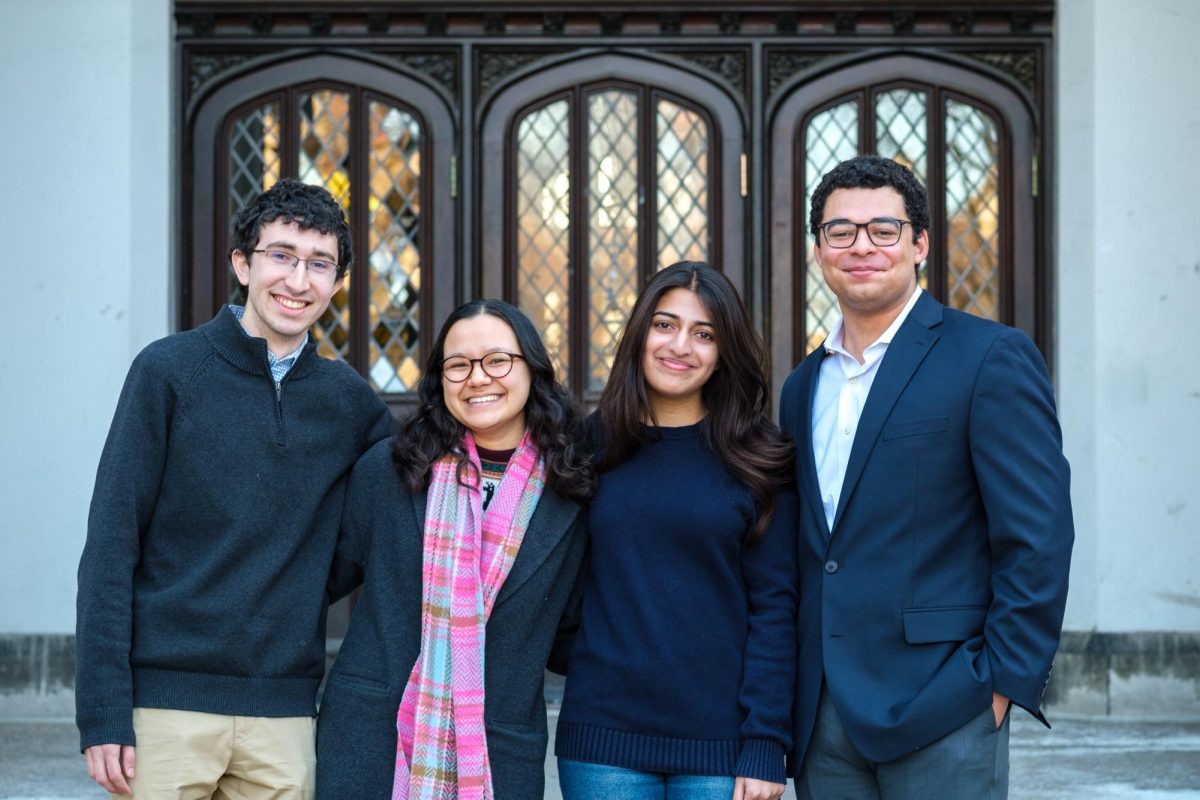
A delegation of UChicago undergraduate and graduate students, sponsored by the University’s Institute for Climate and Sustainable Growth (ICSG), attended the 2025 United Nations (UN) Climate Change Conference, also known as the 30th Conference of the Parties (COP30). Now in its 30th year, COP is an annual global meeting where world leaders, scientists, and other stakeholders discuss and take action on climate change.
For three days, the University’s delegates engaged in various activities across the conference’s two zones: the Blue Zone, where negotiations between UN officials and governments take place; and the Green Zone, a venue for countries and corporations to show their research and developments. Students teamed up or split off to observe negotiations in the Blue Zone or visit different events in the Green Zone.
Throughout the sessions, they learned about the challenges surrounding climate policy and technology—particularly the associated costs—and had the chance to formulate their own ideas for possible solutions.
This year marked the first time UChicago students were able to attend events in the conference’s Blue Zone. Students observed negotiations by official UN delegates from different countries, including members of the African Group and the Group of 77.
For joint M.B.A. and M.P.P. student Eliza Beckerman-Lee, the conference closely aligned with her interests in climate policy. Beckerman-Lee said that her focus during the conference was on the financial relationship between the public and private sectors, a topic she is interested in writing about for the UChicago Sustainability Dialogue, a platform for which she serves as co-editor-in-chief.
“I was definitely most interested in those panels that had people from the private sector saying, ‘Here’s how business can work together with the government,’” she said. “I think one of the biggest challenges from the conversations I was attending was the high cost of capital.… A lot of scientific development takes a lot of time and money, and then there are smaller economies that don’t have the money… to move forward with these things.”
For second-year undergraduate Samantha Alderden, who studies molecular engineering and chemistry, the conference took on a different focus.
“Most negotiations I went to were in the tech room; I was listening to how specifically [the speakers] were working to finance technology implementation,” she said. Alderden explained that much of her own research at UChicago is focused on minimizing the cost of redox flow batteries—large-scale storage systems that often store wind and solar power in liquid electrolytes.
Having also participated in ICSG’s India Summer Fellows Program, which brings students to cities in India for three weeks to study the country’s climate future, Alderden described how that trip informed her perspective on the conference.
“It really is an equity issue.… One of the findings I saw at COP is that the Global North is actually going to gain GDP from climate change, so, from an economic perspective, it’s in the interest of the Global North to not do anything, which is terrible,” Alderden said. “You have to go to other places to understand that it isn’t just about the changes that are going to happen in the U.S., but [in] the rest of the world.”
“Even if you make tech that’s cheaper, you still need so much policy to actually implement anything,” she said. “How do we actually get people to sacrifice some money on the front end to make things cheaper in the longer run… and how do we actually get people to invest in changing our [power] grid? Because that takes a lot of money.”
This year, UChicago established a new major and minor in climate and sustainable growth following the 2024 launch of ICSG, which had already created new programs and added courses to the core curriculum. For Beckerman-Lee, these initiatives reflect the University’s broader effort to build a more coordinated, campus-wide approach to climate and sustainability.
“I think [ICSG] is a huge step forward for the University in climate and sustainability,” Beckerman-Lee said. “I think it’s clear that students care about this and want to be able to learn and understand climate issues and ways to improve sustainability.… Other schools already have these types of opportunities, and UChicago is realizing that people really want that.”