Skip to content

Advertisement

Viewpoints » Contributors

Police blues

UCPD’s actions speak to wider structual inequalities in our society.

I went to a high school where it was not altogether surprising to see a student tackled and cuffed by one of our two school police officers. It was also common knowledge that white students and students of color had different rights and privileges. It was widely known that students of color needed a hall pass but white students did not. Not that there was not enough arbitrariness to go around: One time I (a white student) was brought in on a so-minor-as-to-be-unreal offense, and the officer seemed to relish making clear to me that my future lay completely in his hands. He proceeded with a humiliating “repeat after me” routine meant to bring home the fact that I was not under the authority of the school principal, but under the authority of the law that could and would jail me if it so chose, before finally letting me return to class.

I bring this up only so that, when I say that what I saw on Sunday shook me, you’ll understand that I have at least some experience structuring my perceptions. Some of us in the University community will want to explain this away as a misunderstanding between police officers trying to do their job and rowdy protesters, but it was not. A black University of Chicago student was asking to speak to the Dean-on-Call when he was tackled to the ground by perhaps six officers, who had him laying face-down, cuffed. Three years after the infamous Reg arrest, this is still how police work is done at the University of Chicago, as it is all over the nation. The irony is that the arrested student, Toussaint Losier, was a member of the very ad hoc committee formed after the Reg arrest that led to the creation of the recently-endowed Campus Dialogue Fund.

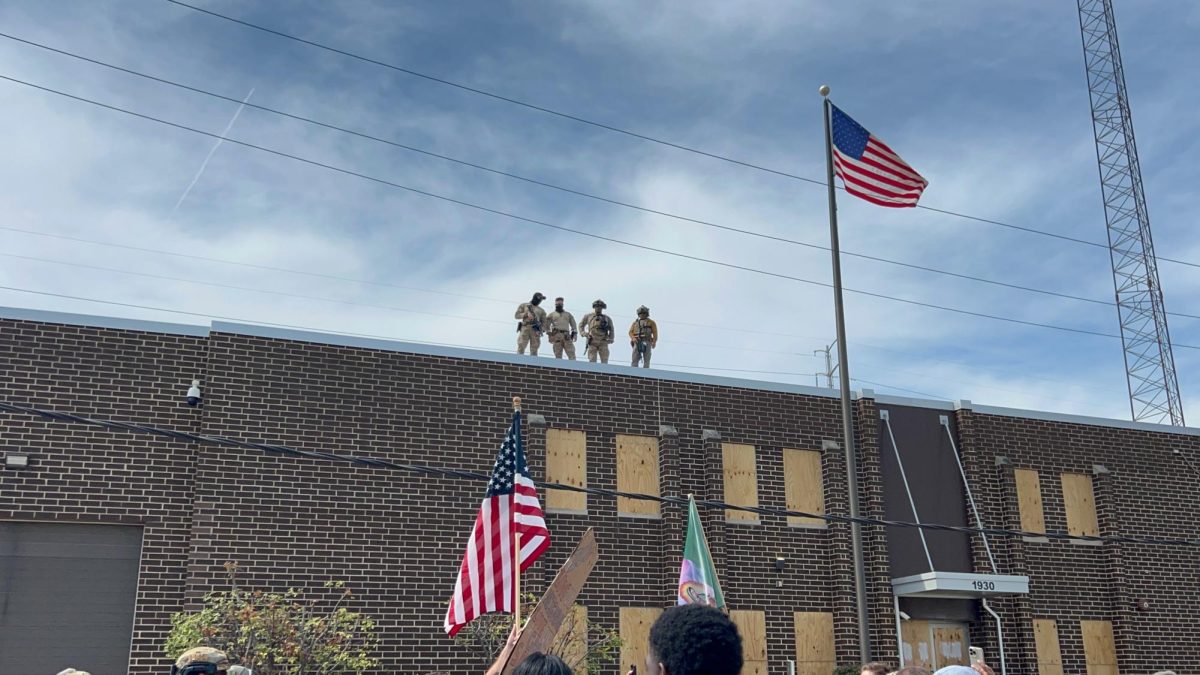
But not only was a University student arrested. Members of Fearless Leading by the Youth (FLY), the group protesting the lack of a Level I trauma center on the South Side, were also arrested and mistreated by the University of Chicago Police Department. The footage, which is on the Internet, depicts an officer striking at protesting FLY youth with a baton. Several arrests were made, including that of a 17-year-old female member of FLY who studies at King College Preparatory. Another female FLY youth was kicked while on the ground. Photos of her bruises were posted on Facebook.

This is the kind of brute force and arbitrariness that the police are used to exerting on black communities, largely without consequence. This is not some stunt that wily protesters put on to make waves—this is the default mode of policing, which is why we see this kind of violence over and over again. When I worked with FLY in the summer of 2011, I brought the youth to campus one day for the innocuous purpose of getting some work done at the Community Service Center. At one point a young man in the group stepped outside, and the next thing we knew, an entire squad of UCPD officers had surrounded him and had him with his hands up against the wall because, believe it or not, he “fit a description” of the perpetrator of a crime that had occurred the previous week. Except this young man lived in Roger’s Park, making him far from a likely suspect.

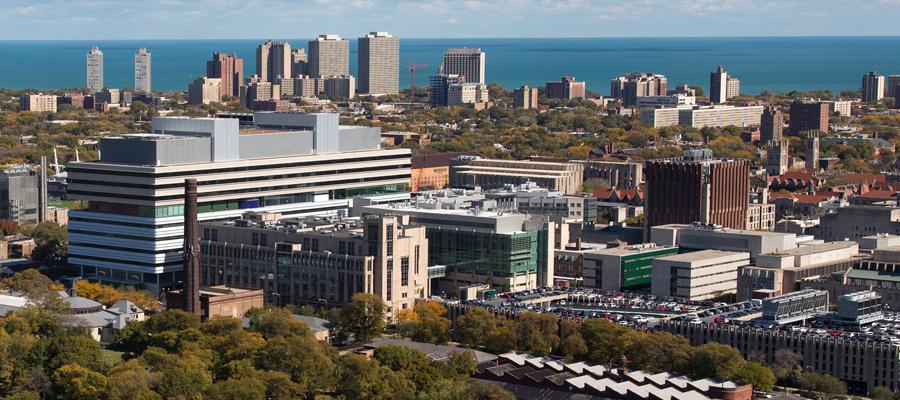
You do not need to think that there ought to be a trauma center at the UCMC to recognize that the fact that there is no trauma center on the South Side, and the area’s general paucity of medical services, is closely linked to the same racial and class marginalization that shaped the UCPD response on Sunday to the protesting youth. And they have truly a lot to protest about. The day before the demonstration, there were seven deaths by shooting on the South Side. While South Side residents face the longest travel time of any population in the city to life-saving trauma care, the most resource-rich hospital in the vicinity is constructing expensive “penthouses” for high-end patients. The UCMC claims opening a trauma center would cause the closure of other vital programs, and maybe that’s true. But to me, the fact that the UCMC emergency room declares itself on bypass five times more frequently than any other emergency room in Chicago indicates that the University’s disinterest in serving this population goes deeper than just trauma care.

People will say that the UCMC is the wrong target. As a private institution, it can structure itself how it will (and forcibly remove dissenters); it is the government’s separate responsibility to provide care for its citizens. I can accept that to a certain degree: It’s true there is more than one way to skin a cat. But when we get right down to it, if the government is truly by the people, it is still up to us to right these wrongs. There is no farming out of responsibility. FLY is demanding a trauma center, but they are also posing a question to the University community: Who and what is important to us? Will this community of intellectuals, businessmen, researchers, politicians, presidents even, take some kind of responsibility for the entrenched disparities of this society—or are we all so helpless? Think what you will about the specific merits of their cause, but FLY is doing this community good by breaking its bubble, by continually manifesting through its protests the bitter reality of social exclusion we have become so adept at not seeing, or maybe not believing.

This is not to suggest that the University must devote all of its resources to charity. The question goes much further than that. We must go far beyond the idea that we owe “charity” to poor communities. What we owe is a world far too long in coming where access to medical care is not left to the whims of hospital administrators and justice is not left to the caprice of the police, who, as it was made clear to me first as a frightened 16-year-old and then again yesterday, feel unconstrained in their authority, and have come to expect from civil society the assent that is silence. Let’s begin by raising our voices and asking that the University of Chicago administration not charge those arrested on Sunday.

Michael McCown is a third-year in the College majoring in history.

9 comments on “Police blues

  1. reply

    I don’t believe that it is the responsibility of the University to create a trauma center. However, the police action taken against those protestors is unacceptable. Whether our not we agree with the cause of these protestors, it is our responsibility to demand better restraint on the part of the UCPD. These acts of violence are unacceptable.

  2. reply

    I saw the video that appeared on the overheard at uchicago page and on my news feed, I’m sure there are a few videos but I just want to be clear which one I saw. How come we are not shown what leads up to the arrests? I assume that they were told to leave the premises by the UCPD before this video took place. Like the article said, as a private institution the hospital can ask people to leave the premises. Now, if they do not leave, they are then trespassing, right? So, why shouldn’t the police come in and make arrests? The protesters are not allowed to be there, and if they are not voluntarily leaving, it is the job of the police to remove them and arrest them. The video only shows from when the protesters were being arrested and taken to the ground. I would like to see footage from before that.
    Also, after I watched the footage with my father, he clearly stated that all of the footage in the video was procedural and not over violent at all. The tackle we see was clearly controlled to the ground. I trust my father, who has been a police officer for over 25 years. If the protesters had left when they were first told to, then I assume none of this would have happened. But, the video unfortunately doesn’t provide enough for us to see whether it happened or not.

  3. reply

    The only thing I dislike about this article (and some comments) is how the “police” and the “UCPD” are all lumped together, as if they are all some collectively functioning (and collectively abusive, in this case) body. They are not. I am a U of C undergrad; however, I am certain there are many things some of my peers do that would appall me (and I’ve seen them do many appalling things over the years, with blatant racism not even beginning to be the most troubling).

    There are good police officers and there are bad police officers, just as there are good people and there are bad people. The only trouble with bad police officers is they have the power to have a huge negative impact on people’s lives, if they choose to behave in an illegal or even inappropriate way.

    But in attacking those police officers who have fallen short of their duty, don’t sully the reputation of the men and women who deserve to wear the badge and do their duty with the honor and integrity they swore to uphold when they were given that badge.

    It is easier to attack vague groups rather than specific individuals, but it is specific individuals we should be attacking. Rather than complaining about “the police” or “the UCPD,” we should be asking hard questions: Who was in charge of the incident that occurred at the hospital? Who was in charge of the incident that occurred at the Reg? What officers were involved? What drove them to make the decisions that they made? Answers for these questions certainly are not always easy to obtain, but they can be obtained. Only by asking hard questions can we begin to work towards a solution.

    But one things is certain: simply complaining about “the police” and effectively alienating some of the very people who would otherwise help us certainly will not help us work towards a solution.

  4. reply

    Andres it totally right; some of these details are revealed in other articles, including the following.

    “Tangherlini said the protesters were holding signs when UCPD formed a line and pushed everyone out the door of the hospital. She sat down in the doorway because she was one of five protesters who had prepared to be arrested.
    “I sat down in the doorway and they started trampling us [Tangherlini and FLY member Veronica Moore]. Telling us it’s a health violation, it’s a code violation—if there’s anybody that gets trampled, it’s going to be because of you,” she said.
    “I looked at him [the police officer] and said, ‘I want the Dean-on-Call.’ He said he’d call him in a second ‘as long as you get out,’ and I said, ‘No, I want you to call the Dean-on-Call now,’ and he said no and then he picked me up and threw me out of the door,” she said.”

    The police arresting people who were, for some reason, TRYING to get arrested is not an abuse of police power or a productive center of anguish for the University community. Police forcibly removing people who had been warned repeatedly to leave private property is completely within their rights. Had the protesters not resisted police action, no one would have been dragged, pushed, or harmed at all.

  5. reply

    I am wary of wading into comments wars, especially on my own article. But, as a point of fact, Toussaint Losier was the designated police mediator for this action and had no intentions of being arrested. He was attempting to engage the police in communication when he was tackled.

  6. reply

    Ann Coulter recently called liberals pussies. I’m afraid I’ll have to agree with her. You young kids are too tame and too civil to do what has to be done. I know its not your cup of tea, but you need to get pissed and start rattling the cage, least you may find yourself in a huge pickle (of your own doing) out of which you may not be able to dig yourself. I studied history at Chaminade of Honolulu and my favorite professor was a guy who rattled the cage at U Chicago during the vietnam era. Yes, he went to jail and had to endure the shit, but as he was in his late 60′s ( in the mid 80′s) he often talked about those days with great pride and no regrets. You better get pissed kids, or you’ll be next to receive the baton, if not now, maybe later, in your 50′s or 70′s, and you’ll be regretting not having had what it took to correct the problem while you were young !!!!!

Leave a Reply

Your email address will not be published. Required fields are marked *

By submitting a comment, you agree to the terms of service of The Chicago Maroon.