The staff of the Chicago Tribune won the Pulitzer Prize for Local Reporting this month for the paper’s coverage of Operation Midway Blitz, a federal immigration enforcement operation in Chicago last year. The Maroon spoke with Tribune reporter and former Maroon Managing Editor Caroline Kubzansky (A.B. ’21), a member of the team that covered Midway Blitz, about what happened during the operation, what it was like to interact with federal agents as a member of the press, and how to remain objective in reporting on these issues.
Note: This interview has been edited for clarity and brevity.
Gabriel Kraemer: Can you give an overview of what Operation Midway Blitz was, and what you all reported on, for those who don’t know?
Caroline Kubzansky: Operation Midway Blitz was a give-or-take 64-day [period] of federal immigration raids conducted by a number of different federal law enforcement agencies, including but not limited to Customs and Border Protection [CBP] and ICE [Immigration and Customs Enforcement], where they said they were getting the “worst of the worst” off the streets of Chicago and its suburbs.
That translated into a lot of them arresting people who looked like they might be immigrants, so mostly people with brown skin, and then figuring out whether they had criminal records later. Some of my colleagues spent a lot of time reporting on the fact that only a tiny percentage of people who were arrested in the Blitz had any criminal record at all, much less a serious one.
GK: When did Midway Blitz get on the radar of Tribune staff as something that was going to become a major story?
CK: As soon as [President Donald] Trump won in November 2024, we all started thinking about what that might mean for immigration enforcement locally, because, of course, they had been making that kind of campaign promise in the run-up to the election, and then in January, there was… a more traditional set of intensive immigration raids conducted in and around Chicago…. And those raids were bad, and that was a very busy period, but they weren’t on the scale that we saw when [immigration enforcement] came back in the early fall.
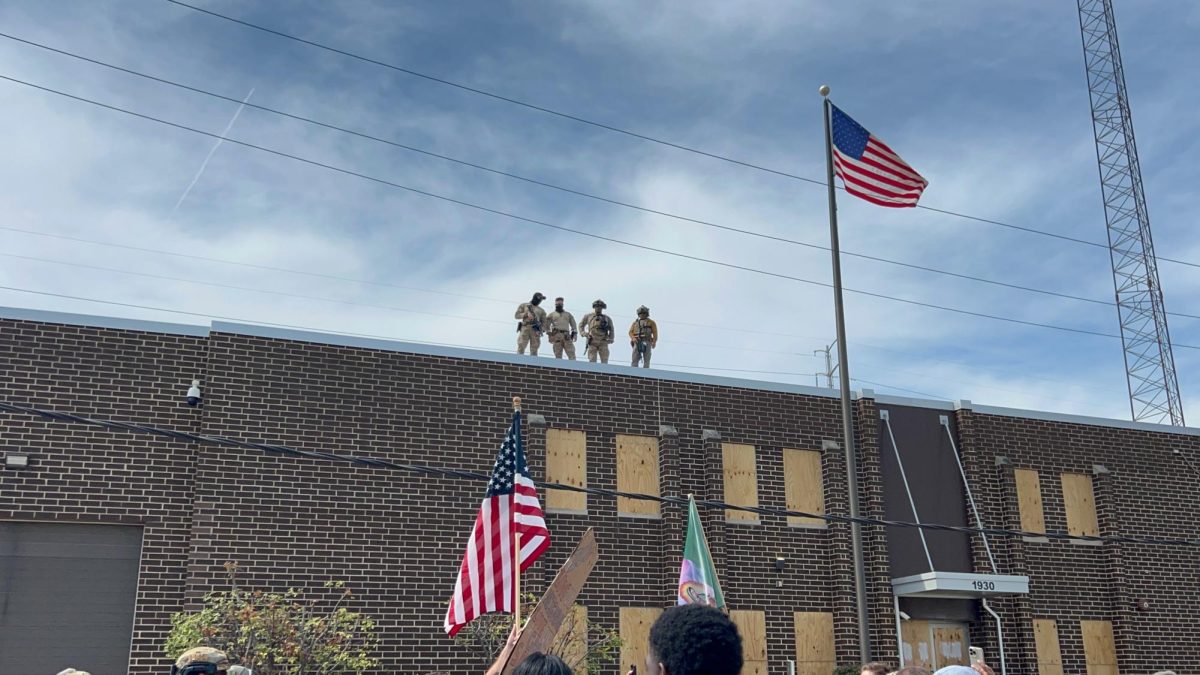
The first person that we know of that they arrested [during Midway Blitz] was a flower vendor, down on the Southwest Side. And that made a lot of people raise their eyebrows, because you don’t really think “flower vendors” when you think “worst of the worst.” For me personally… when I realized that this was going to escalate was when we got a Slack message from a photographer who said, “Things are getting tense at Broadview,” which is the processing facility where [immigration enforcement agents] put a lot of recently arrested people. I remember going out to Broadview, and there were protesters who were trying to block the driveway so that vans of immigrants couldn’t get in or out.… Later that day, [the protesters] wouldn’t get out of the way of the driveway, and my colleague, a photographer named Armando [Sanchez], watched an agent shrug and take the pin out of a can of tear gas. It was a single can of tear gas that they deployed that very quickly dispersed the people at the building that day.
And then when I went back the next week, I saw how many more people were there, and I thought that that had the potential to get very messy and very ugly, and it did.… The agents started to use more and more chemical crowd control, and more and more people showed up, angry, [so] that it very quickly snowballed on itself.
[So] for me personally, the first moment where I was reporting and I went, “This is going to be a bigger deal than even we thought it was going to be,” was at Broadview sometime in late September.
GK: What do you generally cover for the Tribune, and how did Midway Blitz affect what you generally report on?
CK: I had gotten moved onto the criminal justice desk full-time in June of last year, and to this day, most of what I spend my time on is the Chicago Police Department. The simplest way to describe me is that I am a police reporter. But what I typically say is that I cover violence, and I cover the intersection of local and federal law enforcement.
A lot of my job during the Blitz was—I’m kind of like a moth, where, if there’s something happening on the street, I feel compelled to go. I spent a very significant amount of time basically running after [Border Patrol] Commander [Gregory] Bovino and his men with a backpack and a gas mask and a couple of [photographers] who were also spending most of their time doing that. Every week or so, there would be some kind of skirmish between federal agents and residents of a different neighborhood that would escalate and escalate and then lead to a bunch of arrests—in one case, a shooting—and a lot of chemical crowd controls deployed all at once.… So I spent a ton of time basically running after them and being ready to run and trying to figure out where they were and what was happening.
And then the rest of the time I was basically filing public records requests. The feds are so not forthcoming with their public records, and when they were giving out information, so much of it eventually turned out to be not true, the case of Marimar Martinez being the prime example of that.
[After Martinez was shot by a Border Patrol agent in Brighton Park in October, the Department of Homeland Security (DHS) said she had threatened agents and driven into their vehicles, causing a collision. Her defense attorneys argued instead that the collision was the fault of the agents, and the Department of Justice later dropped all charges against Martinez. CBP placed the agent who shot Martinez on administrative leave after the release of footage that appeared to contradict its original account of the incident, though DHS has not retracted its initial claims.]
The way into figuring out what had happened with the feds… was not by asking the feds, “Hey, what happened?” It was by “FOIA-ing” [submitting Freedom of Information Act requests for] the email logs of the police supervisors who were out there that day. It was by sourcing among the actual line police officers who were there. It was by asking for their body cam footage. It was by asking for 911 call audio and something called an event query report, which [looks] blow-by-blow [at] what had happened that day from the view of an eyewitness. You’re thinking about so many things at once [while you’re there], and you only get there when you get there, and so you can’t necessarily know what happened before you got there.
Those records requests… were the best way in, and I spent a ton of time filing, reviewing, arguing with the police department about whether or not they owed me the records… and trying to basically piece together on the back end what had happened there. A colleague of mine has a saying: “The records were the way into, not what they said they did, but what they actually did.”
GK: When you were following federal agents around the city to report on them, how did they interact with and treat the press? What did they think of people trying to cover this and write about what they were doing?
CK: They were doing it for attention. They were playing roles, was my impression. When you look at, for example, that South Shore building raid—that was produced for social [media]. The videos of that, the federal advertising that they had done that—that was produced for public consumption. And so, in some ways, it seems like they were hoping to get our attention, because that’s how mass government campaigns of any kind can work. Our job, of course, was to cover that critically—to say, “Okay, they say they’re doing these things and they’re out here in their camo; who are they actually arresting and are they actually making Chicago safer?” The answer to that was, “No.”
The feds got used to seeing certain of us out all the time; they got to know some photographers by name. I don’t think they ever got to know me…. They had their own embedded photographers also, sort of friendly media who would go around with them.
[In] one instance, basically the last day that they were here doing raids in the month of November, they were tearing through Little Village, and the entire neighborhood basically was out screaming at them and trying to fight them out. I ran up behind a photographer colleague of mine, and I must have run a little bit too fast, because an agent who my colleague was photographing winced [and] reached for his gun, and I froze, because I had seen them point guns, real guns, at other colleagues, both in and out of the Tribune. I stopped moving.
At that point there was also a federal court order in place that the feds were not supposed to use force against media, clergy, [and] other groups of people who were out with the protests but not necessarily protesting themselves. And so I stopped moving. I grabbed my press badge as slowly as I could. I held it up. I made eye contact with the agent. He kind of raised his eyebrows at me. I raised my eyebrows at him, and he kind of nodded [and] took his hand away from his gun, and I very slowly backed off. That was quite scary. Other colleagues actually had guns pointed at them, and people got hit with pepper balls. Everybody [who was on the ground at these scenes] got tear gassed, but we had pretty good gas masks, so that wasn’t a huge problem for us.
I would hope that what we did and what our Pulitzer package shows was, yeah, we were paying attention alright, but we were paying attention to what they actually did, which was not what they said they were doing.
GK: How do you think about objectivity in this kind of work? If you read the “64 Days” story—a piece from last December you cowrote that recounts Operation Midway Blitz from beginning to end—I think it’s fair to characterize it as quite sympathetic to people affected by the raids, to immigrants, and to people who resisted the operation and not sympathetic to the federal agents and their actions. How do you strike a balance between giving all sides a fair treatment and being critically objective?
CK: I’ve thought about this a lot over the period of the Blitz, and then in a lot of the coverage I’ve done since then. I think the only thing I can really say about it is that I wrote what I saw. I saw a [one]-year-old who had just gotten hit in the face with a blast of pepper spray, and I saw the video footage of her family driving in the car and a federal agent leaning out the window and just blasting the car with pepper spray. And I saw a giant armored truck full of federal agents just rolling out [of Broadview] for no apparent reason that I could see. And then Commander Bovino and a bunch of guys on foot marching into the crowd again for no apparent reason that I could see.
In Brighton Park, I saw neighbors, people who lived in the neighborhood, throwing water bottles and bricks at the feds… and I then saw the feds fill multiple residential streets with tear gas as they were leaving. And so if you keep your eyes open and you write what you see, that gets you a long way.
Everybody is entitled to a comment on what happened. We spent a lot of time emailing DHS and saying, “Hello, we have gathered these observations and facts about today’s events. Would you like to comment?”, and we let DHS have their say. Sometimes what DHS had to say would be not immediately provable one way or the other, or it would turn out to be correct in a couple of cases, or it would turn out to be completely false, and that would come out over the course of weeks. Everybody gets a chance to comment, and everyone gets checked out—so everybody who got quoted, for example, in “64 Days” was what we call “scrubbed” or “backgrounded” to make sure that they were who they said they were….
I still don’t know right now, in this climate, what the meaning of the word “sympathetic” is…. In some cases, I regretted not being more descriptive when I wrote what I saw. I think I often felt like I was failing to convey what I was seeing and the speed at which things would escalate. Goodness knows the federal government has had plenty to say about what our coverage was, and some of the people who wrote it—in some cases [it was] extremely personal stuff that they’ve said about my colleagues.
It’s rare that the Chicago Tribune would say, “This is gratuitous use of force,” but the Chicago Tribune reported rubber rounds deployed on Broadview protesters, and it [reported] streets full of tear gas in Brighton Park, and it reported that, in the words of one North Side alderman, federal agents were driving like lunatics near a group of kids doing a fun run, in pursuit of, I guess, some people nearby. We don’t have to say anything. We don’t have to draw a conclusion. Everybody can read those words… and they can see the pictures, and they can see the video. Readers are smart; they’ll make their own conclusion.
GK: What are the challenges you faced reporting on this? You’ve already spoken to issues trusting what the federal government was saying and getting the agents to give you information, but, on the other side, was there resistance to talking to reporters in communities that were affected?
CK: It was extremely challenging to talk to people who had been affected by the raids. It was the worst day of so many people’s lives; they don’t necessarily want to revisit it. And so the people who did… did us a huge favor, and did the historic record a huge favor, by going back through what they had been through with their families or friends or colleagues, and… we never stopped thinking about [that]—it’s challenging [for reporters] logistically and emotionally to do this, but the people who it’s hardest for are the people who are left picking up pieces after somebody’s been arrested, and they have to figure out what detention center they’re in… literally anywhere in the country.
[Immigration enforcement agencies transported many individuals detained in Chicago during Midway Blitz to processing centers outside the region.]
I would say the pace of it was pretty relentless. Any one of those neighborhood skirmishes would have been a serious, serious news story just on its own, and instead there were, like, eight or nine of them, happening once or twice a week for two months. The volume of stuff—of reporting, of records, of follow-ups—was just staggering. I would say the most challenging, and also the most important part, though, was following up with the people who were arrested and their families and trying to figure out how to make them the centerpiece of the historic record and also be respectful of what they were dealing with.
GK: The Pulitzer committee cited the Tribune’s “vivid, muscular prose” that captured “how the siege-like incursion of ICE agents unified Chicagoans in resistance.” What does the more storytelling-oriented reporting in “64 Days” and other stories do that reporting on the hard facts doesn’t? Can you talk about that distinction?
CK: Nate Griffin is the comedy club manager who got arrested in Lakeview because he saw an arrest happening. He shut the door on the leg of a federal agent as it was going on, and he was arrested and charged with a federal crime that later a grand jury refused to indict him for…. We wrote extensively the day that the feds were in Lakeview about what had happened, about the fact that there had been a guy arrested outside a comedy club that turned out to be Nate Griffin, and about the fact that he got charged.
My colleague Jason [Meisner] and I, to a lesser extent, spent a bunch of time following his case as it made its way through the early stages of the judicial process. I was there at court the day his case was dropped and pulled him over in the hallway and said, “Now that this case has sort of wound up, would you be willing to talk a little bit about what the last couple of months have been like for you?” Because people generally won’t comment if they’re in the middle of legal proceedings, but once that case was dropped, it sort of freed him to go on the record and talk about his experience.
So “64 Days” was a lot of going back to people who had had some involvement in the Blitz, and then had had kind of a chance to process it, or their circumstances had changed enough that they could process it, and they could talk to us about it—in many cases, like Nate’s, for the first time. What he told me about his experience pre-, during, and post-arrest, was not something that we had covered or that anyone had covered in the initial flurry the day that the feds showed up in Lakeview. Actually shutting the door on the leg of a federal agent was maybe one sentence of his portion of “64 Days,” right? It was much more about, “What was your life like before this? What is it like now? How has this changed you?”
GK: The Tribune won the Pulitzer Prize for Local Reporting. There’s been a nationwide decline in local journalism—a lot of local papers have closed, and there are serious questions about the business model of local journalism, at the Tribune and elsewhere. Does your experience covering Midway Blitz demonstrate anything about how we should think about local coverage?
CK: Local reporters call this place home.… [Federal agents] were arresting Uber and Lyft drivers [in airport rideshare parking lots] who didn’t have legal status; they did that multiple times. And we have a transportation reporter who knows the rideshare unions, knows the levers to pull when something of substance happens on airport property to get a full picture within days of that incident taking place, and who already knows those people to call who can help her get the story as quickly as she can.
There were many national outlets that had fantastic takes on the Blitz, but for the day in, day out of “What’s the highest-quality story we can possibly have, as quickly as we can have it?” You can’t beat the locals. And all of us, like Block Club [Chicago], [the Chicago] Sun-Times, etc., we all had moments where it was somebody who knew this neighborhood, or this agency— just the city overall deeply in the way that a local reporter knows it; that’s not a story that will really be within the reach of a national reporter, at least not so quickly…. The deepest reporting to come out of the Dirksen Federal Courthouse came from the guy who’s covered the Dirksen Federal Courthouse every day for this paper for 15 years, and there’s no substitute for tenure and familiarity covering a thoroughly local story.
GK: Do you have any thoughts about how local journalism can sustain itself?
CK: The Tribune is, of course, owned by a hedge fund that is commonly called the “destroyer of newspapers,” and so we need people with resources to look at this and say, even under very challenging financial circumstances, where the staff is a fraction of what it used to be, they’re still doing Pulitzer-worthy work, and they are still worth investing in. [Alden Global Capital, which owns the Tribune’s publisher, has been criticized for major staff cuts at its publications.] But I don’t have any silver bullets.
It’s also recently been proved that even when private owners with major resources do take over legacy papers, they don’t always treat them well—hello Mr. Bezos. [The Washington Post, whose owner is Amazon founder Jeff Bezos, laid off over a third of its newsroom earlier this year.] What I will say is that, on the journalists’ side, everyone should be unionized, because that’s how you get a say in the operations of your own newsroom. To go out and to look at the world is what all journalism is about. If we lose sight of that, then we don’t have much.