Dick Clark’s New Year’s Rockin’ Eve with Ryan Seacrest is perhaps the most popular New Year’s Eve tradition, both in the U.S. and worldwide. Footage of the iconic ball drop in Times Square has appeared in several films including When Harry Met Sally (1989), Forrest Gump (1994), and New Year’s Eve (2011). In television, the program’s now-discontinued party segment famously served as the backdrop for Ross and Monica’s iconic “routine” on Friends. This year marked a historic first for the broadcast that is more than 50 years old: a live midnight countdown from Chicago, followed by fireworks launched from bridges along the river.
In New York, New Year’s Rockin’ Eve has hosted a slew of artists over the decades, from Britney Spears to Prince. For its Chicago debut, the program spotlighted five performers representing the city’s musical breadth through outdoor live performances in the Loop: Englewood DJ Mike Dunn; DJ Mike P; Grammy Award–winning spoken-word artist J. Ivy; electric blues vocalist Shemekia Copeland; and critically acclaimed rapper, singer, songwriter, and activist Chance the Rapper.
Chance served as the official Chicago co-host for the national broadcast. Locally, the stage also featured several Chicago personalities, including ABC 7’s Ryan Chiaverini and Val Warner, comedian Mike Epps, The Bucket Boys of Chicago, and Mayor Brandon Johnson.
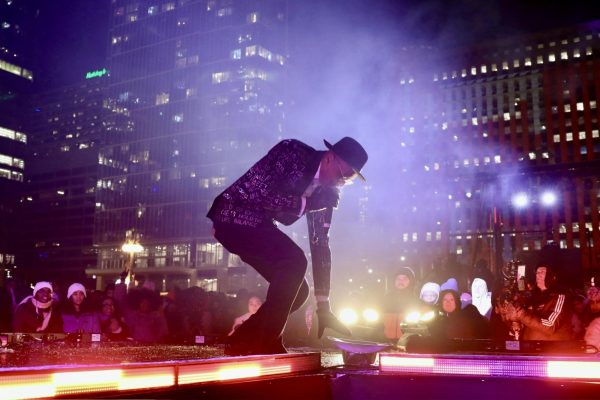
Chance then transitioned from hosting duties into a performance of “No More Old Men” from his latest release STAR LINE. The song included a surprise appearance by Chicago-born singer, songwriter and poet Jamila Woods, who is also featured on the record. Given that this was the only performance that was aired in the national broadcast, it ultimately carried the weight of the city’s artistic statement.
The track opens with a meditation on memories of an unnamed Chicago barbershop Chance frequented in his youth: “Mr. Darden used to take the bus over from Halsted/ Mr. Harper used to be so exhausted/ The barbershop bustling, bootleg Lacoste fits/ Forget the DVDs, they tryna get that golf drip.” But as the song progresses, it reveals deeper meanings. In an interview on Way Up with Angela Yee, Chance emphasized that barbershops like the one mentioned in the lyrics are formative spaces where young men absorb cultural lessons through everyday conversation. In particular, he noted their importance within Black communities and the role of older Black men in shaping those environments.
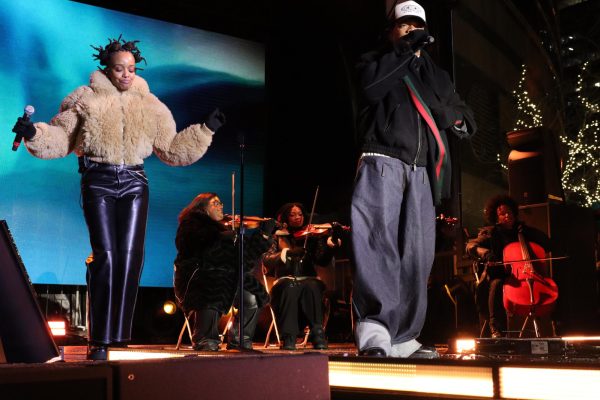
He also shared that this concept was inspired by a poem written by his cousin, South Side native Tanikia Carpenter, which imagines a future with “no more grandfathers,” an analogy for the disproportionate loss of Black men to violence. The barbershop becomes empty as there are fewer men that live long enough to become grandfathers, and therefore fewer men to occupy those chairs.
As the countdown to midnight began, Chance was joined onstage by friends and family to celebrate the end of the broadcast. Although the closing moments were celebratory, the onstage festivities outlasted both Chance’s set and the firework show. For some in the crowd, this part felt drawn out, with many expressing a wish that the time had been used for a longer performance.
This sentiment was echoed online, with some viewers also criticizing Chicago’s limited on-air time in the main broadcast and the absence of additional Chicago-based artists. But while showcasing a city as vast and diverse as Chicago to a global audience through a handful of brief televised moments is no easy task, both Chance and the Department of Cultural Affairs and Special Events appeared to approach the moment with intentionality: to reflect the city’s musical range, to elevate local art through custom countdown projections from ART on THE MART, and, perhaps most importantly, to choose a song that confronts issues still deeply present in Chicago. It was an honest attempt to ground the celebration not just in spectacle, but in meaning.
As a first-year effort, the Chicago countdown offered a foundation that leaves room to imagine how the moment might evolve, expand, and more fully capture the spirit of the city in years to come.