From April 9–11, the Theater and Performance Studies (TAPS) department presented its annual showcase of B.A. performances at the Logan Center’s Theater West. Graduating TAPS majors and minors presented original performances, such as plays, staged readings, and dancing. Three Maroon writers attended the shows and reported back the highlights of each one.
master of none by Jo Selmeczy
The weekend kicked off with TAPS major Jo Selmeczy’s play, master of none, which tells the story of Jack, a teenage boy desperate to find out what it means to be a man but unsure of what it takes.
At the beginning, Jack (played by Selmeczy) behaves like a typical teenager: annoyed, stubborn, and insecure, performing masculinity in the most toxic of manners. As the story progresses, Jack becomes increasingly open about his discomfort with his identity. The play culminates with an epic dream sequence where Jack gets his hair cut live onstage, forcing him to confront his insecurities and relationship to masculinity. The piece ends with Jack singing part of “Here Comes the Sun,” evoking a sense of reflection and pensiveness as the lights dim.
The ensemble cleverly tackled a broad range of themes, providing compelling commentary on things from gender identity to complex family dynamics. The script used witty dialogue to achieve a smart, interesting, and in a way, subversive story. Everyone involved felt invested and together, and that cohesion was palpable on stage.
The Two Storms: A story of life during Maria by Lucienne Totti Martinez
The Two Storms: A story of life during Maria by TAPS minor Lucienne Totti Martinez is a coming-of-age story that explores the complexities of Puerto Rican identity and the life-altering effects of natural disasters.
The play centers on three Puerto Rican teenagers discussing their futures and what their lives would look like after high school. However, these discussions are overshadowed by the uncertainty of the impending Hurricane Maria. This contrast between the teenagers’ excitement about college plans and opportunities in the United States and their fear of a deadly storm creates a dichotomy between hope and fear for the future. Simultaneously, tensions emerge from their differing views about the future. For example, one teen goes against the group by resisting going to the mainland U.S., insisting that Puerto Rico is home and that they would never be able to relate to or identify as “true” Americans.
To open the play, prior to any dialogue, Martinez sang “Preciosa” by Rafael Hernández, long regarded as a Puerto Rican anthem. This powerful introduction immediately underscored one of the production’s themes: the nuances of Puerto Rican identity. The rest of the production captured the question of whether the teenagers’ futures are at home or elsewhere.
The Odysseus Project by Ilie Sturhan
TAPS major Ilie Sturhan’s The Odysseus Project was an immersive and interactive experience, drawing audiences into a personal journey centered on mental illness. Despite the gravity of the subject, Sturhan balanced the performance with elements of lightheartedness and comedy.
Upon entering the theater, I was greeted by a bouncer who demanded that I place a coin in my shoe and eat a piece of candy before the show began. The audience was then divided into small groups of around 10 people and guided by Odysseus (Sturhan) through spaces across the stage, each representing the homelands of various Homeric characters. Television screens around the performance space displayed prerecorded videos, adding another layer of intimacy to the multimedia experience.
One of the most profound moments of the production came in the last scene, when Sturhan compared her mental health struggles to Penelope’s act of weaving her tapestry by day and unraveling her work each night. The representation of how progress in mental health healing can become undone and must often be rebuilt repeatedly in an endlessly frustrating cycle was extremely powerful. By the end, the show had taken the audience on an odyssey of their own, leaving me with the sensation that I had traveled through something turbulent and transformative.
Blurring the Line by Alex Flores
The Saturday showcases started with TAPS minor Alex Flores’s experimental production Blurring the Line. The piece opened with a monologue delivered offstage about an encounter with a skull.
Flores then came onstage and told the audience another story. Suddenly, the characters he spoke about came to life, appearing on stage one by one. In an attempt to ground the oddity of his fictional characters coming to life, Flores invited them to do a table read of his work. However, his characters, exuberant and talkative, could not organize themselves correctly. Out of frustration, Flores began to reprimand his fictional friends, effectively telling them to get lost as he tore up his script. He delivered a final monologue from the crumpled piece of paper, speaking about feelings of inadequacy and loneliness.
Flores’s pacing and tone reflected both sarcasm and sadness, highlighting the loneliness of his character. The performance made the audience feel immersed and distant at the same time.
A Plot to End This Town by Joseph DePaula
TAPS minor Joseph DePaula’s A Plot to End this Town is set in a small town in Louisiana, his home state. Over the course of the play, the characters are confronted with their town’s complicated past after a scholar arrives and reveals the nuances in its history.
The play opens with a town hall meeting displaced due to a storm. The characters discuss a grave site at the local church, which they believe might be the burial site of Civil War soldiers. The characters bicker about what should be done: Is it better to respect the dead or acknowledge a potentially dirty history? Some characters advocate for the former, while others fight for the latter, but the final decision is in the hands of the local priest. Ultimately, he decides to uncover the truth about the graves by excavating them, only to discover that the burial site holds Confederate soldiers. The play ends with the townspeople grappling with the history of their town—some indifferent, others embarrassed.
DePaula used nuanced characters and humorous dialogue to help keep the audience laughing and interested in the story. The work displayed the difficulty of toeing the line between acknowledging a dark past and respecting history. The actors’ Southern accents meshed beautifully and evoked a sense of realism that immersed the audience within the world of the play.
“Reading a Sample from ‘Mother Body’” by Anya Moseke
Anya Moseke, a TAPS minor, a reading of selected works from her poetry thesis for the creative writing major, “Mother Body.”
Beyond her impressive command of language, Moseke’s delivery was powerful and commanding. Her pacing felt calculated and calm. There was a sense of sureness as she spoke, not in a self-righteous way, but more so demonstrative of a confidence in her writing. Moeske’s poems were abstract yet grounded in personal contexts, centering on girlhood, motherhood, and all of the challenges in between.
In a broader sense, some of Moseke’s poems felt existential, grappling with religion and the presence of a God, while simultaneously tackling grounded issues like abortion and body image. Overall, Moseke impressed everyone in the room, and her expertise in both reading and writing poetry were evident.
“Joelle and Katy’s Musical Showcase” by Joelle Jensen and Katy Yeh
TAPS minor Joelle Jensen and TAPS major Katy Yeh put on a musical showcase where they sang a multitude of songs, both together and individually.
Jensen opened the show by singing “Don’t Rain on My Parade.” Accompanied by a piano, Jensen’s voice shone throughout the song. She then transitioned into songs from beloved Disney movies. During this part of the show, Yeh, who was sitting in the crowd, stood up and joined her on stage. They sang several songs together in perfect harmony, before Jensen moved to the audience and gave Yeh the floor. The latter performed “Times Are Hard for Dreamers” to end the show. In addition to singing, the two women also acted and worked together on stage with impressive chemistry, adding to the spectacle and making this dual thesis all the more nuanced and intriguing.
INVESTED. by Camille Cypher
Camille Cypher’s INVESTED. is a comedy about investment bankers in an improv class preparing a show for their company holiday party. The work begins in the middle of a stand-up exercise where the audience is immediately introduced to the core characters, each different in position and personality.
The story takes place over a series of improv sessions. Initially, the characters believe they’re doing team building; however, they soon find out that they are expected to put on a show at the office Christmas party. Throughout the play, whether through snarky suggestions or witty sidebars, we learn about each character: some are trying to work their way up the cutthroat corporate ladder, while others are trying to do what they can in their limited time with the company. Some characters also seem to have trouble understanding the importance of coworker rapport. The piece culminates with a hysterical, yet touching disaster-turned-triumph of an office Christmas party.
The work was pure comedy. Cypher’s characters were witty and complex, the dialogue was rhythmic, and the punchlines always landed with conviction and confidence.
“Altered Perception(s)” by Emily Curran
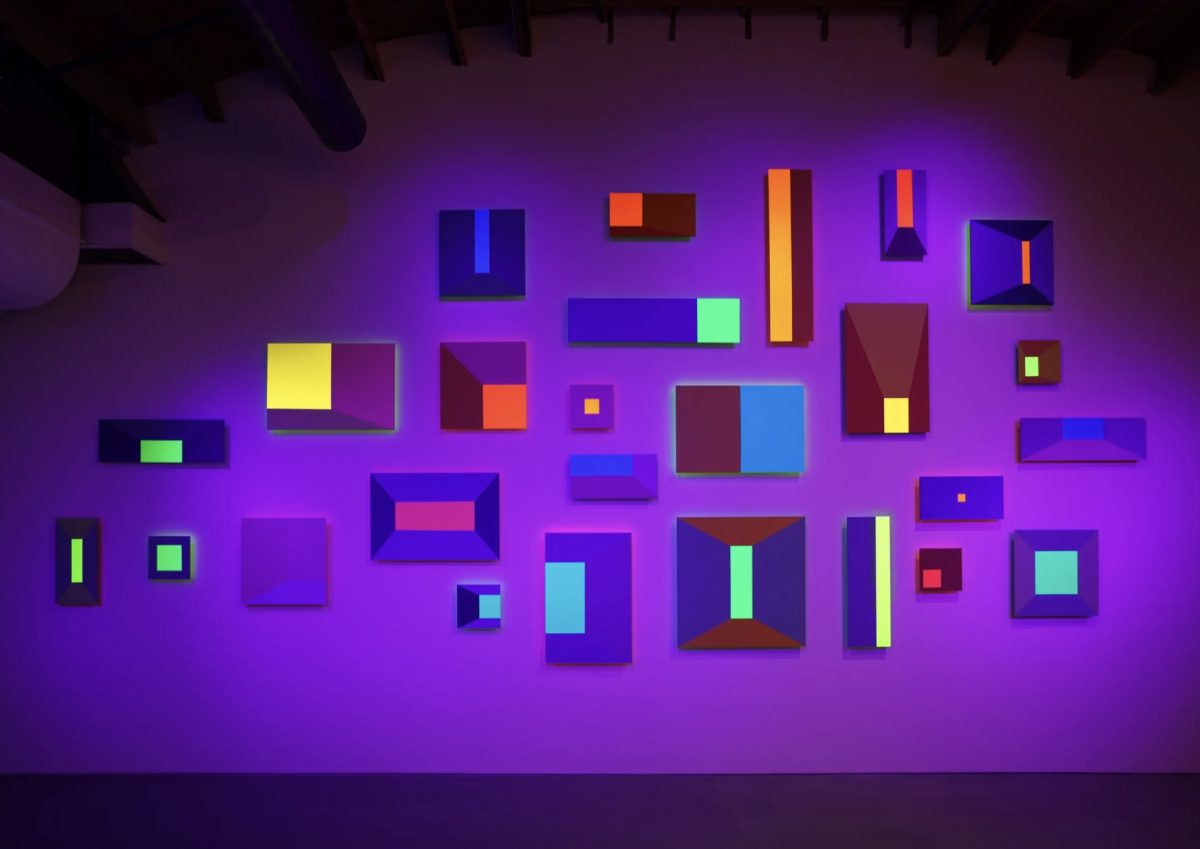
Emily Curran has worked on lighting design for over 30 productions in her four years at UChicago. “Altered Perception(s)” was a culmination of what she has learned in that time. The concept was simple but effective—take a scene and repeat it five times, each with different lighting choices. Underneath the lighting, a bride and groom perform a wedding dance as two actors downstage reminisce. At the end of the scene, taken from Caryl Churchill’s Love and Information, the bride and groom hold hands and walk away with their backs to the audience. The whole production was set over a hypnotic acoustic score.
In one iteration, flashes of light highlighted certain parts of the choreography while resembling photography flashes or glimpses of memory, conveying how recollection can come in bursts. In another variation, purple, bluish hues darted across the dancers, making their costumes eerie, airy, and beautiful while silhouetting their movements. Spotlights showed how the dancers could be separated from the actors and given individuality. Changes in the quality and magnitude of lighting demonstrated how a breathless spin could be made to look different each time: in low light, it looked magical; with greater visibility, more technical. Curran undoubtedly delivered a masterclass in how lighting can alter perception.
“Ready, Aim, Sing!” by Gabriel Brumberg
While practicing folk songs on the piano one afternoon, Gabriel Brumberg had an idea—why not make his thesis about them? The result was “Ready, Aim, Sing!”—a 70-minute solo performance that was equal parts lecture and concert, with a share of jokes, personal anecdotes, and even a recitation of an FDR speech. Brumberg took the audience on a journey through the history of American folk music, swapping skillfully between acoustic guitar and piano, playing well-known songs like “Alice’s Restaurant” but also lesser-known pieces, including an unrecorded song by Woody Guthrie and a Yiddish folk song Brumberg’s grandfather would sing at Passover seders.
Throughout the performance, Brumberg pulled archival materials from a bulletin board behind him and spoke about their histories. He discussed the larger theme of protest music and included a “take-out menu” of activist and community-organizing groups for audience members to check out after the show. Like a good teacher, Brumberg was careful not to impose a single reading.
Editor’s note: Camille Cypher is a staff member of the Maroon. She had no involvement in the reporting or editing of this story.