Petr Popelka’s path to the podium of the Chicago Symphony Orchestra (CSO) has been somewhat unconventional. Before beginning his conducting career just six years ago, he was a double bassist in the Staatskapelle Dresden, one of the world’s best orchestras. He has been chief conductor of the Prague Radio Symphony Orchestra since the 2022–23 season and was recently named chief conductor of the acclaimed Vienna Symphony.
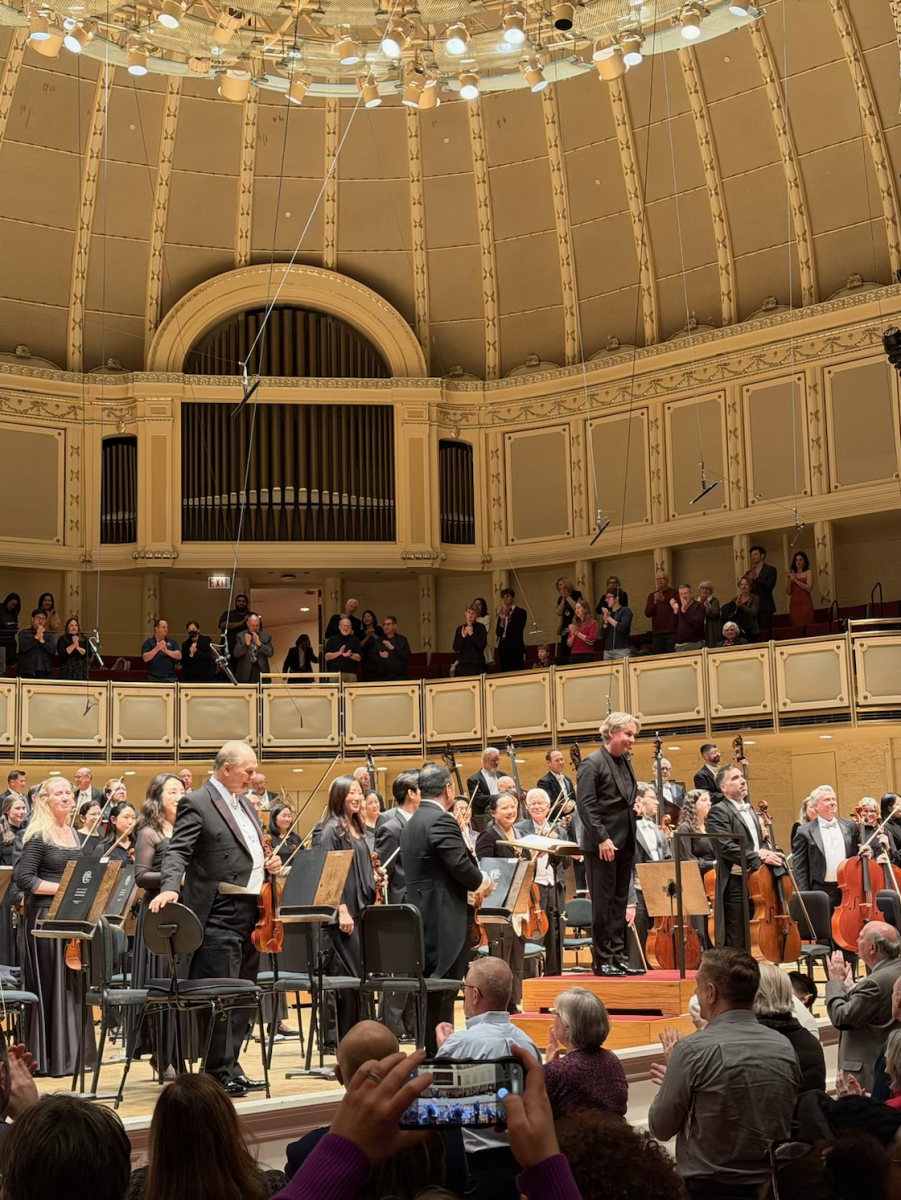
Popelka’s CSO debut took place almost two years ago after he subbed in for Herbert Blomstedt in a program featuring works by Mendelssohn, Schubert, and Beethoven. During the recent December 7 performance, Popelka took on an entirely new program, including Brahms, Strauss, and a world premiere concerto. While his debut drew mixed reviews, his return was well-received by both the audience and critics. Unfortunately, it came to a relatively empty orchestra hall, perhaps due to the harsh weather conditions in Chicago throughout the weekend.
The program opened with Brahms’s Symphony No. 3, one of the cornerstones of the classical repertoire. Written in a burst of inspiration over only four months, the symphony is as close as Brahms would ever come to programmatic music in its thematic cohesiveness, containing many interwoven melodies and references across movements. Clara Schumann, wife of fellow composer Robert Schumann and lifelong friend of Brahms’s, famously wrote to the composer, “All the movements seem to be of one piece, one beat of the heart.”
Under Popelka’s direction, this unity was clear from the beginning. The heroic F-A-F motif, which opens the first movement and represents Brahms’s personal motto, “frei aber froh” (“free but happy”), was crisp and clean. Popelka followed it up with an intriguing dynamic choice, softening the remainder of the passage to create a sense of intimacy rather than triumph. The rest of the movement unfolded with balance and precision, with the conductor and orchestra beautifully capturing the spirit of the music.
Popelka took the second movement at a notably brisk tempo, faster than one might typically hear the symphony’s Andante performed, but the choice proved effective. The movement maintained a clear sense of direction, the musical line remaining smooth and lyrical. In the famous third movement, Popelka wisely did not overcontrol and micromanage the musicians’ playing but rather allowed the music to breathe naturally. As the central melody passed between instrument sections, each one shaped it with subtle differences in phrasing and breath control. The low strings sounded rich and lush, while the French horn and oboe solos built a sense of quiet warmth and longing.
The fourth movement opened with a hushed yet fierce theme, hinting at the intensity and rapture to come, and continued with unbreakable continuity. This movement was a prime example of Brahms’s masterful orchestration skills—every note was carefully placed and every bar packed with nuance. Here, Popelka showcased his keen ear for detail, bringing out some wonderful and refreshing colors in the score, especially in the double basses, while the CSO musicians delivered his vision to perfection. Popelka generally kept the orchestral forces balanced; however, a few climaxes came off a bit too brassy, a tempting but risky choice, since it minimized the beautiful texture in the strings.
After intermission came the world premiere of Song of the Reappeared by Matthew Aucoin, a former Georg Solti Conducting Apprentice who then became a composer. The work is described as a “concerto for voice and orchestra” that uses poetry by Raúl Zurita to confront the brutality of the Pinochet dictatorship in late 20th-century Chile. The piece is the sole commission of the 2025–26 season, a somewhat controversial choice given the increasing emphasis on new music in many American orchestras.
Soprano Julia Bullock, for whom the work was composed, was strong and powerful in her performance. She met the challenging demands of the score, which forced her to oscillate between the lower and upper reaches of her voice with conviction and intensity, and her delivery of the Spanish text was clear and concise. Popelka made sure to control the large orchestral forces so as not to overpower her, even in the piece’s loudest moments. Despite the low turnout, the enthusiasm of the applause indicated that the piece was well-received.
Aucoin deserves credit for successfully setting to music such a politically charged topic, one that might be obscure to an American audience yet remains impactful and relevant. His skillful weaving of music and text reminds us of the enduring power of art to reify real-world issues and the unique ability of music to transcend language and bring it to life.
The program closed with Richard Strauss’s endearing tone poem, Till Eulenspiegel’s Merry Pranks, which tells the story of Till Eulenspiegel, a mischievous prankster. Though Strauss did not invent the genre, he practically perfected it with masterful works such as Ein Heldenleben, Also sprach Zarathustra, and Don Juan, which evoke the content of stories, novels, and legends.
What makes this tone poem stand out from the rest is its humor. Unlike its predecessor, Death and Transfiguration, Till is light, witty, and charming. It opens with a charming theme that seems to say, “Once upon a time…” before entering the iconic Till motif, delivered masterfully by the principal French horn. Through the development of these simple themes, Strauss constructs a vivid and clear narrative.
Throughout the piece, the orchestra responded with precision to Till’s pranks, so much so that I found myself laughing and shifting in my seat, only to be interrupted each time by clarinets mimicking Till’s laughter. Even the execution scene, marked by a dramatic funeral march and a fortississimo roll of the snare drum, was not enough to silence the sound of Till’s laughter until the very last minute. The piece ended with a reprise of the opening theme, bringing the story to a close and reminding us that the entire episode was, after all, just a folk tale.
As a whole, Popelka proved himself to be a conductor of insight and versatility, navigating Brahms’s architectural rigor, Aucoin’s challenging demands for orchestra and voice, and Strauss’s charm and wit. At 40 years old, a young age for a conductor, and only six years into conducting, Popelka certainly has a long career ahead of him. The rest of his season includes performances with the Berlin Philharmonic, Staatsoper Berlin, and the Pittsburgh Symphony.