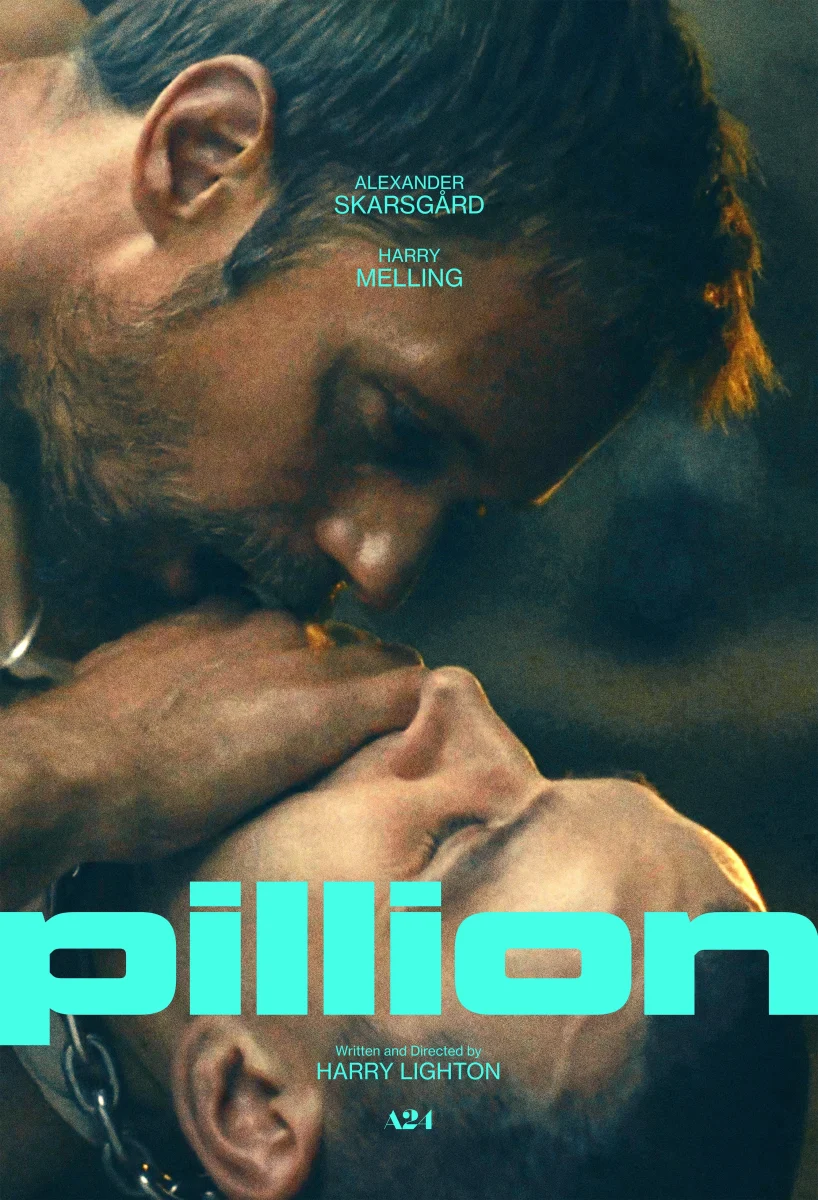
The pillion is the passenger seat on a motorcycle. Pillion tells the story of Colin, a shy man played by Harry Melling, who gets plucked from obscurity by biker Ray, played by Alexander Skarsgård, and occupies the role of Ray’s submissive.
The film is not flush with dialogue but rather is decorated with meandering moments of exploration, both physical and emotional. Skarsgård’s magnetism would be enough to maintain one’s interest for a worse film, but Melling steals the show with the way he communicates with his eyes. The film’s sparse dialogue allows for more full characterization in its silences.
Pillion explores the confrontational romance between two characters unalike in masculinity. Colin’s role as Ray’s submissive both inside and outside the bedroom creates circumstances which, to the external world both in the film and to filmgoers, may appear undesirable. While to Colin these structures are initially enticing, they also instill in him the need to test those limitations and rebel.
The search for mutual recognition inherent to Colin’s boundary testing may at first seem to evoke a Hegelian master-slave dialectic, which is characterized by the dominance of one subject over another and the constant zero-sum struggle for each to force the other to recognize their subjectivity. The film’s undulating developments instead depict power as transient, along the lines of the slightly more nuanced discourse model advocated for by Michel Foucault.
The film demonstrates the inconstant nature of the domination between Colin and Ray. This is emphasized through the interactions of the two main characters and their surroundings, most crucially with Colin’s parents played heartbreakingly by Douglas Hodge and Lesley Sharp. Pillion’s drama and emotional power stem not from gawking at the lives of people to whom presumably most viewers cannot relate. Instead, ambiguity and instability define the film. Foucault discusses this in The History of Sexuality Volume I, writing, “[power] is the moving substrate of force relations which, by virtue of their inequality, constantly engender states of power, but the latter are always local and unstable.” Ray’s developing care for Colin creates the possibility for power not defined on all-or-nothing domination but rather on a constantly shifting set of force relations.
The film’s tender embrace of its characters despite what, to an outside observer, could be a seemingly harsh and fetishistic relationship, is instead a revelation. Debutant writer-director Harry Lighton’s light touch allows the film to go beyond mere representation of their sexual relations.
Lighton demonstrates a great deal of mastery over the medium. The film opens with a wordless bravura demonstrating the allure of Ray hitting the road on a motorcycle set to the Italian song “Chariot” by Betty Curtis. The song’s lyrics serve as an invitation to a hidden paradise accessible by joining the singer in her chariot flying above the world. From the opening, the viewer and Colin are invited into an unknown world, perhaps at the expense of their innocence.
The press screening the Maroon was invited to on February 10 was packed with an excited audience. The lead actors Lighton and Melling were brought to the stage to introduce the film by Gary Wasdin, executive director at the Leather Archives & Museum on the North Side of Chicago, which is dedicated to leather culture and the sexual practices of those that don it. I am not in a position to evaluate the film’s accuracy in its depictions of these practices, but the response from the leather-clad crowd was rapturous both during the film and the audience Q&A that followed. A background in the subcultures explored by the film won’t hurt one’s enjoyment, but if one goes in with an open mind, such knowledge shouldn’t be necessary.
The film climaxes with the largest shift of power relations between Colin and Ray and leaves the viewer questioning the extent to which relationships can find stability in instability. When does a fluctuation in relations shake a relationship past the point of return? If Pillion was merely an opportunity to ogle at Alexander Skarsgård and hear some evocative music over beautiful shots of motorcycle rides, that might have been enough for a good movie. That it is also capable of exploring such important questions in such a nuanced manner makes it a great one. I loved going along for the ride.