For most UChicago undergraduate students, the 12 years prior to attending the College are spent in a classroom. For fourth-year business economics major John Moore, however, those 12 years played out under the bright lights of the National Hockey League (NHL) instead.
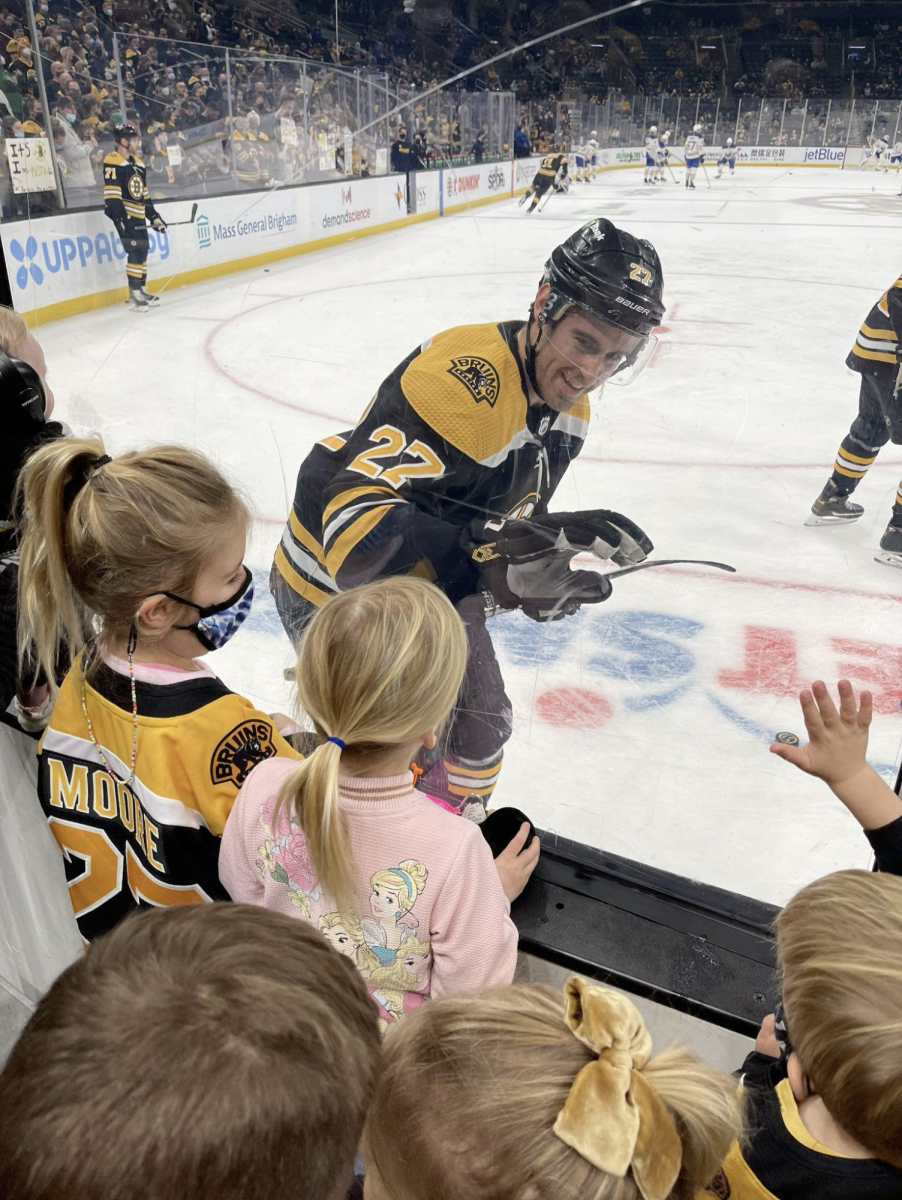
In the 2009 NHL entry draft, Moore was drafted 21st overall by the Columbus Blue Jackets. From there, he traveled across North America and played with some of the most storied franchises in the NHL, making it to the Stanley Cup Finals with the New York Rangers in 2014 and the Boston Bruins in 2019.
When asked if there was something he was particularly proud of in his career, Moore recalled, “The moment I think about most is in 2019. I had broken my humerus and torn the labrum in my shoulder.… I decided to put off surgery and be ready if the team needed me because we had a great team in Boston, and we ended up going to game seven in the Stanley Cup Finals.”
Moore went on to explain that he played with the injury because of the bonds he had built on that Bruins team—bonds that persist today. For him, playing through injury was a “mentality of being there when you’re needed,” he said, explaining, “I think that applies to everyone, no matter what your situation in life is.… There are people that depend on you, and there are certain times when you have to dig deep and kind of overcome whatever you’re feeling internally and show up for the people that matter most for you.”
During his first few weeks at UChicago, Moore leaned on his experience on that 2019 Bruins team. Despite being unsure if he would be prepared for the initial shock that comes with attending UChicago, he “committed to the process and learned and got better every day.”
While his NHL experiences have helped guide his undergraduate experience thus far, Moore has still seen contrasts between his NHL and UChicago careers. “The mantra that was often repeated when I was a young player, by coaches and teammates was ‘The NHL is not a development league,’ meaning, with travel schedules, competition schedules, with injuries, there’s very little practice time,” Moore said.
At UChicago however, Moore found himself with ample “practice” time. As an undergraduate, Moore realized that taking time to understand course material by extensive studying, going to office hours, and approaching other classmates was necessary to development—a clear juxtaposition to the NHL, where most of his instruction was relegated to team meetings and all his energy was saved for puck drop.
Notably, most professional athletes do not pursue a college degree after a long career in sports. They often turn to broadcasting or player development after retirement instead of completing a degree they may have started as a National Collegiate Athletic Association (NCAA) athlete.
Additionally, unlike the National Football League, for example, where virtually all players are drafted from collegiate institutions, the National Hockey League drafts primarily from organizations outside the NCAA, such as top major junior hockey leagues. Moore was drafted from the United States Hockey League, so the first time he ever stepped foot in a college classroom was at the University of Chicago.
So, how did John Moore end up here?
After sustaining serious injuries in the 2018–2019 season, Moore had a lot of downtime while he underwent physical rehabilitation. This time off the ice offered him the opportunity in the summer of 2019 to start taking online classes offered through the NHL’s Players’ Association. A couple of years later, during the COVID-19 pandemic, Moore was in the “bubble” in Toronto, a strictly controlled environment designed to prevent the spread of the virus throughout the league, and once more found himself with a lot of downtime, permitting him to take more online classes.
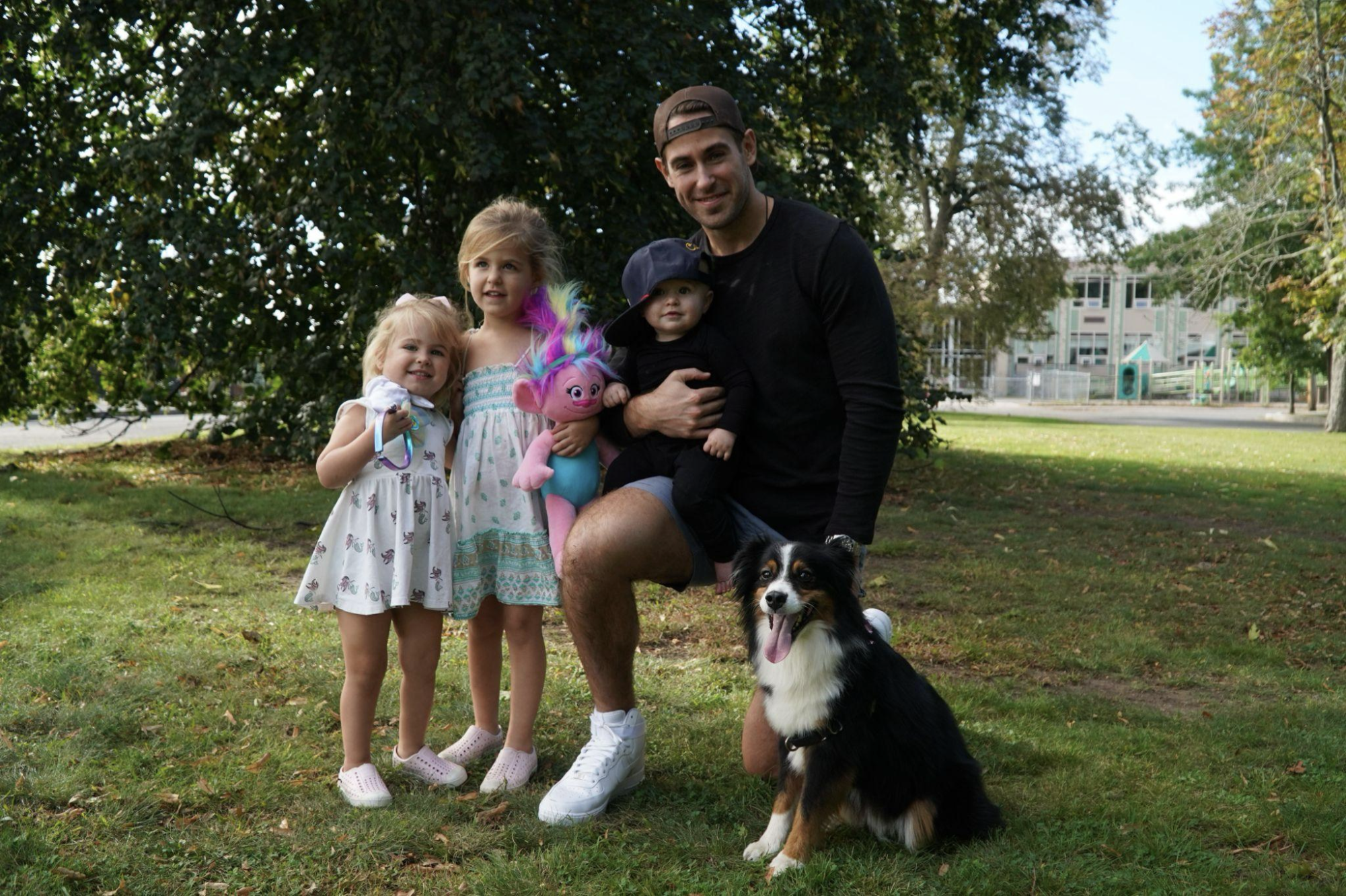
Moore had reconstructive hip surgery the next year, which required extensive rehabilitation and added further to time away from the rink. Reflecting on what this time meant for him, Moore explained, “I started to really think about what life after hockey would look like for me. [After] being exposed to the world and a lot of business opportunities through professional sports, I felt that pursuing an undergraduate education was something I really wanted to do. And I was really fortunate that my wife shared that enthusiasm as well. We have three young kids, so it takes a lot of sacrifice from everyone to allow me to do this.”
While Moore’s time off the ice certainly motivated his educational pursuits, his curiosity to learn was not something that suddenly appeared post-retirement. “I was really lucky to kind of realize a childhood dream and have a career in professional sports, but I’ve always been extremely curious,” Moore explained. “For the longest time, [my curiosity] took a backseat to the demands of my sport and my job.”
Having thus settled on a clear post-retirement plan to explore his previously cast-aside curiosity, there were many qualities, similar to those appreciated by most prospective students, that drew Moore to UChicago: the amazing faculty, the core curriculum, and a welcoming campus.
Moore recalled visiting campus in July 2022, “[I]t was a beautiful summer day, and I was put in touch with a bunch of former military people who walked me around.” If Moore felt any reservations about pursuing a college degree, they were similar to those held by most adults who go to these institutions after solid careers. There is always the question of whether students largely in their early twenties will mix well with someone in a different stage of life. However, Moore was thankful to learn from the veterans leading his tour “that no one really cares about your background, or how old you are, or that you might not look like many of your other classmates. They care about how you contribute in a class setting, what you have to say.”
That’s not to say the transition from a career as a professional athlete to an intense university like UChicago was easy for Moore. When asked about retirement itself, Moore reflected, “I think when you’re playing [in the NHL], nobody ever really takes a lot of time envisioning what the end looks like. And then that happens. It’s so sudden, and [it means] adjusting from the NHL, where you’re given a schedule every day of ‘here’s where you have to be, here’s who we’re playing, these are the training protocols, this is what you need to eat, this is what time you need to be on an airplane,’ to nothing. You’re no longer in a locker room with your peers. You don’t get that social interaction on a day-to-day basis. It was disorienting getting out of it.”
From an outside perspective, retirement after a professional sports career where you made millions of dollars may sound like a great opportunity to slow down and enjoy the fruits of your labor. For Moore, it was different. “I didn’t want to just, you know, be done and kick my feet up when I’m 32, 33. I don’t think that’s any way to get through life. I think in and of itself the process here of learning day in and day out, at my age and my stage of life, is… an indulgence, and I try and bring that gratitude to the classroom,” he said.
Moore was also extremely grateful for the mentorship of professor Christopher Simon, who taught his Classical Latin class, at the beginning of this new experience. “[Simon] went out of his way to meet with me, really build me up confidence-wise, and make sure that my habits and everything were appropriate for this new kind of chapter in my life. I think back, and I don’t know where I’d be without someone like that who took time out of a busy schedule of his own,” Moore said.
Moore acknowledged how much he has grown since retiring from professional hockey through the support of his family and his great mentors at UChicago. When asked what a younger John Moore would think of John Moore today, he remarked, “I think he would be incredibly proud of the 35-year-old version of himself. You know, in the NHL, tomorrow was, in my career… never really a guarantee I’d still be there.… [T]here was an intensity to keep your seat at the table.… I think 22-year-old John Moore, knowing that a 35-year-old version is at the University of Chicago… would be incredibly proud and incredibly grateful to the admissions committee for allowing him to be a student here.”
Besides furthering his own education and knowledge, Moore also highlighted the example he wants to set for his children. Moore described the importance of being a role model for them, saying, “I really love that my kids see me toil over a book, underlining and Post-it-ing things.” Moore continued, “I’m of the opinion that I think it’s great for kids to see their parents or their caretakers working and struggling, especially around education.… I think someday, maybe when [my kids] are older and they have children of their own, if that ever happens, they can kind of appreciate how hard this was, not just for me, but for my wife as well.”
When asked if there was any advice he would give to retiring NHL players, Moore explained that, because of the luck required to become an NHL player, many players have internalized the phrase “always bet on yourself.” For Moore, his “bet” was the decision to go pro right out of high school. Reconciling this NHL adage with his decision to pursue education post-retirement, Moore said, “This ‘betting on yourself’ is something I only saw more of as my career progressed, whether it was deciding to pursue free agency, playing through injuries, deciding to take chances within the team system, or just simply advocating for [myself] in an organization. I would say to my peers that pursuing an education after a professional sports career is an extension of that same philosophy. It is a way of investing in yourself. My time here has given me a toolkit that I can apply to things from Classical Latin to economics, but, more than that, it has deepened my curiosity and appreciation for the world around me. This has been transformative, and I want to promote this experience and remain actively involved in helping attract others from nontraditional backgrounds to the University of Chicago.”
While many of us here at UChicago have not played at Madison Square Garden for the New York Rangers, won a bronze medal at the International Ice Hockey Federation World Championships, or played through severe injuries in the seventh game of the Stanley Cup finals, Moore is no different than your average UChicago student. He reads the same books, enjoys the same courses, and studies at Regenstein Library.