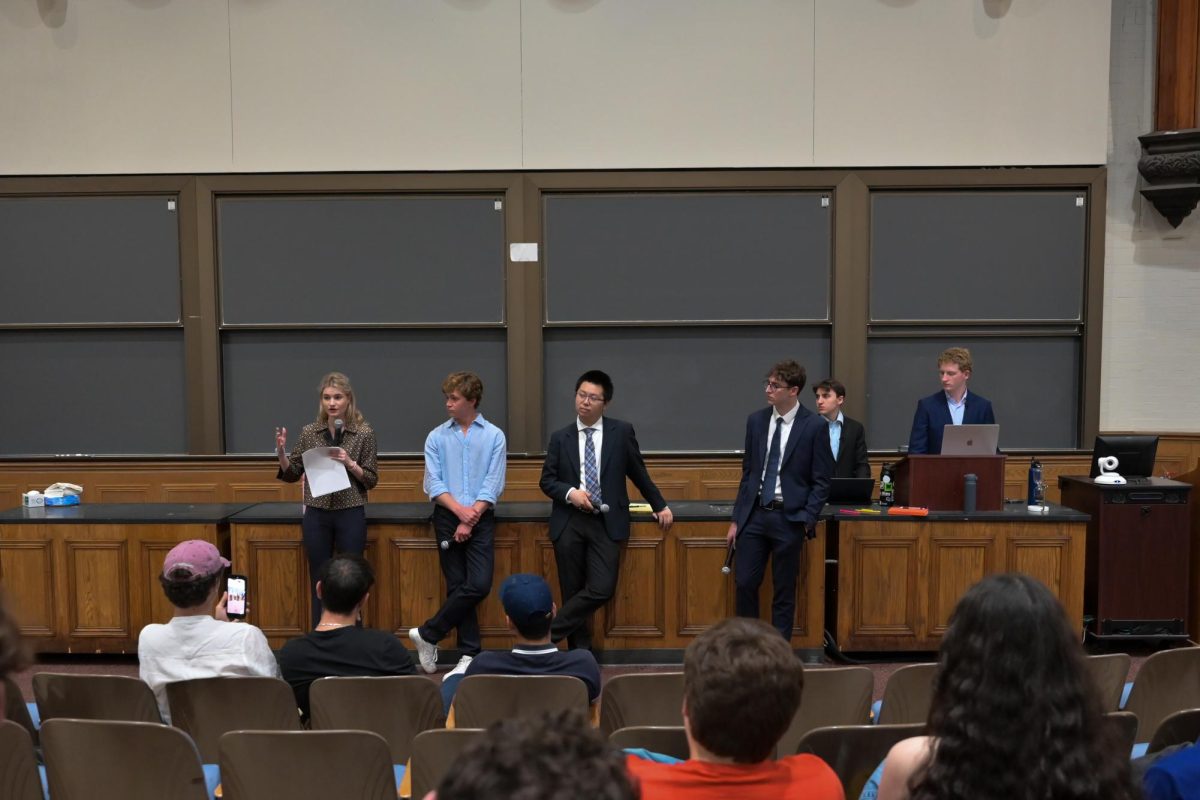
Presidential candidates from the four slates running to lead Undergraduate Student Government (USG) next academic year met for two debates on April 14 and April 16 to take questions, outline their platforms, and differentiate themselves from their opponents.
The USG president leads the Cabinet, which oversees College Council (CC) and committees that allocate RSO funding and implement initiatives passed by CC. The Cabinet also assesses student concerns and communicates with University administrators.
Elections & Rules Committee Chair Jay Love and Maroon Deputy News Editor Julian Moreno co-moderated the first debate, and the second was hosted by the Phoenix, a student-run magazine.
Voting will take place virtually beginning at 9 a.m. on Monday, April 20, and ending at 4 p.m. on April 24.
In addition to Cabinet positions, the ballot will contain a proposed constitutional amendment to create a Judicial Council and a resolution seeking the removal of Thomas Pritzker from the UChicago Board of Trustees.
Presidential candidates are split between current CC representatives and newcomers to USG. Both Class of 2028 Representative Grace Beatty (Premium Party) and CC Vice Chair Kevin Guo (CORE Collective) have served in USG throughout their time in the College. Daniel de Beer (Ida Noyes Party) and William Moller (New Generation Party), in contrast, have not previously served in USG, something both portrayed as a strength.
“For the last 13 years—at least 13 years—USG has handed the baton to insiders, as in someone that has been on USG previously. We believe the cycle needs to change,” de Beer said at the Tuesday debate. He criticized past Cabinets and CC representatives for making excuses about why they had not accomplished more with their positions, saying that USG under his leadership would be “outcomes-based.”
Beatty and Guo argued their experience in USG was central to their ability to lead it effectively.
“I’m not the only candidate on this stage calling for more democratic oversight of [USG’s] finances and more effective advocacy, but I am the only one who has done something about this,” Guo said, encouraging the audience to value “substance” over “noise.”
Budget Processes
Much of Tuesday’s debate centered on how each candidate would steward USG’s approximately $2 million budget, which is allocated annually to RSOs and discretionary projects. Each candidate said they would work to make spending more transparent.
“This is your money, and you deserve to see how it is spent. You deserve to choose how that money is spent, and you deserve, as RSOs, to have that agency,” Beatty said. “However, you, as students, also deserve to have the accessibility to different resources on campus.”
Guo, Beatty and Moller all agreed that the cost guidelines of Student Government Finance Committee (SGFC) should be reformed to give RSOs more flexibility in what they can do with their money.
Moller also argued at Thursday’s debate that SGFC’s current fundraising rules incentivize RSOs not to fundraise. Guo responded that, for any SGFC request exceeding $2,500, “[RSOs] are required to fundraise between 10 percent and 33 percent of an RSO’s requested amount.”
De Beer said he planned to promote transparency by “publishing the USG budget [and] publishing the amount of money that goes into each committee,” arguing that committees should not be fully funded each year if they are not enacting significant projects.
Moller said that, alongside amending SGFC’s cost guidelines, he would work to “root out the waste” in USG spending to help fund his proposed weekend shuttle to downtown.
Attendance Records
Candidates also faced questions about their attendance at subcommittee meetings during the Thursday debate. Beatty in particular was asked about her own absence record at SGFC meetings—29 percent since October, according to a Maroon op-ed by USG Executive Vice President Alex Fuentes. She responded that the attendance records were inaccurate due to recordkeeping issues, calling the criticism a “personal attack.”
Beatty added that the Program Coordinating Council (PCC), which she chairs, faces attendance issues from other members. Only three people besides her attended a recent PCC meeting to fund Summer Breeze, “a pretty important event,” she said.
Beatty said attendance could improve if the next USG president facilitated “a USG people want to join, not one they are frustrated with.”
Student Life Proposals
Beatty described at both debates her slate’s plans to provide a longer reading period, universal recorded lectures, and headshot services for students.
During Tuesday’s debate, she explained that the extended reading period would stretch into the Tuesday of each finals week, reducing the finals period from four days to just three.
Career Advancement currently offers free headshot services to students each quarter on a first come, first serve basis.
Beatty also emphasized two areas she hopes to improve for students: providing free printing when required for class and allowing sports clubs that overlap with official teams to receive funding. Sports clubs are currently ineligible for RSO status, and therefore USG funding, if the University operates a varsity or, in some cases, intramural team for the same activity.
When asked how her free printing proposal would operate, Beatty said that “professors would each have their printing code and people would be able to print their materials when required by their professors through these.” She referenced the printing codes that RSOs are able to use as a model for how this system would work. RSOs are charged quarterly at the standard rate for printing costs.
De Beer’s campaign has primarily focused on “sav[ing] the Pub” and providing an alternative social space for students during the upcoming renovation of Ida Noyes Hall, a timeline for which has not yet been announced. The University has not publicly stated that the Pub will be closed during renovations.
Moller’s proposals included plans to establish a downtown weekend shuttle at a target cost of $53,000 per year, approximately two percent of USG’s current budget.
The weekend shuttle, along with Moller’s other proposals—a “party stipend” for RSOs and a Career Advancement Committee—drew criticism from Guo, who said that, according to his calculations, Moller’s plans would require upwards of 15 to 20 percent flat cut [to RSO budgets].” He did not share the specifics of these calculations during the debate. Moller has written in an op-ed in the Maroon that his ideas would not require cuts to RSO funding and that some of the cost would be taken out of the Cabinet budget.
Moller also touted his slate’s connections with University administration when discussing their plans to create a streamlined alumni network. “I actually spoke with the director of Career Advancement today. She said, quote-on-quote, they would give us a ‘pot of money’ to fund the committee” to create this network, Moller said. Although Moller told the Maroon that he had spoken to Infinity Transportation—the University’s shuttle operator—and received a cost estimate, he did not claim to have made any similar agreement with the University itself.
Vedika Baradwaj and Isaiah Glick contributed reporting.
Editor’s note: Grace Beatty and Aaron Horowitz, candidates for USG president and executive vice president, respectively, are staff members of the Maroon. They had no involvement in the reporting or editing of this story.