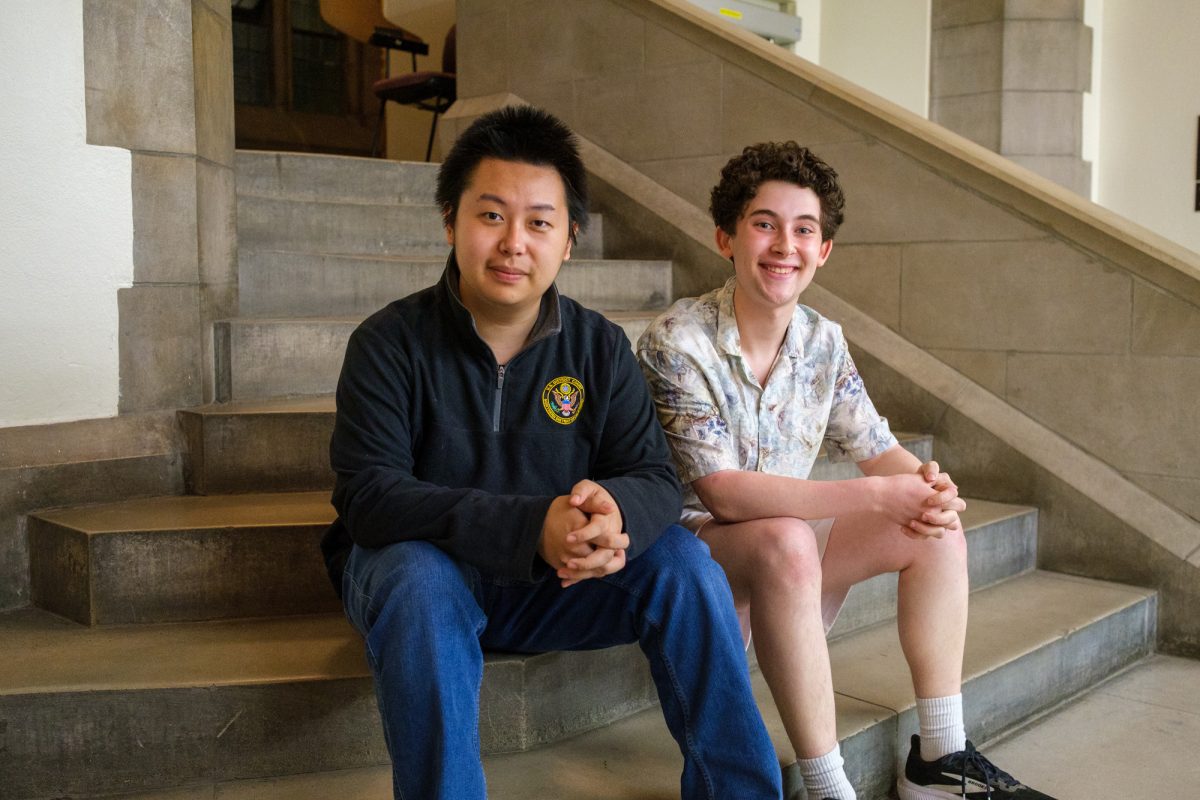
Third-year Kevin Guo and first-year Aaron Horowitz of the CORE Collective slate were elected last month as president and executive vice president of Undergraduate Student Government (USG) for the 2026–27 academic year. The Maroon sat down with them to discuss the election cycle, their plans for next year, and how they hope to combat the perception that USG is ineffective.
Chicago Maroon: What made each of you want to get involved with USG and, more specifically, run for president and vice president this election cycle?
Aaron Horowitz: Neither of us originally were actually planning on running, but we are both so invested in this institution and were encouraged by some people to run. Kevin, I think, was on the fence, but leaning towards running. He asked me if I would be willing to run with him as [executive vice president], and my first reaction was, “No thank you—I’m happy on College Council.” But then he outlined some of the Cabinet’s responsibilities and how they aligned with my personal goals, and I thought, “Okay, that actually sounds like a really great fit.”
Kevin Guo: I was originally not planning on running—the reason I ultimately did was because a few people in [USG] encouraged me to. As Aaron would also tell you, there were many points where I really wanted to drop out of the race.
That said, going back to the broader question of why I wanted to join [USG], I think UChicago has a very unique student government in the sense that our student government actually does things. We have $2.05 million in annual budget that students are responsible for allocating. I want to make sure that student needs are prioritized while ensuring that administrative work gets done. That was my original goal [in] running for [USG] in the first place. On College Council, I was the one who helped make it a much more active body than it was my first year. I want to continue that spirit of making sure that we have a very active student government.
CM: For people who didn’t follow the campaign, what are your main goals and priorities for your term as USG leaders?
KG: Making sure more funding gets to RSOs, improving the transparency of our financial system, and working with administrators to implement quality of life changes, which my running mate, Aaron, can speak to.
AH: Yeah, Maroon Dollars for laundry is a big part of that. It’s something I campaigned on when I ran for College Council at the start of this year. We passed a resolution earlier this year asking the administration to make it happen, but we recognize that’s not enough on its own, so I’ve been consistently meeting with administrators ever since to check in on the progress of that proposal, and it’s something we’re really going to push for going into next year.
Beyond that, making syllabi publicly accessible is also a big priority, so students have a better idea of what they’re getting into before starting a class. Add/drop is a great mechanism to have, but it’s probably not anybody’s first choice—you’re adding or dropping a class because something isn’t the way you’d like it to be, so it would be better to make things right before it ever gets to that stage.
CM: On financial transparency, the CLEAR Act, passed by College Council earlier this year, has already mandated that USG’s allocations to RSOs be made publicly available starting next year. And on Maroon Dollars for laundry, you mentioned yourself that this is already in the works. If these things are already ongoing or done, what’s actually going to change with you two at the helm?
KG: We have these pieces of paper—the CLEAR Act, and so on. But I think these pieces of paper, in the end, are useless without someone actually believing in them and wanting to implement them. That’s where we stand.
AH: One thing that we have talked about doing since day one is publishing an advocacy agenda once we take office next year, which is actually really valuable. It’s not just a piece of paper. It sets the vision for [USG] for the year, identifies goals that we intend to pursue, and makes those goals available to the members of the public so they can ask questions as they see fit. It also guides us as an institution and helps us coordinate focus. You generally see people either run away from advocacy or towards it. Both of us believe in running towards advocacy, but you also have to do so in a smart, coordinated, and pragmatic way.
CM: RSO funding is one of USG’s main responsibilities. How do you plan to approach that?
KG: The biggest thing is trying to get through to the administration about the consequences that our current lack of funding has had on RSOs. Going forward, that’s just one of the things we want to emphasize: what RSOs haven’t been able to do—the things that would have been a big value add to the University community but didn’t happen because of insufficient funding.
AH: The increase in USG and RSO funding we secured this year was thanks in large part to Kevin’s advocacy as vice chair of College Council and as a College Council representative for the Class of ’27.
KG: I wasn’t the only one in the room. I want to thank the outgoing president, Elijah Jenkins; the vice president of student organizations, Fred Lee; the outgoing executive vice president, Alex Fuentes; and the outgoing College Council chair, Ben Fica. All of them, collectively, were very important in getting this done.
AH: This is a year-round goal. The budget that USG receives is allocated at the end of the academic year in spring quarter… so it’s something we can push for and bring up in meetings with administrators throughout the year. That said, the budget for the 2027–28 academic year will not be published until spring quarter of next year, so the more immediate change that RSOs will see next year is a result of the advocacy that Kevin was talking about.
CM: There is a widespread perception among students that USG does not do very much. Do you plan to address and change that perception, and, if so, how?
KG: Unfortunately, a lot of people hold this view, though I don’t think it’s true. Just this spring, members of [USG] spent hundreds upon hundreds of hours doing Annual Allocations for RSOs. I was part of this process, as were many of my fellow College Council members, and I want to highlight how much time people in [USG] take out of their lives to help the student body.
The other thing [USG] should do is publicize its wins more. That’s what I tried to do last week, for example, when we learned we were getting the largest budget increase in at least my three years here. Making sure that the hard work everyone does is actually shown is really important.
AH: First, on publicizing our wins more: that’s not so that we individually look better; it’s so that people can realize that [USG] actually does have the power to do things. That then encourages better, more qualified candidates to run, leads people to ask better questions of their elected officials, and generates greater engagement with USG generally, which is great for the institution.
The second point I want to raise is that USG has a clear set of financial responsibilities, which Kevin outlined, that are very important and recurring every year. But we also have advocacy-based priorities, and those are slower; they take more time and don’t always work out. But a lot of them do. And that ties back into publicizing our wins more. For example, the reason that we have extended hours in the Reg during finals week is because USG pushed for 24/7 Reg access. They didn’t get it—there were logistical and financial reasons for that—but, because they took that step, passing a resolution and talking to administrators, something else happened which has had a significant, positive impact on students’ lives. That kind of work is what USG is all about.
CM: A lot of USG Cabinets have promised big things and fallen short due to limitations and obstacles. What’s going to set you two apart, and how are you going to deliver on what you’ve promised?
KG: What differentiates us is that we’ve already been doing this work. We’re not trying to do new things—we’re trying to continue what we’ve already been doing. That’s the biggest difference. I’m already in conversation with the administration about syllabi accessibility, as is Aaron with Maroon Dollars for laundry.
CM: And, finally, what do you see as the broader role of [USG], beyond policy?
KG: When I was training new College Council members, I specifically emphasized that there are two halves to USG: policy work and administrative work. I’m much more involved in the administrative side than the policy side. At the end of the day, people need to realize that [USG] has $2 million. It’s real money, and we need to allocate it properly and responsibly. That’s the biggest role of [USG] beyond policy: making sure that everything runs smoothly administratively, that RSOs are getting the funding they need and want. We also sometimes spend money on school-wide events and initiatives, for example—just to make sure that the student body as a whole is satisfied.
AH: Another role that often goes underappreciated is this: we are elected to represent the student body, and that gives us an elevated platform. That really does matter, because even though [USG] isn’t always in a position to effect change on every issue it wants to, it can speak on behalf of the student body. We can say, in the capacity of an elected official, “I’m concerned about this,” or “This is something I’m prioritizing.” And because the student body has put their faith in us to represent them, that message takes on a broader meaning.
Editor’s note: Executive Vice President–elect Aaron Horowitz is a staff member of the Maroon. He had no involvement in the reporting or editing of this story.