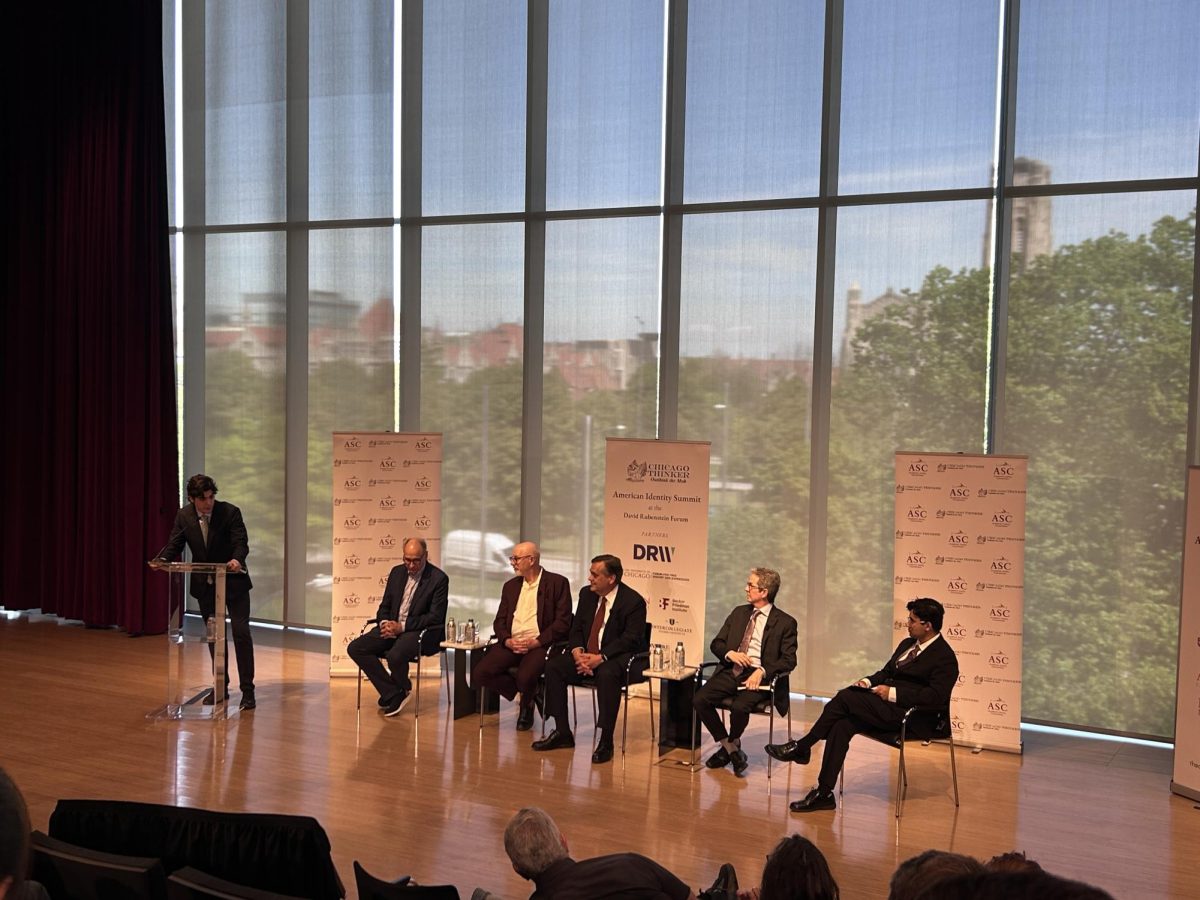
The Chicago Thinker, a conservative student publication, hosted its second American Identity Summit at the David Rubenstein Forum on May 15 and 16. The summit focused on evaluating America’s identity in the context of President Donald Trump’s foreign policy, AI, and attacks on higher education.
Speakers at the summit included Tim Pool, a podcast host; Scott Atlas, a COVID-19 advisor during Trump’s first administration; and Jonathan Turley, a professor of constitutional law at George Washington University Law School. The event featured four panels on foreign policy, AI, constitutional law, and free market economics.
Christopher Phillips (A.B. ’25), president of the Chicago Thinker Foundation—the nonprofit that oversees the publication—delivered the opening remarks on the first day of the summit. He described the summit as an opportunity to analyze the fundamental tenets of American identity through “critically [engaging] a lot of the underlying assumptions that our leaders have held for decades.”
Phillips said he looked forward to establishing the Thinker as a “nexus of a broader, collective network to bring together people and effectuate positive, thoughtful change.”
His remarks were followed by two panels. The first, titled “America and the World: The Donroe Doctrine,” featured Seth Jones, a defense expert at the Center for Strategic and International Studies and a commissioner on Congress’s Afghanistan War Commission; Justin Logan, director of defense and foreign policy studies at the Cato Institute; Leslie Vinjamuri, president and chief executive officer (CEO) of the Chicago Council on Global Affairs; and Robert Pape, professor of political science at UChicago. The panel was hosted by Thinker chief financial officer and media manager Eduardo Ribeiro.
Pape emphasized the importance of American primacy, which he defined as “what you need to keep America the wealthiest country on the planet,” arguing that primacy should be America’s chief priority in geopolitical strategy.
He posed several economic pathways to securing primacy, including offshoring and pivoting to renewable energy, citing China’s solar infrastructure as a model. Pape also cautioned against entering foreign conflicts recklessly and proposed gradually pulling out of Israel over 10 years.
Vinjamuri questioned the underlying premise that America should be bound by primacy. “One of the phenomenal sources of our competitiveness is that we aren’t nationalists,” she said, adding that a more nationalist orientation might compromise the “American Dream” that has attracted global talent and intelligence.
“The United States needs allies, needs partners, needs a strategy for the Global South, and I don’t think it gets us very far to talk about how we need to be number one,” Vinjamuri said. “It unnecessarily alienates the people on whose goodwill we need to depend.”
The panel then shifted to the ongoing conflict in Iran and America’s legacy of persistent military engagement in the Middle East.
Logan was against American presence in the region. “The Middle East is a small, poor, weak region whose problems we cannot fix, and the best thing we could do would be to leave it alone,” he said. “We should have our hair on fire about the extent to which the ingredients for conducting the American way of war are being drawn down by insane, idiotic, counterproductive conflicts in the Middle East.”
Pape considered multiple hypothetical scenarios of resolving the Iran conflict, like keeping the blockade or American air and ground pressure. In the spirit of primacy, he said the best option would be for the U.S. to hand over negotiations about reopening the Strait of Hormuz to the United Arab Emirates and Saudi Arabia.
The second panel, titled “Building America’s Future: The US in the Age of AI,” was led by Thinker director of development Shubhaankar Gupta. It featured Donald Wilson (A.B. ’88), founder and CEO of derivatives trading firm DRW and a UChicago trustee; Jordan Blashek, co-founder of venture capital firm America’s Frontier Fund; and Alec Litowitz (J.D. ’93, M.B.A. ’93), an original partner at Citadel Investment Group and founder of asset management firm Magnetar Capital.
Blashek opened by advocating for a hands-off approach to AI policymaking, emphasizing the importance of not slowing down innovation. “The pace of artificial intelligence is so high. There is no chance that the government can make the right choices of how to intervene and how to build the economy,” he said. “The only organizational unit that can move fast enough to keep up with this race and make sure we beat it is entrepreneurs.”
Litowitz contrasted the United States’s structure with China’s, where capital markets enable experimentation but “institutions on a national level serve as a vessel for coordination,” he said.
The discussion then shifted to how investors could take advantage of developments in AI to facilitate profit. Blashek highlighted the importance of increasingly scarce resources like Nvidia’s graphics processing units. He said he was looking to invest not only in scarce manufactured capital but also in entrepreneurs who can lead and navigate this new era of technology.
Litowitz raised concerns over navigating a “cognitive revolution.” While he praised the accuracy of large language models (LLMs) in compressing large amounts of data and information, he simultaneously fears that a reliance on LLMs could lead to “cognition atrophy” in humans.
Scott Atlas, a senior fellow at the Hoover Institution, a conservative think tank at Stanford University, gave the opening speech on the second day of the summit. As a special advisor to Trump on the Coronavirus Task Force, Atlas advocated for a quick end to lockdowns and fewer testing requirements. He also pushed for faster reopening of K–12 schools, universities, and businesses.
In his speech, Atlas emphasized that “dishonest journalism” combined with a “corrupt government” had culminated in poor management of the pandemic, arguing that the lockdown precautions taken by institutions of higher education during the pandemic called into question their ability to facilitate free exchange of ideas, critical thinking, and civil discourse. “University presidents and professors broke the social contract with our most precious resource, our children, but they failed as role models on free speech, and now free exchange of ideas is under threat,” he said.
Atlas also criticized broader resistance in academia to conservative thought: “Self-censorship by conservative students is rampant, tolerance for controversial speakers is low, [and] disruption of conservative speakers goes unpunished,” he said.
The first panel on day two of the summit, titled “America 250: Origins, Evolution, and Future of the Republic,” featured Turley, a professor of constitutional law, alongside David Axelrod, a former senior advisor to President Barack Obama and founding director of UChicago’s Institute of Politics; Tom Ginsburg, a professor of constitutional law at the Law School; and John Pinheiro, the director of research at the Acton Institute, a think tank that says it integrates “Judeo-Christian truths” and free-market principles.
The moderator, Thinker managing editor Akshay Kirthi, began by asking the panelists whether they were proud of or apologetic for the nation’s origins, contrasting two commonly cited starting dates for the nation: July 4, 1776, when the Founding Fathers signed the Declaration of Independence, and 1619, when enslaved people first arrived in what would become the United States.
The latter date reached the national spotlight with the publication of the New York Times’s “1619 Project” in 2019. The project, which sought to center slavery in the story of America’s founding, has attracted significant controversy, with many critics arguing it overstated the role slavery played in early America.
For Axelrod, acknowledging America’s flaws is not incompatible with taking pride in the nation.
“To say that I am proud of my country is not to say that I think our country has not made mistakes,” he said. “Thomas Jefferson had 600 slaves over the course of his life, and he understood the conflict in writing about the equality of men and being a slaveholder.… What is the genius of America is that we’ve created a structure that allows us to keep trying to perfect our union, to keep trying to overcome those problems and imperfection.”
Pinheiro was hesitant to endorse 1619 as a starting point for the nation. For Pinheiro, it’s more important to recognize both that the founders were “flawed people” and that they made important contributions. “I would take those flawed founders as a group over flawed people from any other time group,” he said. “Despite their flaws, look at what was produced.”
Axelrod referenced how his family, who immigrated to the U.S., was attracted by its ideals of opportunity. “I’m the most grateful American there can be,” Axelrod said. “My father was a refugee from Eastern Europe, and he came to pursue that ideal that’s encoded in the Declaration of Independence…. One generation later, I was the senior advisor to a president of the United States.”
Ginsburg noted that the Constitution, as a product of efforts by the Founding Fathers in 1776, codified the ideals of life, liberty, and the pursuit of happiness that are nearly universal today.
“Life, liberty, and the pursuit of happiness may not be honored in every place, but they have won the normative battle,” Ginsburg said. “In an era in democratic decline, I’m still optimistic about democracy… and you’ll see these claims [of democracy] are ultimately grounded in the 1776 ideals.”
The conversation then pivoted to tracing how the scope of the federal government has changed over time. Turley discussed how the Constitution protects federalism, noting that the U.S. Supreme Court has historically debated how to protect state rights while remaining within a framework that “adhere[s] to our values.”
Both Turley and Ginsburg described how court-packing in the judicial branch and the expansion of the executive branch’s war powers have diminished the role of Congress, heightening the stakes of presidential elections.
Turley questioned the accuracy of labeling the country’s current state a “crisis.” He argued that Congress’s inability to act is not a constitutional crisis, but rather evidence of democracy working. The real problem, he said, is that people can’t agree.
“[The country is] a priesthood that lost its faith but kept its frauds, and we just lecture at cold altars about how we have to change the system,” he said.
Pinheiro, too, cautioned against using the word “crisis” to describe the present. “Beware the influencer, beware the technocrat, and beware the political operative that tells you things are worse than they are, and this is the most important election in your life.”
Axelrod suggested that today’s political divisions are rooted in social media, where algorithms encourage people to stay within their silos and avoid compromise and cohesion.
The second panel of the day, titled “Free Market Economics in the 21st Century,” was led by first-year Noah Bauserman. It featured Jonathan Gould, current U.S. comptroller of the currency; Harald Uhlig, the Bruce Allen and Barbara Ritzenthaler Professor in Economics and the College; and Lydia Newman, managing director of monetary economics at the American Institute for Economic Research.
The summit ended with a “fireside chat” featuring keynote speaker Tim Pool, a podcaster with over one million YouTube subscribers known for his anti-establishment views and commentary on culture wars.
Pool began by detailing his time livestreaming the Occupy Wall Street movement, a series of protests against corporate greed and political spending in 2011. Pool said he judged that many of the activists he spoke to at the time were more interested in obtaining wealth and power for themselves than reducing wealth inequality.
Covering the protests shaped his belief that wealth inequality fuels violence and discord. “The idea [of being wealthy] pushes forward a politics based on envy, which can result in political instability,” he said.
For Pool, the nation is split into two distinct factions: “a Constitutional Republican movement that is the tradition of America, and… a multicultural democracy movement… that is the new world, new vision for progressivism.”
Pool then posed a scenario: “If a parent says, ‘My child is trans and should have their genitals removed at 13,’ you would say that’s allowed.”
When Phillips responded that he wouldn’t consider that a “medical decision” and instead an ideological one, Pool said Phillips’s apparent inconsistency demonstrated that conservatives’ thinking on the question was based on a “moral worldview, not a principled one” that could transcend ideology.
Phillips’s response highlighted “two distinct ways of reading reality” for Pool, such that each political faction sees issues like gender-affirming care in a fundamentally unresolvable way. He cited Scott Adams, an American cartoonist and conservative commentator, who described political polarization as “two movies playing on one screen.”
“We have to reconcile that we have a fractured culture,” Pool said. “There are two principled factions with massively worldly divergent worldviews.
The fireside chat ended with a discussion of right-wing political activist Charlie Kirk’s assassination in September. “Charlie was feared, respected, and valued tremendously. People saw him as someone who was honorable, honest, and empowering,” Pool said.
For Pool, many conservative public figures come across as inauthentic, a view he said was reinforced for him in the wake of Kirk’s death. “There [are] a great deal of prominent personalities that I would particularly single out from the conservative movement who do not believe a thing they say and get paid to say,” he said. “Maybe these people will be our saving grace, because they will expose the machine for being a bunch of grifters.”