


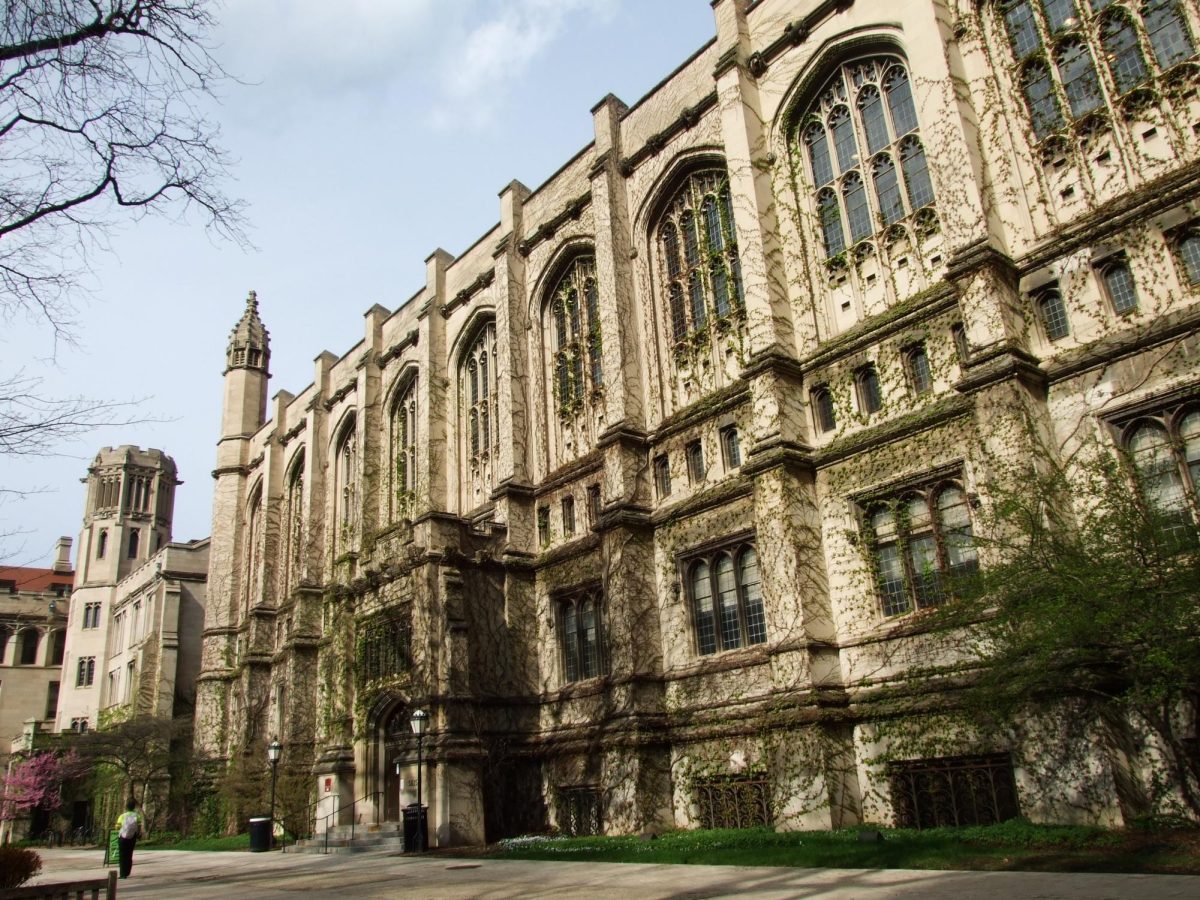
The University of Chicago chapter of the American Association of University Professors (AAUP) criticized a recently published report on humanities scholarship, calling it poorly substantiated and a threat to academic freedom.
The “Report on the State of Scholarship in the Humanities and the Humanistic Social Sciences,” commissioned by the chancellors of Vanderbilt University and Washington University in St. Louis and co-written by outgoing Vice Provost for Academic Affairs Jason Merchant, identifies “ideological distortion” in humanities scholarship and calls for an “intensive study” of certain departments.
In a statement, UChicago’s AAUP chapter said the report “is obviously intended as a pseudo-intellectual justification for an open attack on faculty governance…. As faculty, we must expect and demand that the university disavow this letter, which is contrary to all the principles of freedom of inquiry the university claims are central to its values; and that whoever succeeds Vice Provost Merchant chart a different path.”
Merchant—one of 10 academics who contributed to the report—has served as vice provost at UChicago for eight years, overseeing all academic appointments and adherence to the Kalven Report, a 1967 document outlining the University’s commitment to free inquiry and institutional neutrality. The report includes Merchant’s faculty title, but does not reference his role as vice provost. Next month, Merchant will leave UChicago to become dean of the Vanderbilt College of Arts and Sciences.
The report describes the goal of humanities and humanistic social science scholarship as the pursuit of objective knowledge and contends that the fields have been damaged “by a general erosion of standards” and by the treatment of scholarship as “a form of political activity.”
The document cites feminism, decolonization, and opposition to neoliberal capitalism as political aims that have co-opted humanities scholarship. For instance, it identifies anthropology as one of the most extreme cases of “widespread deterioration in scholarly standards” and says dissent in the field is rampantly suppressed and punished.
The report does not urge university administrators to directly intervene in departments it deems as having gone awry, but it suggests that action may be necessary in certain cases. “If and when the department of astronomy morphs into the department of astrology, it will at some point make sense for the administration to object,” the report states.
“The report does not meaningfully engage with the content of the fields that it’s criticizing,” associate professor of history and UChicago AAUP President Gabriel Winant told the Maroon. “The report rehashes a set of things that some of its authors have now been saying for 30 years with no seeming acknowledgement of that fact. It represents a position, but it presents that position as the position of objectivity and neutrality, which is frankly unrigorous, intellectually bankrupt, [and] incoherent.”
Fearing threats to academic freedom and inquiry, Winant questioned whether the report reflected a broader perspective among UChicago’s leadership. “Did [University leadership] know that [Merchant] was doing this—that he was going, signing off, preparing, and signing on to a document which is directly at odds with the policies that he’s supposed to be administering?” he asked, referring to the Kalven Report.
The University declined to comment.
Merchant did not respond to questions about his involvement in the report, institutional neutrality, and his recommendations for University policy.
The AAUP also tied the report’s threats to academic freedom to the UChicago Laboratory Schools’ new viewpoint-neutrality standards, which call for teachers to engage with “contested issues” only when “pedagogically justified.” The policy has divided community members; some have praised it for bringing the Lab Schools into alignment with the University’s position on institutional neutrality, while others—including the AAUP—have said that it limits what teachers are allowed to discuss in the classroom.
“All spring, the university administration has insisted that the Lab standards have no bearing on freedom of inquiry on central campus… and faculty need not concern ourselves with the issues at Lab,” the AAUP statement reads. “Now we learn that the very individual charged with administering the Kalven Report believes otherwise.”
The report comes amid efforts by the Trump administration to root out what it has deemed progressive ideological uniformity in higher education. Cuts to federal grants and other financial pressures forced UChicago and several of its peer institutions, such as Harvard, to reduce admissions to humanities and social sciences graduate programs last year.
Critics of the report have argued it lends credibility to the Trump administration’s arguments, and Republican lawmaker Elise Stefanik, who has spearheaded congressional investigations of antisemitism on college campuses, called the report a must-read. Kwame Anthony Appiah, one of the report’s co-authors, told the Chronicle of Higher Education that he and the other academics behind the report “do not think the solution to any of the problems we identify is for external political actors to come in and dictate to the universities what we should do.”
The report also criticizes relativism—the belief that objective knowledge is unattainable and that perspectives invariably “depend on contingent non-epistemic values and interests,” according to the report—and says humanities scholars with political motivations have come to rely upon it.
Lorraine Daston, a visiting professor in the Committee on Social Thought at UChicago whose book the report cites to acknowledge a broader debate about the nature of objectivity, called its reference to her work “gratuitous.”
“There are times when the quest for objectivity and the quest for truth can be in conflict with one another,” Daston told the Maroon. “I think that it’s very difficult to make a sweeping generalization that all objectivity should always be the cardinal epistemic virtue. There are other epistemic virtues.”
Daston said she does not view relativism as a significant problem facing historical scholarship and believes most political pressure comes from outside the academy. She said she was “perplexed” by the report’s recommendation for an “intensive study” of certain disciplines by “reliably broad-minded” experts.
“I don’t see why one would need additional machinery to evaluate the scholarly quality of a department,” she said.
Aaryan Kumar contributed reporting.





BR / Jul 3, 2026 at 12:18 am
Gabriel Winants’s and Lorraine Daston’s inability to formulate any actual arguments rather than lightweight talking points shows that contemporary historians aren’t exactly know for their philosophical depth.
Most scholars are trivial and irrelevant in the wider scheme of things. Nor are they are not above criticism. They can dish it out their shallow social justice critiques but make the preposterous assertion that no can criticize them.
Maybe they should read Plato rather than preaching.
Matthew G. Andersson, '96, Booth MBA / Jun 18, 2026 at 5:28 pm
The AAUP misunderstands the report. Diermeir (previously in UChicago administration), commissioned the report, as did his peers at Yale and Dartmouth, in order to signal political compliance, and strictly in response to threatened throttling of federal funding. It will be forgotten in the next political cycle that asserts the status quo ante. Moreover, like Yale and Dartmouth, the study group was comprised strictly of faculty which further limits its scope to internal gesture. Diermeir’s report states that its purpose is directed at “regaining trust,” as did the Yale and Dartmouth reports. If that is its objective, it is not a relevant, credible response. The AAUP otherwise ratifies current White House criticism, as it demonstrates that it is a political organization fundamentally anchored in reactive progressive ideology, acting under claims of “academic freedom.” Over ninety percent of its members are registered Democrats, and at least in the Humanities, generally oriented to Marxist sociology which does indeed insidiously inform many of its interpretive priorities. The problem is not limited to universities, as the Secretary of War recently announced concerning the necessary purges in military academies which threaten national security, and intellectual integrity. Until the faculty academy is ideologically balanced in structural labor market terms, such reports are otherwise not intended to affect or capable of directing ideological variance; indeed, they reinforce the academy’s progressive solidarity. Diermeir and his peers haven’t begun to face the actual institutional economic factors of public trust. See the NAS opinion, “Regaining Trust Will Come at a Cost,” May 7, and Hartford Courant oped, “Yale can regain trust by gaining control of its costs,” May 3.