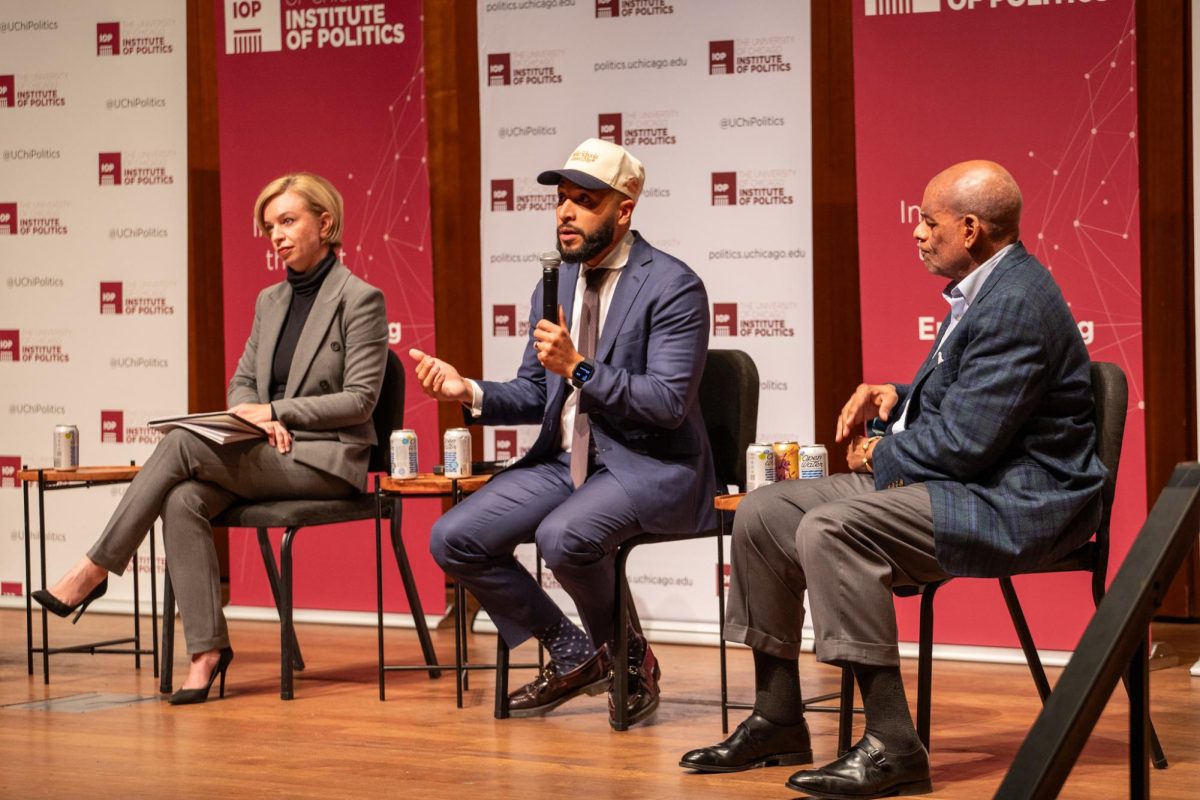
The three candidates for president of the Chicago Board of Education fielded questions from Max Blaisdell of the Hyde Park Herald, Reema Amin of Chalkbeat Chicago, and Chicago Public Schools (CPS) parents on issues ranging from special education to school closures at an October 14 forum hosted by the Institute of Politics.
The race marks the first time all 21 members of the Chicago Board of Education, including its president, will be elected rather than appointed by the mayor.
Jessica Biggs, a current CPS board member and former principal, is backed by the Chicago Federation of Labor and Cook County Board President Toni Preckwinkle. Her platform emphasizes expanding pre-K access and combating declining enrollment, alongside a five-year financial recovery plan to stabilize the district’s finances.
Hilario Dominguez, endorsed by the Chicago Teachers Union (CTU) and Mayor Brandon Johnson, is a former CPS special education teacher. His platform includes universal prekindergarten, expanded extracurricular and vocational programs, an extension of the district’s school closure moratorium, and improved school lunches. He hopes to finance much of his agenda with the $2 billion that the CTU contends Illinois owes CPS under the state’s Evidence-Based Funding (EBF) formula.
Victor Henderson, an attorney and accountant, previously served on the board of Urban Prep, a now-dissolved charter school network. His campaign is largely self-funded, and he has emphasized using his accounting experience to improve CPS’s financial management and transparency.
Declining enrollment and school closures are among the race’s central issues. CPS enrollment fell by more than 11,000 students this fall, dropping below 305,000. Even before this year’s decline, over 250 schools, representing 54 percent of its buildings, were under-enrolled. At some severely under-enrolled schools, annual spending can reach $95,000 per student. But then-Mayor Rahm Emanuel’s 2013 closure of 50 schools remains deeply controversial, with critics arguing the move destabilized neighborhoods and disproportionately affected students of color.
Both Biggs and Henderson expressed conditional support for school closures. Biggs argued that such decisions should respond to community needs while accounting for educational quality.
“These need to be responses to community asks and demands, and at the same time, we need to be having a conversation about the kind of educational experience the district needs to provide and the best way to provide it for all of our students,” Biggs said.
Dominguez, by contrast, firmly opposes closures and wants to extend the district’s moratorium on them, which is set to expire after the 2026–27 school year. He argued that struggling schools should receive additional resources and serve as community centers. He pointed to Drake Elementary, Austin High School, and Steinmetz College Prep as examples of schools offering full-time health clinics.
“They’re generating revenue for the school community as well as driving costs down. But the most important part is they’re adding value to the school community,” Dominguez said.
The presidential race has also been marked by attack ads and controversies surrounding the candidates’ records.
Dominguez said at the forum that the CPS Office of Inspector General had closed an investigation into sexual misconduct allegations against him involving a 17-year-old CPS student during a 2017 summer jobs program.
“Today, the Office of Inspector General closed its investigation on allegations that have been waged against me for now the fourth time over the last 10 years, and for the fourth time the conclusion was the same: unfounded, unsubstantiated,” he said.
Sixteen Chicago City Council members have signed onto a letter demanding an independent investigation of the allegations—which date back to his work in 2017 at an immigration rights nonprofit—noting that CPS’s inspector general was appointed by Mayor Johnson, who has continued to support Dominguez following the allegations.
Henderson also addressed allegations by his ex-wife that he had abused their children. He denied the allegations, describing the dispute as a disagreement over his parenting style.
“There’s a legal definition of abuse, but… I had teenage boys, and my parenting style was, ‘If I tell you to do something three or four or five times, listen,’” Henderson said. “I’m not going to get into the details of it, but the judge didn’t see abuse.”
Henderson also criticized Biggs for accepting support from Michael Sacks, the billionaire CEO of asset management firm GCM Grosvenor, who has funded advertisements attacking Dominguez and Henderson through the super PAC Common Grounds Collective.
“[He] has poured over 3.4 million dollars into this race to buy those misleading ads, to buy our democracy, to control our schools,” Henderson said. Dominguez also condemned the advertisements.
Referring to ads highlighting the abuse allegations against him, Henderson said, “My children were harmed by the nastiness in this campaign.”
Dominguez criticized an advertisement highlighting his family’s property tax payment plan. “One of the ads [suggests that] he’s discovered that my wife and I are on a payment plan for property taxes,” he said, saying that the advertisement’s suggestion that he was financially irresponsible was false.
Biggs, meanwhile, addressed her dismissal as principal of Edmund Burke Elementary School in Washington Park following a report that she had failed to properly document student absences. Biggs attributed her dismissal to her advocacy for increased special education funding.
Audience members also pressed the candidates on their financial plans and their approaches to charter and alternative schools, particularly their exclusion from the district’s Opportunity Index, which helps determine school funding.
Henderson responded to criticism that his financial plan consisted largely of a proposed audit. He argued that the board’s lack of financial transparency made it difficult for either him or Dominguez to develop proposals as detailed as Biggs’s, given her access to district information as a sitting board member.
All three candidates expressed support for charter schools and reiterated their desire to avoid closures, pointing to their respective financial proposals. Biggs also expressed openness to reevaluating how charter and alternative schools are funded.
The Chicago Board of Education election will take place on November 3.