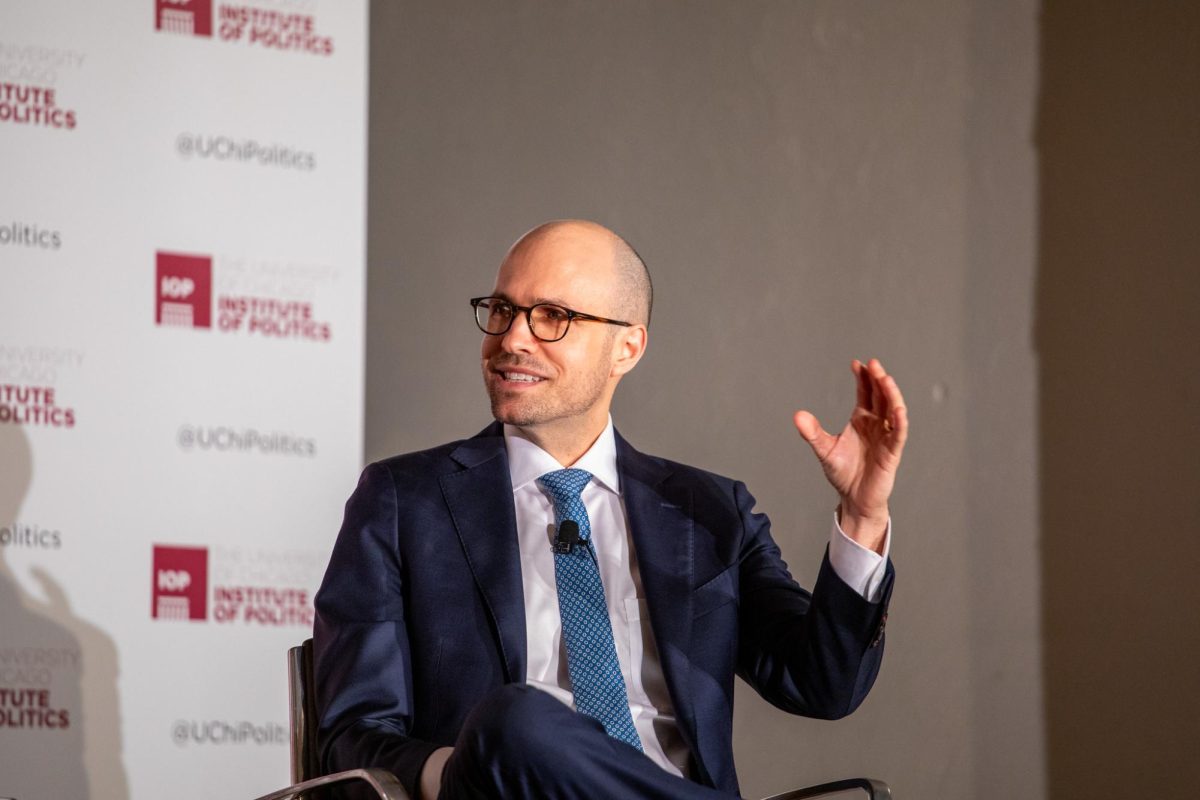
New York Times Chairman and publisher A. G. Sulzberger joined Melissa Bell, CEO of Chicago Public Media, for a conversation at an Institute of Politics (IOP) event on November 10, focused on how the Times has evolved in the face of a rapidly changing media environment and the future of independent journalism in the age of AI and “Big Tech.”
In 2014, Sulzberger, along with other select journalists at the Times, created the Innovation Report, a 96-page demo outlining recommendations for the transition from traditional print to a digital-first focus, which was later leaked by BuzzFeed News. Sulzberger said the leak served as a “wake-up call” in the midst of a financial crisis in the journalism industry.
“I thought that this was the most damaging thing that anyone had done, and it ended up being the most important because it was the first time that we as a company had all the same information to have this really important conversation about change,” Sulzberger said. “It was the first time people understood there was more danger to not changing than to changing.”
Sulzberger said that shifting away from relying only on print and incorporating more technology into the Times’s storytelling in the years since 2014 “allowed us to reach readers all over the world in numbers that we never experienced.… It allowed us to tell stories in ways that we never could have imagined.”
In December 2023, the Times filed a copyright infringement lawsuit against OpenAI and Microsoft, alleging that millions of articles published by the Times were used to train automated chatbots that now compete with it as a source of information. Sulzberger quoted an internal document from Microsoft in which one Microsoft executive called Microsoft’s actions “an astonishing theft of unprecedented proportions” and “the largest theft of labor in human history.”
In 2025, the Times launched two lawsuits against the Pentagon. The Times argued that the Pentagon attempted to restrain independent and honest reporting of military affairs, actively infringing upon the Times’s First Amendment right.
“When the Pentagon tried to get us to sign what amounted to a loyalty oath not to publish anything that they didn’t approve of, we took the Pentagon to court,” Sulzberger said. “We do not let outside forces influence our journalism. Our journalism should be independent.”
Sulzberger noted how news organizations have to work together to protect transparency. “The responsibility we have to all of you, to the public, is not to let that influence what we do. You guys deserve the fullest, fairest set of facts that we can possibly gather,” Sulzberger said.
When asked by Bell what deserves more coverage, Sulzberger said, “I think foreign news really, really matters, and I find it extremely unnerving how few news organizations are left that actually are willing to put their resources behind this type of coverage.”
“To the point of the Israel-Gaza story, we’ve got folks telling every part of this story trying to inform camps that are so entrenched that they’ve lost the ability to see the humanity and experiences on the other side of the conflict,” he said. “If you look at the great challenges of society today, it is really hard to get through those challenges without seeing the fuller story.”
Sulzberger said that the public’s ability to form balanced perspectives is imperiled by big tech’s atomization of the web. According to Sulzberger, tech companies’ algorithms prioritize content that evokes outrage and fear. “We are stuck in an algorithmic equation [such] that we can’t see for ourselves,” said Sulzberger.
Sulzberger asked the audience when they last saw coverage of Ukraine. “How many of you feel like Ukraine is still trending in your algorithms?” Sulzberger asked. “For the online audience, not a single hand went up.”
In addition to its widespread national and international coverage, Sulzberger said the Times is increasing its efforts in rebuilding local journalism. “We are trying to support the health of the local journalism ecosystem,” he said. “Informed communities are the fourth leg of the stool, and I think every community in America should be grappling with how we strengthen that leg.”
Sulzberger said his hope for the Times is to identify how to illuminate intercommunity collapse and unify the country by understanding people across lines of division.
“One of the amazing things about this country is that we believe in self-rule. And with that comes a responsibility to try to be informed about what is happening in your society, to make sure your vote is informed,” Sulzberger said.
Sulzberger said that it is the duty of both the citizen and the news organization to work together to create an informed society, through curiosity of the individual and transparency on the part of journalists.