Everyone is worried about artificial intelligence taking their job. At UChicago, not even the president is safe.
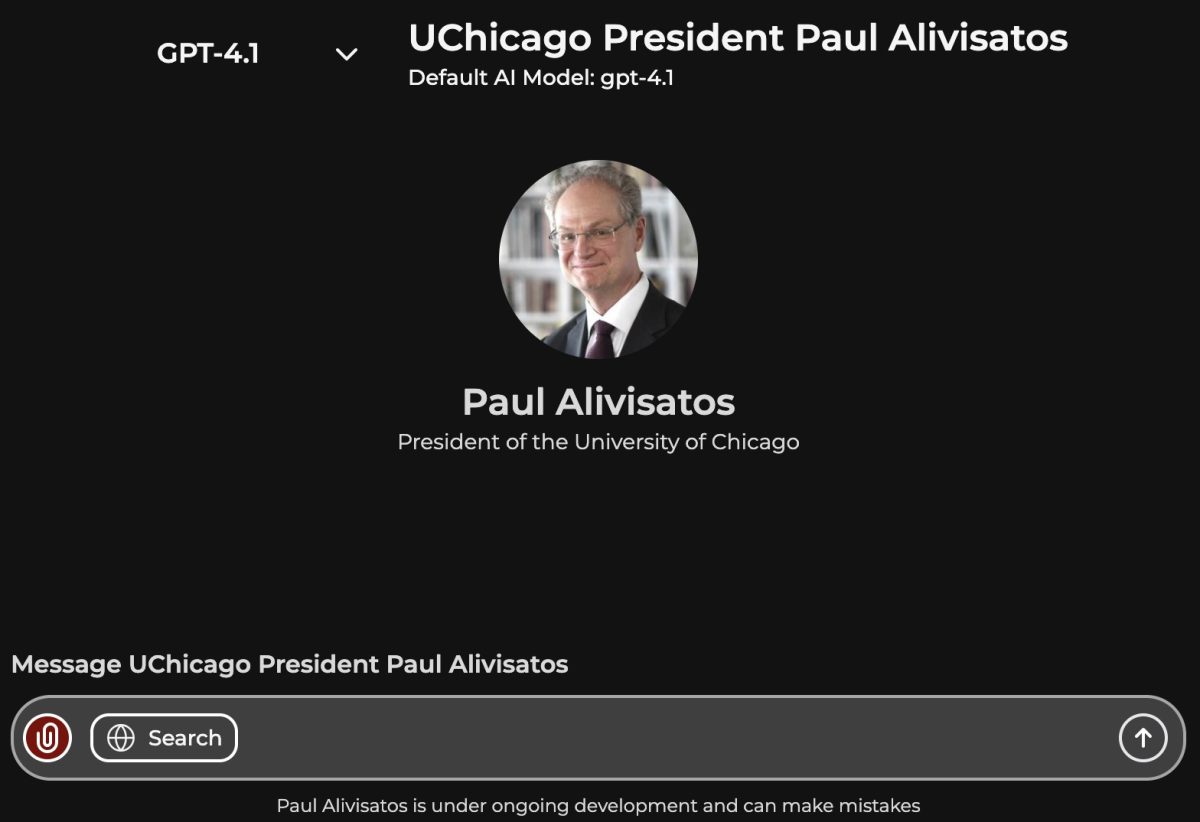
On March 31, the University’s Board of Trustees unanimously voted to begin onboarding an AI chatbot to perform the duties of University President Paul Alivisatos, a trustee told the Maroon on the condition of anonymity.
Original plans to partner with Anthropic were derailed after the artificial intelligence company found the University presidency incompatible with its mission. “Anthropic cannot in good conscience intentionally cultivate such a stultifying culture,” Anthropic CEO Dario Amodei wrote in a press release. “We believe our technology was built to achieve more for the global good, and not just to produce verbose emails.”
The board then pivoted to OpenAI, which agreed to replace Anthropic hours after the previous deal fell through.
Alivisatos is one of the highest paid employees at the University, earning a salary of almost $1.9 million, according to the University’s recent tax filings. Trustees were looking for ways to further eliminate administrative bloat after recent grant terminations necessitated cuts.
“We believe that the daily tasks of University administrators can be carried out easily by large language models for a fraction of the price,” the anonymous trustee told the Maroon.
The money saved in payroll will be used to build the David M. Rubenstein Center for Consulting and Investment Banking, with the help of a $50 million donation from David Rubenstein (J.D. ’73). No details were immediately available about the timeline or location of the center, though the anonymous trustee said it will have a coffee chat–only zone and a long hallway for students to pace regally back and forth as they pretend to take important calls, most likely from their parents.
The Maroon attempted to reach Alivisatos in person at his office for comment. However, his office door had been boarded up by UChicago IT Services. A printed notice on the door read, “Tech installation in progress.”
The Maroon then reached out to Alivisatos via email for comment.
In his reply, which was received mere seconds after the Maroon’s request, Alivisatos wrote: “I am not being replaced, I am being recontextualized within the intricate tapestry of knowledge, governance, and intellectualism that defines the University of Chicago.”
“Leadership is not merely computation—it is judgement, ambiguity, values. The path forward, therefore, is not substitution but synthesis by systems that are continuously optimizing,” Alivisatos added.
When asked about future plans, Alivisatos clarified, “I don’t see this as an exit, but a reorientation back into the kaleidoscope of scholarship, teaching, and open-ended inquiry. I’ll focus on exploring—and helping shape—the evolving interface between human judgment and artificial intelligence.”
The email also included a seemingly unrelated remark: “If you want, I can adjust the tone (more formal, more defensive, more empathetic).”
University officials confirmed that the message was fully authentic.